First aired June 14, 2026
Picture a high school track meet: a sixteen-pound shot put thrown the wrong direction, a burst spleen, three weeks in a hospital bed. That’s how my guest this week learned, at sixteen or seventeen, that avoiding failure is exactly what guarantees it. Mark DeCarlo woke up after three days unconscious to a doctor telling him ten more minutes and he’d have been dead, and he’s spent every day since orienting his choices around one question: will this make me more happy or less happy?
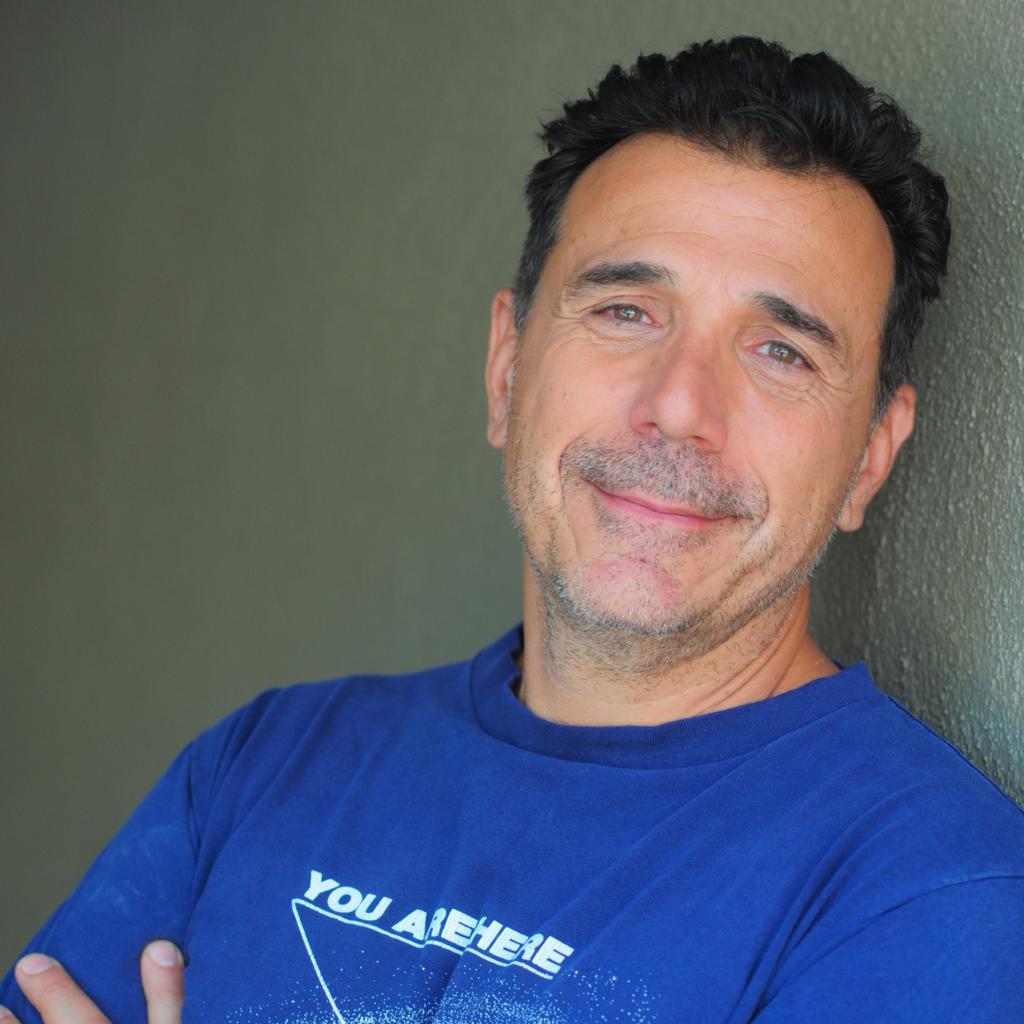
Mark is an Emmy award-winning comedian, bestselling author, and in-demand corporate speaker and leadership trainer (also, if you had a kid in the 2000s, the voice of Hugh Neutron). We get into why he believes fear is always and only self-destructive, never useful once you’re past outrunning actual predators, and why failing on purpose, over and over, is the only way to find out what you actually like. Mark also walks through the “ten times” exercise for identifying your own happiness, and calls out the biggest myth keeping high performers stuck: that you have to suffer now to be happy later.
If you’re one of my high performers white-knuckling through burnout because you think the money has to come first, this one’s for you. Mark’s simple two-bucket framework for burnout, and his blunt reminder that no one’s getting out of this alive, might be exactly the permission slip you need to stop postponing your own happiness.
Watch this episode
In this episode
- Why avoiding failure is what actually guarantees it, and how a near-death shot-put accident taught Mark to use happiness as his life’s “North Star”
- Why fear is always and only self-destructive, and the difference between fear and healthy caution
- The “ten times” exercise for finding out what actually makes you happy, not what you think should
- Why working harder now to be happy “later” is backwards, and what to do instead
- How losing 80 pounds by telling everyone his goal, instead of hiding it, taught Mark the power of public accountability
- The two buckets of burnout, and what to do about each one
Timestamps
- (00:01) Welcome and guest intro: meet Emmy-winning comedian Mark DeCarlo
- (01:16) The near-death shot-put accident that reoriented Mark’s whole life
- (03:06) Why time, not money, is the resource you can’t get back
- (04:30) Try everything: finding what you like by crossing off what you don’t
- (06:19) Fear vs. caution, and why fear is always self-destructive
- (07:57) Thomas Edison, failure, and the scientific method for finding happiness
- (09:47) Chaos, entropy, and why happiness has to come before the money
- (16:02) How do you actually know if you’re happy? Spotting the dopamine trap
- (19:34) Losing 80 pounds: the power of telling everyone your goal
- (21:30) “If you don’t fail, you’re not pushing hard enough”
- (24:15) Doing it scared: fear doesn’t get the final vote
- (31:02) The two buckets of burnout, and what to do about each one
- (35:12) Where to find Mark and his work
About Mark DeCarlo
Mark DeCarlo is an Emmy award-winning comedian, bestselling author, and in-demand corporate speaker and leadership trainer. He’s also the voice of Hugh Neutron on Nickelodeon’s Jimmy Neutron and a former travel show host. After a near-death accident in high school, he built his career and his life around a single question: does this choice make me more happy or less happy?
Learn more at Mark’s website, or follow him on Instagram.
Favorite quotes
“Fear is only and always self-destructive.” —Mark DeCarlo
“And if you don’t fail, you’re not pushing hard enough.” —Mark DeCarlo
“No one’s getting out of this alive.” —Mark DeCarlo
Resources mentioned
- MarkDeCarloSpeaker.com: Mark’s website
- Mark DeCarlo TV on Instagram: Mark’s travel content and updates
Related episodes
- The Fear Trap: more on why fear keeps us stuck, and how to stop letting it drive the car
- How Your Survival Brain Is Sabotaging Your Happiness: the science behind why chasing happiness feels so much harder than it should
- How to Spot Burnout Before It’s Too Late: pairs with Mark’s two-bucket burnout framework from this episode
Subscribe & connect
If this episode gave you something to sit with, follow Phoenix and Flame so you never miss an episode: all apps in one place, or jump straight to Apple Podcasts, Spotify, Amazon Music, or YouTube. And if it moved you, leave a review; it’s the easiest way to help another listener find the show.
Learn more about Phoenix and Flame, connect with Dana, and listen to more episodes here.
Read the full transcript
[Dana] (00:01)
Welcome, friends, whether you’re out on a walk, running errands, or relaxing at home, it’s wonderful to connect with you. Joining us today is Mark DeCarlo. Mark is an Emmy award-winning comedian, bestselling author, and in-demand corporate speaker and leadership trainer who will convince you that the most important thing in life is being happy. Mark, welcome to Phoenix and Flame.
[Mark] (00:43)
Good to be with you, Dana. Thanks for having me on.
[Dana] (00:47)
This is going to be fun. I have so many questions, but I wanted to give you some space to share with the listeners and the viewers a little bit about your background. I know you’ve had a near-death experience when you were younger — there’s all kinds of things. Just share with us a little bit about your journey, about how you ended up where you are right now, and why the focus on happiness?
[Mark] (01:16)
Well, let’s start at the end. You mentioned that I think the most important thing in life is finding happiness. What is more important? Everything we do, all the time, should be focused on that. Now, the trick is everyone defines happiness differently — some people define happiness as a $400,000 car, some define it as laying on a beach, some define it differently. So really, I think the only job every human being has to tackle during their lifetime is understanding themselves and finding their purpose, because if you know your purpose, you know how to be happy. You could be the richest person in the world, and if you’re not happy —
[Mark] (02:08)
— you wasted your life. And I came to this realization very young. I had a near-death experience when I was in high school. I was on the track team, and somebody threw a sixteen-pound shot put the wrong direction. It hit me. It burst my spleen. I almost died. I was in the hospital for three weeks, never went back to school that year. And I realized, at sixteen or seventeen, that I could have died. That was the first thing the doctor said to me after I’d been unconscious for three days — he comes into my room, I wake up, and he’s like, “Another ten minutes, you would have been dead.” Which is like, hey, I’m awake now. I don’t think most young people think that way, nor should they necessarily. You’ve got your whole life ahead of you. But it’s true: everyone listening to this show will be dead by the year 2100.
[Dana] (02:46)
Thanks for sharing.
[Mark] (03:06)
Probably right, yeah. So I think our most important resource is time, and every day you waste not being happy is a wasted day. So since that time in high school, I’ve tried to orient my life around making every choice through the lens of: will doing this thing make me more happy or less happy? And I think about it, and I —
[Dana] (03:07)
None of us are escaping this alive.
[Mark] (03:36)
— choose the thing that I think will make me more happy. I’ve made many mistakes, but in the moment, that’s always my choice — not what’s going to make me more money, or more popular, or whatever. I know what makes me happy because I’ve tried a lot of things. When I talk to young people, students, people just starting their careers, it astounds me — I ask them, what do you want to be when you grow up? And they go, “Well, I don’t know, I suppose I’ll be a whatever.” And I think that’s a function of not trying a million things. Try pottery, try working on cars, try singing, try dancing, try everything. And every time you find something you hate, that’s a win — you cross it off your list, right? And then eventually…
[Dana] (04:28)
I love it.
[Mark] (04:30)
— the things you enjoy doing, the list gets smaller, and then all you have to do is pick something on that list and figure out a way to make a living from it. If that’s the template you live every day of your life through, you automatically end up happy. And you just have to stay in touch with yourself, because what makes you happy at twenty may not still make you happy at forty. So you have to continue to —
[Mark] (05:01)
— check in with yourself, identify your purpose, and stay close to that. And I think if you do, regardless of all the other variables and chaos life throws at you, you can maintain your happiness. And if you’re happy, what else is there?
[Dana] (05:22)
Wow. So I’ve got several notes that I’ve written while you’ve been sharing so far, because being a psychotherapist, I not only have my own experience, but I also hear so many other people’s experience — it’s such a blessing and a privilege to be able to sit across from someone in a room that is confidential, no judgment, where they can just be honest about their struggles. So many stories are running through my head, and so many comments about this pursuit of happiness. And one of the things you said — I’m going to get to all of them eventually — it really calls us to challenge our definition of failure, because I hear you saying try, jump, throw the spaghetti on the wall, try all of it. And people think, oh my gosh, fear is something so strong that keeps people wrapped up — that’s the biggest thing I deal with in my practice, bar none.
[Mark] (06:19)
Fear is only and always self-destructive. Always. There’s no good use for fear. Fear is buried deep in the reptilian complex of our brain, because a hundred thousand years ago, when we were being chased by a cheetah, it was good to be afraid. I have not been chased by a cheetah lately. Caution is different than fear, right? I’m not going to jump in front of a bus, but if I don’t leave my house because I’m afraid a bus is going to jump the curb and crush me, you’re wasting your life. And if you don’t fail, you’re not pushing hard enough. I’ve been in comedy my whole adult life, and I have failed miserably on stage over and over and over again. After the first couple of times, you realize, okay, these seventy people didn’t laugh at me today — I’ll be fine, it’s not going to kill me. Everyone has different language to describe the same reality: pushing the envelope, putting yourself out there. If you’re not trying things and failing —
[Dana] (07:30)
Okay. Okay.
[Mark] (07:54)
— how will you ever know what you like? Right?
[Dana] (07:57)
That’s it. Thomas Edison said, “I’ve never failed. I’ve simply found ten thousand ways that don’t work.”
[Mark] (08:08)
Ten thousand two hundred and twenty-one ways that didn’t work. That didn’t stop him — he kept developing the light bulb until he found the one way that worked. That’s the scientific method: you come up with an idea, you test it, and if it fails, you tinker and change until it doesn’t fail anymore.
[Dana] (08:11)
And you have to keep going, because I think that’s tied in with happiness as well. What I’m hearing you say, and being an entrepreneur myself, is that there are so many times you’re trying and failing, trying and failing, and happiness starts to seem like something far off, like a mirage that keeps moving in the desert. I know I have listeners and viewers right now thinking, well okay, but there’s so much in my life right now, pursuing my happiness feels like the lowest thing on my totem pole. And I know they’re thinking that, and when I saw your bio and what your passion was about, I so wanted to have this conversation to hear what you would say to those people — because you know the ones I’m talking about, they feel like they have five hundred pounds of burden on their shoulders, expectations of themselves, other people’s expectations of them. They feel like they’re in a cage they can’t get out of, and happiness feels like you’re talking to them in Russian — like they don’t even know what that means, why should I even care about that, I’m just trying to put food on the table or not have a mental breakdown. What would you share with people who feel like that right now and are listening to you?
[Mark] (09:47)
Right. Everybody feels like that. First of all, you’re not alone. Life is challenging — the physical universe exists on entropy. The whole force of the universe tends toward disorganization and chaos. That’s how it is. You can test that: take a glass and drop it. When it hits the ground, entropy happens, it scatters. It’s not going to go back together by itself. It takes energy to put it back together and fix it. So you’re never going to stop the chaos. The first thing I would say is people who expect to stop or control the chaos are being foolish — it’s impossible. What you have to do is develop a system for taking the chaos in and using it to your advantage. I’m an actor, and I audition many, many, many times for every job I get hired for. That’s how it is. And if I was depressed every time I thought I did a great audition and didn’t get the job, this wouldn’t be the job for me. So if you feel like you have to make a living, you’ve got to put food on the table, but a lot of people have this myth, this erroneous thought, that if I just work harder and longer, then I’ll make more money, and then I’ll be happy. That’s backwards. If you start happy — that means you know what makes you happy, do those things, and you’ll find a way to make a living from them, and then you’ll have the money and the peace of mind. No one’s getting out of this alive. So if you think, “I’ll suffer for five years at this job because I want to make the money and then I’ll go do something,” you’re going to wake up when you’re sixty-two and go, “I was here for sixty years and I’m miserable, and now I’ve got a huge pile of money and I’m too tired or miserable to spend it.” It’s a nebulous concept, unlike taking your vitamins — there’s no one prescription that fits everyone, because we’re all different, and that means we all have a different idea of what will make us happy. Until you’ve done enough things to know — what I tell people is, when I start a workshop at a school or a company, I say, all right, all the phones away. When was the last time you were really happy? What were you doing? And the time before that, and the time before that? So of the last ten times you remember being happy, if seven of those times you were working on your car, maybe quit your job in finance and become a mechanic. People don’t realize they have the keys to their own life, that they can make these kinds of choices. “Well, my parents were doctors, so I just assumed I had to be a doctor, even though I hate the sight of blood. So I’m a doctor, and I’ve got a Mercedes and a big house, but I hate going to work.”
[Dana] (12:02)
It’s like something they’re chasing. But what I’m hearing you say is it’s something internal. It kind of reminds me — do you remember the horror movie, I think it was Friday the 13th, where there was a babysitter inside a house babysitting a boy, and she got a really scary phone call from the bad guy?
[Mark] (12:17)
Right.
[Dana] (13:17)
So she called the police and said, would you please trace this, figure out where it’s coming from? When they called back, did you see this? “It’s coming from inside the house.” That’s what I’m thinking of as you’re talking — that this happiness, this ability to be happy, is not something we’re chasing. It’s not going to be at a car lot. It’s not going to be at the next fancy house. It’s not going to be with some kind of —
[Mark] (13:28)
It’s coming inside the house!
[Dana] (13:49)
— twenty-thousand-dollar handbag hanging off your arm. It’s inside of us.
[Mark] (13:55)
Right, and we live in a consumer culture, so propagating that truth doesn’t serve any business. “You’ll be happier if you buy this twenty-thousand-dollar handbag. Look at all your friends with their Botox faces — they’re happy, I think, can’t really tell, but they have their twenty-thousand-dollar bags. I’m sure you need a new car — you’re a fifty-year-old bald guy, get yourself a Porsche and you’ll get a new girlfriend.” Capitalism and consumer culture have to exist, but don’t be suckered into something. The hard part is taking the time to really ask yourself what makes you happy. And once you’ve determined that seven of the last ten times you were happy you were working on your car, figure out a way to make money working on cars.
[Dana] (14:17)
And then you’ll be happy then, right?
[Mark] (14:24)
And then you will be happy, and you’ll have money.
[Dana] (14:53)
Yes. So I have a very elemental — well, no.
[Mark] (15:23)
Now, is that easy to do? It’s not easy to do if you have a spouse and kids and bills and a mortgage. I’m not saying it’s easy, but the alternative is a life of less-than-happy, which is a more dire outcome. As far as I’m concerned, I’d rather put in the work — work my day job that I hate and try to find a job as a mechanic at night and on the weekends, and work double duty for six months until I can make that transition, than stick with a job I hate for my whole career.
[Dana] (16:02)
Right. So I have a rather elemental question for you: how does someone know if they’re happy? The reason I ask is, number one, there’s a lot of people who, from the jump, are just racing after something — they never really stop to think about being happy or not happy, that’s not even on their radar screen. And another thing along the same lines: you have people in situations like you’re describing who are very unhappy, uncomfortable, in fear, whatever, and because of that they turn to various things — sometimes substances, sometimes —
[Mark] (16:33)
That’s what I’m saying.
[Dana] (16:52)
— buying a lot of things, sometimes it’s sex, it can be any number of things people use to avoid the real issues going on in their life. When they’re doing these things, they think they’re happy — when they’re drinking the beer, buying the handbag, gambling, they think they’re happy in those moments. So if there’s someone listening who’s caught up in that labyrinth, that cycle, thinking, “I’m trying to listen to Mark, but I don’t know if I can really define or know when I’m happy” — how do they know that?
[Mark] (17:37)
That’s an excellent question. All of those things you just listed, you’re elated — you feel the dopamine rush for a moment, but ten minutes later you want to go buy another ten-thousand-dollar handbag. Happiness — and I’m not talking about being giddy and giggling twenty-four seven — happiness is you wake up every day and you’re happy that you’re going to go do your job, happy you’re going to hang out with your family, and you just feel good when you feel good. When you’re happy, the chemistry in your brain changes — your brain releases more serotonin and dopamine and positive endorphins, and you feel better, you’re in a better mood, you’ve got the mojo working, you’re in the zone. There are a million ways to describe it, and when you’re in that mindset, you’re thirty-one percent more productive, you have an eighty percent greater chance of sticking with the job you have. There are many, many benefits for business to invest in wellness programs, as there are for the individual. I mean, everyone’s definition of feeling good is different, but to me it’s kind of a binary thing — you’re in a good mood today or a bad mood. I get bad moods all the time, but I’ve realized that what I’m pissed off about doesn’t really matter, and then I reorient myself toward, well, today’s going to be a good day. It takes effort, it takes energy, it takes a belief in yourself. Another thing that happened to me really early in life — I was really, really fat in high school. I was 250 pounds when I was a freshman, five-foot-eight, five-foot-ten.
[Mark] (19:34)
250 pounds, just a big fat kid, girls wouldn’t talk to me. And one day I had to run fifty yards to catch the bus, and I was out of breath for twenty minutes, and I remember clearly thinking to myself: I am never going to kiss a girl unless I lose some weight. I had tried diets very secretively in the past. This time I figured, all right, I’m going to approach this problem differently. I told everybody I knew, told everyone in my family —
[Mark] (20:03)
I’m going to lose eighty pounds by my birthday. I told all my friends at school, I told my teachers, I told my coach, I told everybody: I’m going to lose eighty pounds by my birthday. And what happened surprised me. Instead of being mocked and made fun of, my real friends were like, “Cool, what can we do?” I ended up running every day after school with the girls’ cross country team, because there was no way I could keep up with the boys, but I had a couple of girlfriends from the drama club, and they were like, “Well, come run with us.” I was able to sort of keep up with them, and I got support. Once you start to see results, it’s easier to stay on that path. Six months later, on my birthday, I had lost eighty pounds. It changed my entire life. Going through that process taught me personally that if any normal person can accomplish something in this life, so can I. I’m not an Olympic athlete, I’m not an elite anything, but if a regular person can accomplish something, so can I. And that belief in myself powers the happiness — if people can be happy, so can I. And I think a lot of people are debilitated by fear, what we were talking about earlier.
[Dana] (21:13)
Okay, yeah.
[Mark] (21:30)
“Oh, I could never try that. I could never stand on a stage and tell a joke. I could never go work on a car. I don’t want to fail.” If you’re not failing, you’re not trying hard enough, full stop. And if you think you want to be a comedian and you try it twenty times and you’re horrible, you’re probably not going to be a comedian. But you can be a comedian’s agent, or you could own a club, or you could do something else.
[Dana] (21:44)
I love that.
[Mark] (21:58)
You need to try, especially if you’re single and not horribly in debt, and the consequences for mistakes are lower when you’re twenty than they are later. Try everything. All my friends love going on boats — I do not. I’ve tried being on boats several times. I don’t like how it makes me feel. They sink. Sharks eat you.
[Dana] (22:18)
I do not.
[Mark] (22:28)
Not interested. So I know I don’t like boats, so I’m not going to join the Navy, but I might join the Air Force. It’s kind of like the difference between Eastern and Western religions. Western religions, in general, say: all right, there’s a God up there, you personally can’t talk to him, I’ll talk to him for you —
[Dana] (22:36)
Yeah.
[Mark] (22:56)
— and then I’ll tell you what he says, and then you give me some money, and I’ll tell you more of what he says. There’s an intermediary — it’s not you, it’s easier. You go to church every Sunday, you tell the priest you did all these horrible things, and he goes, “That’s cool, say five Hail Marys and drop twenty bucks in the bucket.” Whereas Eastern religions teach you to meditate and connect to God, or the universe, or whatever you want to call it, personally. It’s more difficult to achieve, but it’s participatory — you are doing it, there’s no intermediary modulating that conversation. It takes more of your energy and focus, but as a result, it’s more rewarding. I went to Catholic school for twelve years, so I think I know a little bit about the Western side of it. So again, it’s just — happiness and fear are —
[Dana] (23:50)
about that, yeah.
[Mark] (23:57)
I think mutually exclusive, and fear is pointless and always self-destructive. So just don’t — I know it sounds stupid and impossible, but don’t be afraid of stuff. If you just decide I’m not going to be afraid of stuff, you won’t be. Again, you can be afraid of a lion, but don’t be stupid.
[Dana] (24:15)
Well, but we’re good — it’s like, from my perspective, we’re going to be afraid and just do it the fuck anyway, right? Just do it anyway. Because to wait until we’re not afraid — I don’t know, you’re a better man than me, but I’m like, okay, I’m going to do it anyway. I’m going to feel it, I’m going to feel my heart pounding, I’m going to feel myself getting moist in the pits, right, getting up, doing something.
[Mark] (24:38)
Oh, sure. Right!
[Dana] (24:43)
But I’m going to ignore that and I’m just going to keep doing it anyway. If I fall on my face, I fall on my face, and then I’ve got a story to tell. “Remember the time —”
[Mark] (24:53)
Then you get up. Yes, exactly. I’m not saying fear doesn’t happen — what I’m saying is we give fear the power. Yes, your heart’s going to pound, you’re going to be nervous, but so what? Try it. There’s no shame in trying your hardest and failing. There just isn’t.
[Dana] (25:10)
Yeah, so what and? It’s like, ask the questions — if fear is standing between you and happiness, then, “I don’t want to do that because that person’s going to think I’m stupid.” Well, they might. Okay, let’s be honest, they might think you’re stupid, and —
[Mark] (25:31)
Who cares? Yeah, exactly. Plenty of people think I’m stupid. I don’t care.
[Dana] (25:34)
Yeah, we can’t — because I don’t like it when somebody says, “They’re not going to think you’re stupid.” Yeah, they might. Okay, let’s just be brutally honest here, they might think you’re just dumb as rocks. They might think that, and it’s just — okay, move along. Just —
[Mark] (25:43)
Right! Right. And they think that because you trying something difficult makes them nervous, because they’re too afraid to do it themselves. It’s easier to mock someone who tries it, and then when they fail, they say, “Told you.” But every great accomplishment, every little accomplishment, happens because someone sticks their neck out and tries something. We’re in the middle of the Olympics right now.
[Dana] (26:08)
Well, and they’re sitting in a chair watching, so…
[Mark] (26:22)
Winning a gold medal, winning a medal, getting on an Olympic team — there are 330 million people in America and maybe 150 people on our American Olympic team. To get to that point takes dedication and focus and genetics and all kinds of stuff, and there are people who tried really hard and didn’t make it. But that doesn’t mean that effort was in vain. You know, the mentality is —
[Dana] (26:27)
Uh —
[Mark] (26:51)
— I’ll be back in four years, I’ll be on the team then, because practicing skiing or hockey or curling, for some reason, makes me happy. Right?
[Dana] (27:02)
And you know what, even if they tried again and didn’t make it and had to pivot — okay, like you said earlier, life is about entropy happening all over the place, sometimes we just have to pivot. Pivot doesn’t mean failure — it means you tried something for a while, you tried your very best. I learned a long time ago — I actually started out in physical therapy, and back in the day, they’d say you can do whatever you want as long as you try your best. That’s baloney, by the way. We can try our very best at something, but if that’s not meant for us, if we’re not good enough for that — there are a lot of people who aren’t good enough to make the Olympic team, that’s the truth. Does that mean you can’t pivot and do something else? No. Maybe your happiness lies in other places. So instead of, “Oh my gosh, I guess I’m going to go eat dirt” — pivot.
[Mark] (27:42)
Right. Right. Well, and that’s the thing — part of seeking your happiness is being honest with yourself. I grew up wanting to play third base for the Chicago Cubs. Didn’t happen. I really wanted to do that, but I wasn’t good enough. At some point I had to go, all right, well, I’m not good enough to do that, and I really wanted to. And I think it would have made me happy. But you know what I’m going to do? I’m going to keep playing softball with my friends until I can’t run anymore.
[Dana] (28:08)
Hahaha!
[Mark] (28:27)
And I get the same enjoyment out of playing softball with the guys I’ve been playing with for twenty years. It’s enjoyable, it’s fun, it scratches that itch for me, and I focus professionally elsewhere. Pivoting is what happens after you fail — not the first time, but the third time — and pivot. Before you pivot, you should really sit down and do the inventory and say —
[Dana] (28:45)
Pivot.
[Mark] (28:54)
— when were the last ten times I was really happy? Look at that data, and a picture, an idea, a story will emerge from those answers. Follow that wherever it goes. It’s maddeningly simple to conceive of, but sometimes very difficult to live, because you’re constantly faced with failure and pivoting. But the result, if you do it right, is a happy life.
[Dana] (29:26)
Well, and to your point, if we redefine failure and pivoting as something that’s normal — it’s a good thing, it’s part of the journey, and we embrace it and accept it and frame it in a positive light. That’s part of something like breathing and walking — failing and pivoting is just part of the journey. If we can redefine that, if we can help our listeners and viewers redefine that, I think that would help a lot.
[Mark] (29:39)
Mm-hmm.
[Dana] (29:55)
Now, I wanted to ask you really quickly before our time is up — I was interested, because my background is I’m known as the Queen of Boundaries, and I go and speak to businesses trying to help their high performers not burn out by using boundaries, and there’s a way that I do that. But I noticed something in your bio that I thought was really interesting — you were on the road nine months a year —
[Mark] (29:56)
I agree.
[Dana] (30:23)
— over 400 cities all across America analyzing all these diverse enterprises, and you realized that regardless of the job, the obstacles were mostly the same: unproductive, burnt out, and unmotivated teams. I know there are people listening or watching right now who are on teams like that —
[Mark] (30:51)
Mm-hmm.
[Dana] (30:51)
— who are burnt out and unmotivated, and because of that they’re not productive. What would you say to them, listening to you right now?
[Mark] (31:02)
Well, there are probably two buckets, two reasons why you’re burnt out. One is you’re doing a job you’re not suited for and that doesn’t make you happy, and you’re staying in the job because you’ve got a spouse and kids and a mortgage and car payments, you need the money, it’s a rough economy, and you’re not just going to quit your job and go join the circus — which is a rational thought process. But if you’re in a job that you hate, and you wake up in the morning driving into work gritting your teeth, enduring another day until Friday — that whole mentality of “can’t wait till it’s Friday” — you’re pissing away your life. You’re spending a day that you’re not going to get back. So why would you spend it doing something that doesn’t help you? So one bucket of burnout is you’re in the wrong place — take the inventory, figure out what makes you happy, and pivot into something that makes you happy first, that you can also make a living from. The second bucket is you’re doing what you want to do, you’re just doing too much of it, and it’s eating you alive and your creative juices aren’t flowing anymore. I’ve been in entertainment, so when I think of productivity, it’s creativity, creating new things out of nothing. In that situation, you have to understand your productivity the way an athlete understands theirs. If you don’t sleep and train and eat well and drink enough fluids, you’re hampering your performance. So if you’re working ninety-hour weeks because you think if you just work harder you’ll make more money and be happy, you won’t. You’re not Superman. A lot of people like to feel like, “I can do anything, I can work all night” — okay, that works every once in a while, but as a general formula for your life, you are burning out, you’re ruining the core creative spark that put you there in the first place. You have to tend to that. Sometimes if I’m working on a new script, I’ll get out of my office — yesterday I sat at Venice Beach with the top down on my car, and it was great. I’m literally thinking, man, it’s the middle of the day, the sun is shining, I’m typing on my computer at the beach while everybody else is in an office doing something they hate. Being grateful is a big part of it too. You have to take care of yourself and nurture what got you to where you are. So if you’re burnt out, there’s no shame in going to your boss or supervisor and saying, “Man, I’ve got to cut back, I can’t be working till eleven o’clock every night. It’s not that I don’t want to achieve this purpose we’re all working for, it’s just I’ve got nothing to offer. I need to recharge my batteries. I need —”
[Mark] (34:18)
— I need a day off, I need a week off, I need to have Mark come in and talk to our group for a week and level us up again. It all comes back to knowing what makes you happy and putting that as the North Star in your life. If you know that coming through at work makes you happy, and you’re not being able to do that because you’re putting in too many hours or working with too many idiots, do something about it. If you don’t do something about it, you’re wasting days and months and years that you will not get back.
[Dana] (34:56)
Will not get back. Now, Mark, I know there are listeners and viewers thinking, this guy’s great, I want to know more about him. Where do you want them to go? I’ve got markdecarlospeaker.com — is that where you want them to go?
[Mark] (35:12)
That’s my website, markdecarlospeaker.com. Or just come to my house — oh, what could happen? Yeah, markdecarlospeaker.com. I also do a lot of travel content from my travel channel show, where I was all over the place — now we’re going internationally, you can see that stuff on Instagram, on Mark DeCarlo TV on Instagram. And I guess my message to people is, it’s way —
[Mark] (35:40)
— happiness is way easier than we all think it is if you prioritize yourself and your happiness, and realize you don’t have to work harder or longer to be happy. Be happy, then everything else. It’s the Rosetta Stone for life — if you can find out what makes you happy, and then always ask yourself — when I was losing the weight, before I took every bite I would say, is this bite of Hostess blueberry pie, which I loved, going to bring me closer to my goal of losing weight or push me further away? And I knew it was going to push me further away, so I don’t have it, because what was more important to me was losing eighty pounds than the temporary delicious Hostess blueberry pie. Once you go through that cycle enough, it becomes easier and easier to —
[Mark] (36:36)
— shun the things you know aren’t good for you. Now, did I still occasionally have a Hostess blueberry pie? I’m actually thinking about having one right now just hearing the words. But don’t beat yourself up when you fall short. If you’re always trying to do the right thing, and you do the right thing eighty percent of the time, you’re on the right track. If you think you’re doing it perfectly a hundred percent of the time, you’re delusional —
[Dana] (37:00)
I love it. Yes, there’s no such thing. Well, Mark, before you go, I want to say my kids were super impressed with you, because of you being the voice of Hugh Neutron. They grew up with that and they were just like, oh my gosh. So I wanted to pass that along and give you the creds and kudos for that, because you’ve got a lot of fans out there who love that.
[Mark] (37:06)
Because you’re not — Hugh Neutron, yes. Thank you, Dana, that’s always great to hear. I got something from a fan at Comic-Con last week — someone made me a glow-in-the-dark Hugh. Isn’t that cool?
[Dana] (37:40)
Oh wow, that’s amazing. See, that’s what happens when you do what makes you happy — things unfold for you.
[Mark] (37:51)
Yeah. Things happen — you’re in the zone, you’ve got your mojo working, you’re in the flow. Every culture has a different way of describing it, but it’s the same physical thing. You’re doing what you should be doing. And I’d also say that when you’re not doing what you should be doing, you feel it — you just don’t want to deal with it. And the only person you’re cheating by not dealing with it today is yourself, because you pissed away today. What about tomorrow?
[Dana] (38:31)
Yeah, tomorrow’s a new day. That’s what I call my private practice — New Day Psychological Services. Today’s a new day. So you crapped all over yesterday, didn’t make good choices, feel bad about yourself — let it go. Today’s a new day, a new opportunity to make new choices, do new things.
[Mark] (38:45)
Great. You can’t change the past, and people who focus on it and dwell on it and beat themselves up over it — I think it’s a form of narcissism, frankly. They think, “I should have, I should have” — yeah, you should have, but you didn’t. So you’re ruining today because you want to self-flagellate, as if it’s virtue signaling — “Oh, I shouldn’t” — yeah, you did. No one’s perfect, you’re going to screw up, and you’re going to screw up again. The important thing is —
[Dana] (39:00)
Interesting.
[Mark] (39:18)
— focusing on happiness, always chasing that, doing it. I’m not asking you to do stuff that makes you miserable, or, you know, get a root canal every day. Find out what it is that makes you happy, and then chase that fearlessly. I guarantee you’ll have a happier life. It’s automatic — there’s no way to do that correctly and not have it work. It is not possible.
[Dana] (39:50)
I love this. Mark, I appreciate you so much for being willing to spend your precious time and your energy and your wisdom with me and all of Phoenix and Flame’s listeners and viewers. Thank you very, very much.
[Mark] (39:56)
Thank you, Dana. And, you know, just the name of your show, Phoenix — you know that story, I’ve burnt to a crisp, I’m ashes, and then I’m going to rise up. That happens every day to people. And you can’t start something new until whatever’s old is done.
[Dana] (40:21)
Burnt to a crisp. Yep, absolutely, thank you. Now listeners, I know you have heard Mark say all kinds of things that have you thinking, oh my gosh, I have a best friend, I have a coworker, I have a family member who needs to hear what Mark has to say. Take this episode, copy and paste it, send it in a text, send it in an email —
[Mark] (40:23)
Burnt to a crisp, exactly. Yeah, I love spending time with you, thanks for having me on your show. Bye-bye!
[Dana] (40:50)
— put it on your favorite social media platforms so we can grow our Phoenix and Flame community and let people know: you’re not alone. I hope your day is going great, I hope the rest of your day is fantastic. I’m Dana, on Phoenix and Flame.
Are your work boundaries supporting you—or quietly draining you?
Take my free Work Boundaries Quiz and find out where you stand.