First aired July 27, 2025
My guest bought a little plastic herb keeper for his fridge, all excited about eating fresher food. His daughter picked it up, immediately threw it on the ground, and it broke into a million pieces. He didn’t yell. He didn’t say a word. He just turned his back on her. That quiet moment, he says, is exactly how shame gets passed down without anyone meaning to do it, and it’s a perfect case study in what Matt O’Neill calls your “survival brain”: the part of you that’s wired to feel negative, not because something is wrong with you, but because that’s literally its job.
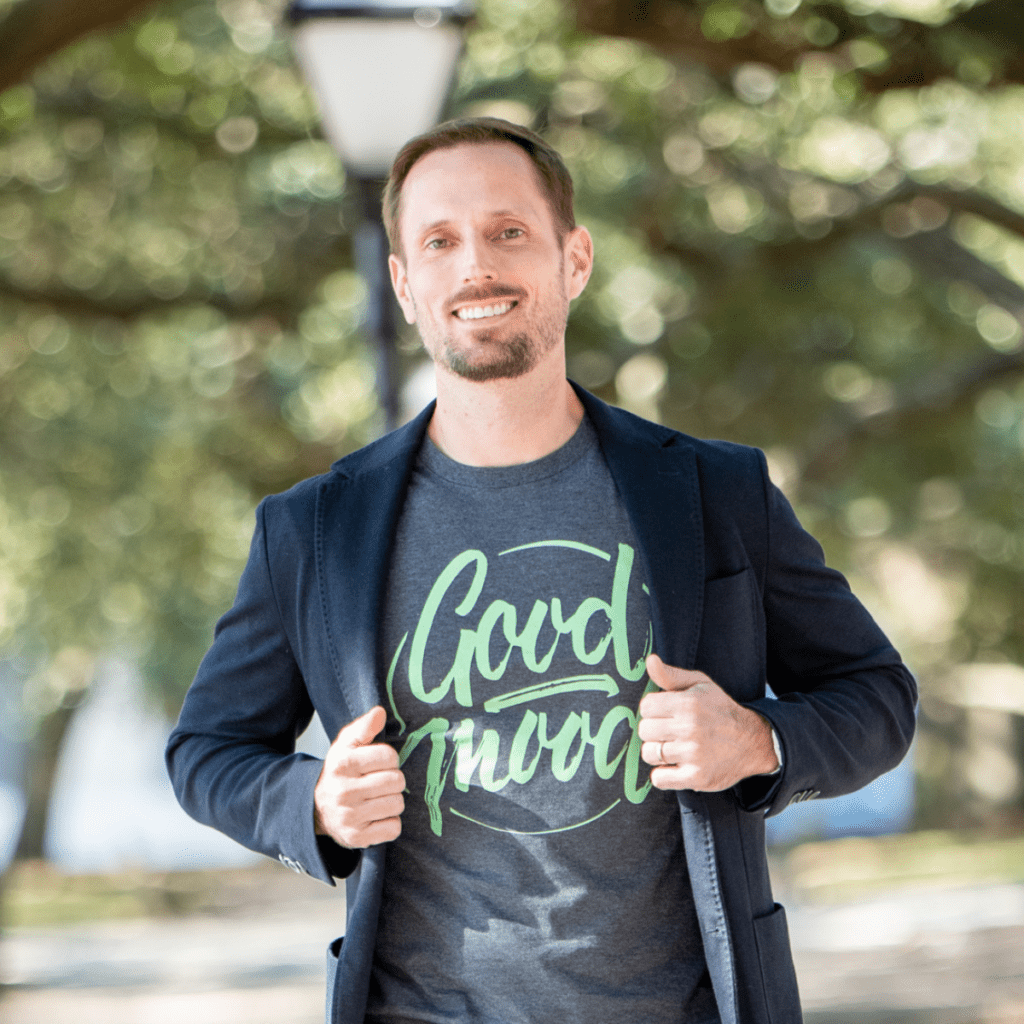
Matt is a happiness educator and the author of “Good Mood Revolution,” where he teaches conscious happiness: an intentional practice of catching the eight negative moods that hijack all of us (shame, overwhelm, hopelessness, and more) and swapping them for the eight positive ones. He’s also a dad of four, runs two companies with $8 million in revenue and 80-plus employees, and somehow got his company named the number one place to work out of 470,000 companies in the state of South Carolina. Spoiler: gratitude had a lot to do with it.
We dig into why “I’ll be happy when everything is perfect” is a lie that will chase you your whole life, the two habits Matt uses that take zero extra time (shower affirmations and a two-word ritual the second his feet hit the floor), and his “Grab the Rope” story for anyone who feels like life is beyond hope right now.
Watch this episode
In this episode
- Why “I’ll be happy when…” is a trap that never delivers, no matter how much you achieve
- How your survival brain turns ordinary stress into shame, and how to catch it in the act
- Two zero-extra-time habits (shower affirmations and a two-word wake-up ritual) that rewire negative self-talk
- The “Grab the Rope” story for anyone in a real crisis who feels hopeless
- Why gratitude is the fastest way out of a “meh” mood, and how it helped make Matt’s company the #1 place to work in South Carolina
- How to be happy WHILE life is messy, instead of waiting for it to be perfect
Timestamps
- (00:01) Welcome and guest intro: meet Matt O’Neill, happiness educator and author of Good Mood Revolution
- (01:20) Spinning plates: four kids, two businesses, and the trap of keeping up with the Joneses, and the lie that “if I just make everything perfect, then I’ll be happy”
- (07:21) The eight negative moods, and the one underneath all of them: not feeling enough
- (10:43) The herb keeper story: how shame gets passed down without a single harsh word
- (13:25) Reprogramming a lie into a truth by writing new affirmations
- (16:55) The “no extra time” myth: shower affirmations and the two-word wake-up ritual
- (20:18) Dana’s own gratitude experiment, and why journaling her feelings wasn’t working
- (27:07) “Grab the Rope”: the fable for anyone feeling hopeless
- (32:19) Why no one is really self-made, and what that means for asking for help
- (37:14) Where to find Matt and the Good Mood Revolution podcast
About Matt O’Neill
Matt O’Neill is a happiness educator and the author of “Good Mood Revolution: Igniting the Power of Conscious Happiness,” which he also hosts as a weekly podcast. He is a father of four and co-runs two companies with $8 million in revenue and more than 80 employees, one of which was named the number one company to work for out of 470,000 companies in the state of South Carolina.
Learn more at Matt’s website, or connect with him on LinkedIn.
Favorite quotes
“Until I learn to be happy while everything is uncomfortable and messy, I’ll never be happy.” —Matt O’Neill
“The truth is a hundred times more powerful, a thousand times more powerful, than the lie.” —Matt O’Neill
“You got to grab the rope.” —Matt O’Neill
Resources mentioned
- MattONeill.com: Matt’s website
- Matt O’Neill on LinkedIn
- “Good Mood Revolution: Igniting the Power of Conscious Happiness,” Matt’s book, discussed throughout the episode (chapter three is “Grab the Rope”)
- The Good Mood Revolution podcast, Matt’s weekly show on building happiness habits
Related episodes
- How You Can Find Hope After Hitting Rock Bottom: another take on climbing out of the hopelessness Matt calls “grabbing the rope.”
- Adapt or Drown: Finding Your Life Raft in the Modern Workplace: more tools for staying steady when life (and work) feels like too much.
- How to Spot Burnout Before It’s Too Late: pairs with Matt’s take on the “survival brain” behind chronic overwhelm.
Subscribe & connect
If this episode gave you something to sit with, follow Phoenix and Flame so you never miss an episode: all apps in one place, or jump straight to Apple Podcasts, Spotify, Amazon Music, or YouTube. And if it moved you, leave a review; it’s the easiest way to help another listener find the show.
Learn more about Phoenix and Flame, connect with Dana, and listen to more episodes here.
Read the full transcript
[Dana Skaggs] (00:01)
Welcome friends, whether you’re out on a walk, running errands, or relaxing at home, it’s wonderful to connect with you. Joining us today is Matt O’Neill. Matt is a recognized leader in happiness education. He teaches how to live a life of conscious happiness. His work includes the Good Mood Revolution book and podcast, where he explains the importance of conquering negative thought patterns while embracing habits that lead to a happier life. Matt, welcome to Phoenix in Flame.
[Matt O’Neill] (00:43)
Dana, I am so happy to be here with you today. I love your podcast. I love you. This is an honor.
[Dana Skaggs] (00:53)
That’s awesome. Thank you so much. Now you also have a wife and four young children. You run two successful businesses with eight million dollars in revenue and over 80 employees. Oh my gosh, you definitely have a lot of spinning plates. I feel like my audience can definitely resonate with you and what this is like, and how to do all the things. So how did this come about for you?
[Matt O’Neill] (01:20)
Oh, wow. Okay. Yes, what a great question. The thing is, is that life is busy for every single one of us. I don’t care if you have no kids or if you have children, what ages they are, what your career is. This is just a world in which every single person I know is stretched thin and super busy. And it just feels kind of overwhelming sometimes, all the different things that we have going on and all the people we’re trying to keep up with. We’re trying to be a great friend and we’re trying to be social. And then we need time for ourselves and we know that, but we always neglect ourselves. We kind of put ourselves on the back burner so we can do all the other things for all the other people and kind of keep up with the Joneses. And I certainly have been in that trap. What I did is I grew up in a not super emotionally healthy household, and got a bunch of bad habits about how to not be in good moods, how to not be happy, and went on a really self-destructive path. And then found some really good books, “The Secret,” I watched that movie a few times when I was in my 20s, and I’ve read at this point almost a thousand books about psychology and happiness and how to feel great. Two decades worth of work on this. I’ve got quite a few answers about how to not get swallowed up by this world. But on that path, I kind of fell into the lie that we all fall into, which is: if I just make everything in our world perfect, if I get the right spouse, if I have the right children, they behave the right way, if our family looks perfect, if our Christmas goes great, if the house is right, if the car is right, if all of that stuff gets right, then I’ll be happy.
[Matt O’Neill] (03:12)
And you know what, I worked super hard to get all that stuff right. I worked really hard, as hard as you possibly can. And it was never right enough to be happy. So eventually I woke up and I was like, I’ll never be happy this way. There’s no end to it. It’s like the unhappy billionaire, you know, wanting more and more and more and it’s never enough. Well, I found out that this is actually just one of the eight bad moods that we all experience. And this desire for more is insatiable. It’s the emotion of desire. And when we’re trapped in that particular emotion, we can achieve a lot, but we never can actually experience happiness. So I write about, I talk about this progression of moods, which is my framework. And at the bottom of the progression of moods is this feeling that we’re not enough. That was driving me my whole life. And you can do a lot of good things by not feeling like you’re not enough, because you’re trying to prove you’re enough. So you do all this great stuff to prove it, but you’ll never satisfy it no matter how much you do. So the progression of moods is these eight negative feelings, and then beyond the eight negative feelings is eight positive feelings that we want to actually embrace and build as habits. That’s what I teach.
[Dana Skaggs] (04:31)
Like a hierarchy, I like that. Listening to you talk already, thoughts and memories are sparking in my mind. One of them is years ago, when I was still in high school, I had this list, and I had this very interesting idea that at some point I was going to get to the end of my list, the to-do list. Now Matt, I have forgotten a lot of things in my life, but let me tell you something. I remember the moment that it struck me that I was never going to get to the end of the list, because for everything that I checked off the top, more would be added on the bottom, because I was, like you said, thinking, if I can just finish this, then I’ll be happy. If I can just check these boxes and finish these tasks, then I’ll be happy. And so happiness kept getting pushed out and pushed out and pushed out. And the moment when I realized that I was never going to get to the bottom of that list, it’s like the earth tilted on its axis. I thought, oh my.
[Matt O’Neill] (05:27)
Right. It’s such an awesome awakening, to awaken to this reality that I can’t actually get through all of my problems, because as soon as I get through them all, another one shows up. I can’t get through all of the life challenges, because as Phoenix in flame, there’s always another flame. There’s always something else on fire. Always. What we have to learn is that until I learn to be happy while everything is uncomfortable and messy, I’ll never be happy.
[Dana Skaggs] (06:12)
Yes. I love it, I love it. It’s almost like embracing the process, because when we think about a phoenix, phoenixes repeatedly catch on fire, burn to a pile of ash, and then they’re reborn. And then they catch on fire again, and they burn to a pile of ash, and then they’re reborn. Is it not?
[Matt O’Neill] (06:31)
I think that’s our life. This is our life. But the beautiful thing is, each time we catch on fire, it’s not comfortable ever. It doesn’t feel, catching on fire and burning to a crisp never feels good. But the rebirth, I think we rebirth at a higher level, more understanding. It’s not just this kind of linear repetition. It’s almost like we’re going around a mountain, and each time around we’re a little bit higher and we can see more, because now we have more wisdom and we bring all of those other rebirths with us. We haven’t lost any of them. Just new levels, there’s new devils, right? That’s just how it is.
[Dana Skaggs] (07:21)
I love that. So Matt, help my listeners understand the ones that are caught in this loop of feeling like happiness is a myth. They feel like happiness is something other people have, or other people say they have but they don’t really have because they’re actually lying. And the people that are caught up just trying not to drown, to be honest, for them, happiness is like a mirage that keeps moving in the desert, that someone says is real, but down in their core, they don’t really believe it’s real and they don’t feel like they can reach it.
[Matt O’Neill] (07:51)
Or it’s fleeting. All of us, every single one of us, I haven’t met a person that hasn’t had happy moments. I haven’t met a person that hasn’t had happy moments this week. Even the ones that are on the brink of depression, that are at the very edge of their rope, there are still happy moments every single day. It’s just that maybe we’re only hanging on to all of the negative emotions, or the negative thoughts, or the circumstances that aren’t going well. So the first thing is to say everyone is dealing with this. I also haven’t met a single person that hasn’t had bad mood emotions every single week. I don’t care who you are. The most enlightened being on the planet gets angry, frustrated, sad, and annoyed. We all have to deal with it. What we want to learn, though, first, is that when I feel that way, there’s nothing wrong with me, and that everyone’s going through the exact same feelings. We all go through the exact same eight negative feelings. All of us. There’s nothing wrong with you when you’re feeling negative. It’s just actually part of the survival brain. Our brain is wired to feel negative to help us survive. And that’s where all these eight negative emotions come from. So the first negative emotion is the emotion that I’m not good enough, that there’s something wrong with me, I’m rejectable, I’m unlovable, I’ll never be enough, no matter what I do, it’ll never be enough. That’s the emotion of shame. That was my hardest emotion. It drove me to a high degree, it drove me to a lot of success, because I was trying to prove that I was enough. So like a mom that’s trying to prove she’s enough might have the perfect house and the kids might be dressed up perfect, and they might always get to school on time, and at the same time it just never feels like it’s going to end, and it’s never enough, and there’s no joy in this grinding it out to try to prove that you’re enough, because you can’t. We can’t prove we’re enough with our external results. I just teach how to get past this. The first thing is that those feelings that we’re not enough are lies. They’re not true. They came from experiences when we were children. Maybe an adult directly said, you’re not good enough, or maybe their actions did. Me as a parent, I’ve done this to my own kids. I’ve shamed my own kids. I teach people how not to feel shame, and I’ve shamed my own kids. I did it the other day. I bought this little herb keeper, like something for the refrigerator that keeps your dill and your spices fresh, just a little plastic thing. My daughter said, oh, that’s cool, picked it up, and immediately threw it on the ground and it breaks into a million pieces.
[Matt O’Neill] (11:00)
And I was angry that I just bought this and I was excited. I’m trying to change the way I eat, eat more fresh herbs and fresh foods. It just showed up, and I was, you know, I’m trying to make this change, it’s hard to make a nutrition change. And here she’s been careless with the thing, and it breaks the day I get it. Now, I didn’t say you’re stupid. I didn’t say how dare you. I didn’t yell at her. But what I did is I turned my back on her.
[Matt O’Neill] (11:31)
I didn’t say anything. I was upset and I turned my love away from her. Now as a child, this has happened to us so many times. For me, I did it just as, it just happened last week. I just know that I’m doing it. Most people don’t know they’re doing it. And she then in that moment ran off to a room. She runs away, and now she feels like she’s not good enough. You think she meant to break the herb keeper? No, she broke it, it was an accident. I’m also a normal human, and I was excited about this thing, and I’m trying to make a change, and I’m juggling all the things, as you said. And now this is one more thing, I’m trying to cook dinner and wrangle my three year old son who’s being crazy and wants to potty train at this exact moment.
[Matt O’Neill] (12:28)
I’m not a perfect human, I’m not Jesus, I’m just a normal human. So me turning my back on her, or going silent, or going cold, sends a message to her that if you don’t behave perfectly, you’re not enough. Now, when I was growing up, this happened all the time. And then if I did really well on my grades, I was loved. So I started to think I have to succeed and prove in order to be lovable. This has happened to all of us, every single one of us, even if you’re raised by a happiness coach, if you’re my daughter, it still happens to you. And so it’s not a truth though that we’re not enough. It’s not a truth that my daughter is not enough. She’s completely enough as she is. She’s totally lovable as she is. We do all make mistakes, every one of us. And so this lie is powerful when we believe it.
[Matt O’Neill] (13:25)
I’m going to wrap the story with saying I went up into a room and I gave her a big hug, and I said, “People are more important to me than things, and you’re way more important to me than a piece of plastic, and I love you so much.” I said, “Would you come back downstairs and help me with dinner?” And she said yes. So even though I wasn’t perfect in the moment, because I can’t be, I am doing the best I can to make sure she knows she’s lovable in all circumstances. Well, when we grow up, we’re the adult to ourself. We’re the parent to ourselves. So when we keep saying subconsciously, I’m not enough, and nothing I do is enough, we’re just being that parent that says unless you’re perfect, you’re unlovable. So this is how we end it. I want everyone to end shame, because it actually, when we feel unlovable, we do the worst things. That’s when we’re awful. We actually believe we’re unlovable, so we do things that are unlovable. We’re mean, we shout, we treat people terribly, and we’re like, well, if I’m already unlovable, I might as well just be it. And so I want to heal it. And so what we do is think about the practices, just go back in your childhood, think about the times that were the hardest, the worst things that were said to you, the times you felt awful, and then what were the lies you started to believe about yourself? For me it was, I deserve to be punished, I don’t deserve a dad, I should be rejected and abandoned. And so these were the lies that were kind of running my whole life. And I look at this list and I’m like, wow, no wonder I’m always in a bad mood. I’m believing this, this is the worst. And I said, well, what is the truth here? And I said, well, rather than “I deserve to be abandoned,” I deserve to be cared for. And I wrote that. And I said, rather than “I’m unlovable,” I’m always loved. And I wrote that. This became a list of affirmations for me. And every single day, I said out loud my new affirmations. And when my brain said, wait a minute, you’re not actually lovable because you did this to your brother and you did this to your friend and you did that to this girlfriend, I would say, great, okay brain, if you want to collect all that evidence, I’ll collect evidence about why I am lovable. Well, the other day, I helped my friend when she was sick. And so every time my brain said the opposite, trying to pull me back into that lie of negativity, I said, well, here’s my evidence about why the positive one is more true. Here’s the great thing: the truth is a hundred times more powerful, a thousand times more powerful than the lie. So it doesn’t take long to reprogram this lie into the truth, because all of us are the light. Jesus said, you’re the light of the world. Every single person is.
[Dana Skaggs] (16:18)
I like that. So you’re creating a balance. You’re intentional. That’s what I think you mean probably by conscious happiness, that we develop an awareness of what’s going on in our mind so that we can counter it. Now what do you find as the most common barriers to achieving this kind of emotional transformation, this belief system transformation? What have you experienced as being the most common barriers that people have to being able to do what you’re suggesting they do?
[Matt O’Neill] (16:55)
I don’t have enough time for that. I’ve got to get the kids up. I’m just trying to get it all done, and I don’t have enough time for it. This is one of the other negative emotions, it’s the emotion of overwhelm. It’s one of the eight. We’ve talked about shame, and now we’re talking about overwhelm. That’s great if you own your own company, and you can just use your time however you want. But I have a real job that I have to report to somebody, and I don’t have time to say affirmations every day. Well, here’s what I did, because I am sure my time is stretched just as much as anyone’s. I put these affirmations in my shower. I taped them to my shower wall, high enough that the paper got all messed up, and now I’ve got them on the outside of a glass shower. While I’m showering, I’m saying out loud the person I’m programming myself into being. This doesn’t take any extra time. Just in the shower, I’m being conscious about where I’m directing my focus rather than unconscious about where I’m directing my focus. So no extra time to reprogram our beliefs. In the shower, we can say our affirmations. Another way that I reprogram myself with no extra time, one of the positive emotions I teach is gratitude.
[Dana Skaggs] (18:22)
I was just thinking about that. Likewise.
[Matt O’Neill] (18:24)
That’s a good one. It’s awesome. Gratitude is the gateway to all positivity. The survival mind doesn’t want to be grateful, because it’s a waste of time, it always needs more. Remember, it’s like more, more, more, why would I take time to be grateful? Well, our higher self, or our soul, it wants us to be grateful. It just does, and it feels good to be grateful. But every day when I wake up, I put one foot on the floor and then I put the other foot on the floor. Everyone does that, unless you jump up with two feet on the floor, like a super athlete. But everyone gets up and puts their feet on the floor. What I did is I taped a little sign next to my bed on the floor, and it says two words: thank you. When my left foot hits the ground, I say “thank,” and when my right foot hits the ground, I say “you.”
[Dana Skaggs] (19:03)
I’d like to watch somebody do that.
[Matt O’Neill] (19:22)
And as I walk to the bathroom, because everyone walks to the bathroom when they wake up, and as I go to turn off my phone alarm, as everybody turns off their alarm when they wake up, I’m saying, thank you, thank you, thank you, thank you, thank you. No extra time. It takes me no extra time to mutter these words of gratitude to the universe, to God, just out loud. It doesn’t even matter what I’m saying thank you to. There are all these studies done about water, that if you just write the word “thank you” outside of a cup of water and you freeze it, it turns into the most beautiful crystals. And if you write the word “I hate you” or “you’re not enough” on a cup of water and you freeze it, the crystals look all broken and ugly. So just the act of saying thank you out loud turns the water and the cells in our body into really beautiful crystals. It also changes our mind and makes it really beautiful. This is a very easy thing to do every single morning, and it takes no extra time.
[Dana Skaggs] (20:18)
Matt, what you’re saying is absolutely spot on. I wanted to share, I did a mini experiment one time. Every once in a while, I’ll have, like we all do, struggles with dysphoria, just kind of down moods, kind of a meh, you’re not in a terrible mood, but you’re not in a good mood. And then you have the shame and the guilt, because you feel like I’ve got so much that I should be thankful for and I’m not. So then, in addition to feeling kind of blah, now I’m feeling guilty and bad that I don’t feel better. I decided to try gratitude as something to counter that. Whenever I started this about a year and a half ago, whenever one of those moods started kind of creeping up on me, I would just start saying things out loud, like, I’m grateful that I was able to sleep in a warm bed last night. And if I’m in the shower, whenever it hits me, I’m like, I’m grateful that I like the smell of my shampoo, I’m grateful that I have a razor to shave my legs. Just wherever I am, whatever my eyes fall on, or whatever my senses touch or smell or taste, I just say I’m grateful for this, I’m grateful for this. Very, very simple things. I did it as an experiment to see if it would have any impact on those rather dysphoric moods. And in fact, it did, it absolutely did. I used to journal, and when I was feeling these down moods, I would pull out and start writing how I felt. And I noticed that wasn’t helping. Just writing how I was feeling was kind of reinforcing it. So I said, well, I’m going to try this other experiment. And that’s when I tried the gratitude thing.
[Dana Skaggs] (22:14)
And like I said, I started about a year and a half ago, and it absolutely has made a difference. Like you said, it doesn’t take any more time. Just wherever I happen to be, whatever I happen to be doing, I just talk about what I’m grateful for in that moment, and it does make a difference.
[Matt O’Neill] (22:31)
Well, let’s talk about why it actually saves us time to do these things that take no extra time. When we’re in that blah mood, how good of an employee are we? Mediocre, we’re blah. How good of a parent are we? How good of a spouse? How good of a lover are we when we’re meh? We’re just, life is just meh.
[Dana Skaggs] (22:36)
Perfunctory, we’re going through the motions. Let’s be honest.
[Matt O’Neill] (22:59)
We’re not actually good at anything. However we feel is however we perform in any area. So if we do what you do, and as we’re feeling, we’re like, you know what, I am grateful that I have running hot water. There are so many people in the world that don’t, and man, it feels so good to have running hot water.
[Dana Skaggs] (23:21)
Doesn’t it? It is clean.
[Matt O’Neill] (23:22)
It’s so good that my house doesn’t have a dirt floor, that I actually have carpet and hardwoods, and that there’s air conditioning and heat that comes through my registers. This is unbelievable that I get to have this, that I’m so lucky, I’m so blessed. And then all of a sudden now we start to feel pretty blessed. When we feel pretty blessed, I’m looking at my kids and I’m like, oh my god, I’m so blessed that I have you.
[Matt O’Neill] (23:52)
You’re amazing, you are such a good kid. I look at my wife and I’m like, you are the best wife ever. And then, how do you think my love life is when I think my wife is the best wife ever? Amazing. How do I think I am as a father, when I’m so blessed to have these kids, I’m the best father. How am I at work, when I’m saying to every single person I get to work with, I am so blessed I get to work with you. We were named the number one company to work for out of 470,000 in the state of South Carolina.
[Dana Skaggs] (24:26)
You are kidding me. Say that one more time. Say that one more time.
[Matt O’Neill] (24:28)
The number one company to work for out of 470,000. We’re the number one place in the whole state of South Carolina to work. And all it is, is that I do what you said, I practice gratitude, and because my heart is grateful when I see people in my company, I’m so grateful. Now we weren’t this ten years ago. We had all kinds of turnover and people were like, meh, because that’s where my mood was. So we were talking about how the myth is, I don’t have enough time. What I’m saying is that if we take just a little bit of effort and become the happiest version of ourselves that we can, this is a skill, it is a skill that you can learn. Get my book, Good Mood Revolution, Igniting the Power of Conscious Happiness. Listen to my podcast, Good Mood Revolution. You will learn the tips on how to become happier. I’ve given a few of them here, and then you just do them. As you do them, everything in your life gets better. And in fact, you save time, because now I’m not having to run after my daughter and sit down with her and say sorry for yelling at her as often. I’m not having to go to marriage counseling because my marriage is falling apart. I’m not having to hire all these people because everybody’s leaving my company. In fact, it’s probably the thing that saves me the most time: becoming my happiest self. And there’s a side benefit. I feel fricking awesome.
[Matt O’Neill] (25:54)
That’s what we all want. Again, I haven’t met anyone that doesn’t want to be happier. It is what we all want. No one’s teaching us how, though. That’s the disconnect. We all want it. And then we all fall into that lie that I said I fell into, which is: if I just get everything perfect and there are no problems, then I’ll be happy. It will never happen. There will always be problems, and nothing can ever be perfect.
[Matt O’Neill] (26:17)
So then, the way is figuring out how to be happy as there are problems and things aren’t perfect. And that is totally possible.
[Dana Skaggs] (26:26)
That is amazing. Now, let me ask you this. If there’s a listener who happens to be in a really big crisis right now, they are just ass over elbows in fear and anger and resentment and bitterness and rage and all the things, for any number of reasons, and they’re listening. Sometimes when you’re in that place, you listen to someone talking like you’re talking, and you feel like you can’t get to where they are. How can you reach out to them? How can you throw them a rope where they can actually get to where you are?
[Matt O’Neill] (26:59)
This is chapter three of my book. It’s called “Grab the Rope.”
[Dana Skaggs] (27:17)
You are kidding me! Oh my goodness.
[Matt O’Neill] (27:17)
So good. I’ve been in those. I’ve had disasters, I’ve had betrayal, I’ve walked people through cancer treatments that didn’t make it, close family members. Those crisis times, those are really hard times. We move into the emotion, one of the eight negative emotions, of hopelessness. When we’re in that emotion, we all experience it. I experienced it. You will experience it. The person listening experiences hopelessness. If you’re there right now, it’s a lie. The lie of hopelessness says life is beyond hope of brighter days, and it’s always going to be like this. I’ll never be able to have those beautiful days that Matt’s talking about. That’s the lie. And when we’re in the emotion, the lie is true, and we really believe that life is beyond hope. So the story I tell is the little fable about the guy that, a flood is coming to his town, and he prays to God to save him. He says, God, please help me, save me from the flood. That night he puts some sandbags in front of his front door, and the waters come and they rise over the sandbags, and they start to flood the first floor of the home. He sees his two neighbors rowing away on a boat, and they’re like, hey, come on, jump in the boat, here’s the rope. He’s like, no, I’m good, I prayed to God to save me, I’m good, you guys go ahead. Then the water rises to the second level, and his neighbors come by in a motorboat, they’re like, dude, take the rope. He’s like, I’m good, I’m good, you guys go, I prayed to God, he’ll save me. Then it gets up to his roof, and a helicopter comes by and drops a rope ladder, and they’re like, grab the rope. He’s like, no, I’m good, I prayed to God, he’ll save me. Then the waters come and sweep him away, and he dies. And he gets to heaven, sees God, and God says, and he’s like, God, why didn’t you save me? And God’s like, I sent you a rowboat, a motorboat, and a helicopter. You got to grab the rope.
[Dana Skaggs] (29:32)
That’s it.
[Matt O’Neill] (29:33)
This is it. So when we’re feeling hopeless, the lie is that life can’t be brighter. It feels totally true in that moment. All we have to do in this emotion is ask for help. For me, it’s prayer, but we can ask for help from anyone. We have to ask for help sometimes multiple times, like every day. Pray for help. God, help me, universe, help me, source, help me, whatever it is, whatever is a bigger thing that we believe in, if we ask for help, it will show up. It might look like a rowboat, a motorboat, a helicopter. It might look like a friend who calls you and says, hey, would you like to go with me to this event? And you’re like, I don’t want to go to that event, I don’t feel like doing anything, I don’t want to go out. That’s the rope. It might look like somebody calling and saying, hey, do you want me to watch the kids so you can go out, or go to the spa, or something like that? And you’re like, no, I couldn’t do that, I couldn’t impose on you, you couldn’t watch my kids. That’s the rope. The two ways out of that emotion of hopelessness, of darkness, is to ask for help. For me it’s prayer, but you can ask anyone for help. You can just ask for help out to the ether, it’ll show up.
[Matt O’Neill] (30:48)
And then you have to take it when it shows up. It won’t look like what you think it’ll look like. It’ll look like a rowboat, and you’re like, it shouldn’t be a rowboat, God should save me, he should float down on a cloud and I should jump on the cloud. It’s not going to look like you think it’ll look, but it’ll show up, and then you have to grab it. It’s hard to do when you’re feeling hopeless. The only way out of that is to ask for help and receive it.
[Dana Skaggs] (31:14)
I love that. Ask for help and receive it. There’s two things there, because one of them requires us to be transparent and to be vulnerable, to share with someone that we’re in a bad place and we need some help. That’s hard for us to do. And also, receiving it, being able to be receptive to that. I kept thinking of mindfulness instead of desire and running after other people, being in the moment. Something like appreciating a cup of coffee, or if you’re walking to work and you happen to notice that a wildflower has pushed its way up between two concrete slabs, and there’s something about that moment that draws your attention to that flower, and just receiving that, being in that moment, and receiving what that feels like to you, to notice that wildflower that has pushed its way up between these two concrete slabs, is just having an awareness for those kinds of things. I think that’s amazing.
[Matt O’Neill] (32:19)
Dana, you’re right with it. There’s a reason your podcast is so successful, and it’s because you’re so far along this path. And that’s absolutely the answer. This kind of thought that no one’s here to help me, and I’m all alone in my struggles, is not true. I’ll tell you why it’s not true. Do you grow your own food, Dana? Do you grow your own food?
[Dana Skaggs] (32:50)
Do I grow my own food? Well, wouldn’t you laugh if I said, actually Matt, I do. But no. No, I don’t grow it.
[Matt O’Neill] (32:57)
Did you design the car you drive? How about that chair you’re sitting in, did you build it? Did you build your house? So let’s just think about this. No one’s here to help us, and yet thousands of people are picking the food we eat, putting it in trucks, driving it to the grocery store, working and managing the grocery store, just so that you can have help and eat something today.
[Matt O’Neill] (33:26)
Thousands of people have designed the automobiles we get to drive, or gotten the gasoline that goes in them, or the electricity that goes in them. They have paved the roads, kept the roads in good shape. All of these countless people every single day are helping us. So we’re always being helped by so many people. There’s so much support around us all the time. And yet here we are like this. It’s such a selfish thought to think, I’m all alone and no one’s here to help me and nothing will help me. That’s ignoring, that’s why gratitude’s so powerful, that’s ignoring all the things that are currently helping you. As we start to say, thank you, thank you, thank you for the grocery store workers, thank you for the people that picked this beautiful grapefruit that I get to eat today, thank you for the person that made the eggs, got the eggs ready for me for my breakfast, now we’re starting to say, oh my gosh, there’s help all around me, and it’s okay, I can ask for more.
[Matt O’Neill] (34:21)
This was one of the things that I used to think, I can’t ask for help unless it’s really bad, I don’t want to ruin my favors now. But what’s cool is that the universe, God, whatever you subscribe to, it actually wants to help you with every single thing. Every single thing. The more you ask for help, the more you receive it. So every morning I pray, and I say, guide me today, I want your help today, I want your help with every interaction, I want your help with this podcast. I prayed before this podcast, tell me what to say, tell me what needs to be said, tell me what the person that will listen in the future needs to hear me say today. And when we start to ask for help all the time, we start to notice that the whole world is like magically showing up to help us all the time, and everything goes easier. God also gives us complete free will. So if we want to pretend like we’re on our own and suffer, and say it’s all up to me and nobody can help me, our free will allows us to feel that way, even though it’s not true. And we get to suffer because we’re choosing it. It’s a choice. This is why I talk about it as conscious happiness. That is an unconscious choice, to say it’s all up to me. It’s not true. And then consciously we can counter it and say, actually, I can ask for help and receive it.
[Dana Skaggs] (35:26)
Matt, I can unequivocally say that I feel like we could talk for at least another hour. And I know my listeners are like, wait, wait, wait, wait. But I know they’re going to want to be able to access you and all this wonderful information and experience and wisdom that you’re sharing. So the website that I have that you want them to go to is your name, mattoneill.com. Is this correct?
[Matt O’Neill] (35:48)
At least. Yeah, right.
[Dana Skaggs] (36:10)
I want to make sure I’ll put that in the show notes. Listeners, if you’re out running or whatever, no worries, it’s going to be in the show notes.
[Matt O’Neill] (36:18)
The best place to plug in is with my weekly podcast. If we’re already listening to Phoenix in Flame, which is a phenomenal podcast, but if you were looking to add a second podcast each week, it’s the Good Mood Revolution. And each week I just talk about little ways to be happier. It’s a really good way to plug into my world and start. It doesn’t take any extra time. We drive for 30 minutes a week, we just put a podcast in instead of music, and then, no extra time, we start to get these little ideas and then they just start to become our way of life. That’s how I reprogram my own mind, by listening to countless books while I drove, while I was working out, and I just let all that information sink into my subconscious instead of what I was doing, which is all these stressful TV shows. And guess what happens when we listen to all that true crime?
[Matt O’Neill] (37:14)
True crime being the number one podcast genre out there, we listen to all the ways that people get murdered and the bodies hidden. How do we feel inside when we’re listening to that garbage? If you’re a true crime fan, no hate, okay, I get it. It’s fun to indulge in fear and anxiety, but it is a shallow form of fun compared to indulging in actual beauty and joy and happiness.
[Dana Skaggs] (37:24)
Yeah, oh my gosh, that is fantastic. Matt, thank you so much for your time and your attention and your wonderful experience, and being willing to share with my listeners today. Thank you so much.
[Matt O’Neill] (37:53)
Dana, thank you for being who you are. Your show is awesome.
[Dana Skaggs] (37:56)
Thank you. Listeners, I know that you have heard numerous things today from Matt that you’re thinking, oh my gosh, I have a best friend, I have a coworker, I have a family member that has got to hear what Matt has to say. Take this podcast episode, copy and paste the link in text, copy and paste in email, put it on your favorite social media platforms. Let’s grow our Phoenix and Flame community so we can reach out and let people know you are not alone. I’m Dana. I hope you’ve had a great day. I hope the rest of your day is fantastic. This is Phoenix in Flame.
Are your work boundaries supporting you—or quietly draining you?
Take my free Work Boundaries Quiz and find out where you stand.