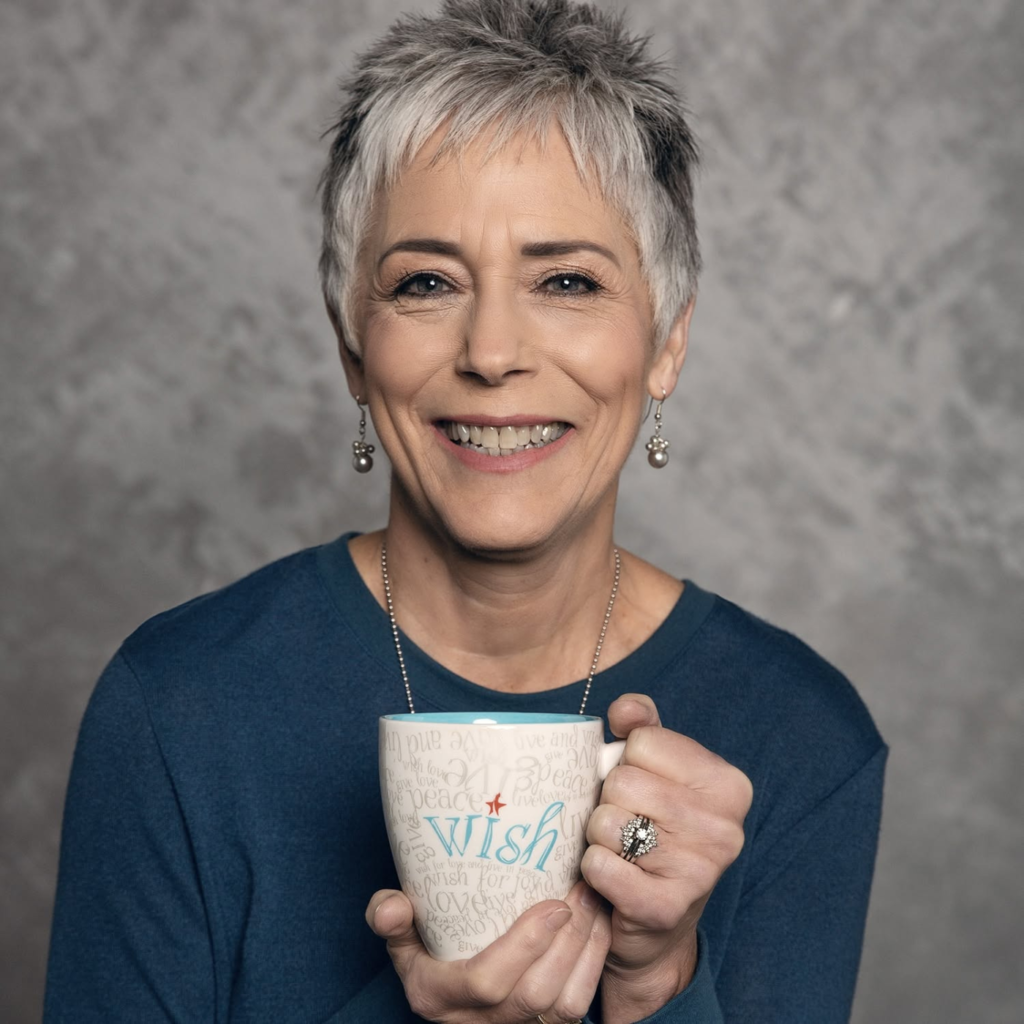
First aired July 12, 2026
Four years of chronic pain. A fibromyalgia diagnosis. Muscle relaxers, pain pills, migraines, MRI after MRI. And through all of it, my guest this week kept hearing the same quiet voice: something doesn’t fit. Rebecca Russell listened to it anyway, tracked down a neurosurgeon, and asked for one test nobody else had run: a discogram. It found the bulging disc that had been the actual problem the whole time, and eighty-five percent of her symptoms disappeared after surgery.
Rebecca is a metabolism and lifestyle coach, certified essential oil specialist, and author who’s spent more than three decades turning her own health crises, a prediabetes warning in her thirties and years of unexplained chronic pain, into a holistic approach she now teaches other people. We talk about the difference between managing symptoms and finding root cause, how to bring up wanting to try something holistic without blowing up the relationship with a doctor you’ve trusted for decades, and the “black year” she spent as a stay-at-home mom feeling brain-dead and guilty for wanting more, before a community-college pamphlet turned into an unexpected ten-year path to becoming a published novelist.
If you’ve ever been told your labs are “normal” while you know something is wrong, Rebecca’s message is blunt and useful: do your homework, and don’t let anyone, including a doctor you love, talk you out of your own intuition.
Watch this episode
In this episode
- Why Rebecca trusted her own intuition over four years of doctors telling her to just manage the pain, and the one test that finally found the root cause
- How a lifestyle overhaul helped Rebecca avoid a lifetime of medication after a prediabetes warning in her thirties
- The self-awareness, self-acceptance, self-love formula Rebecca built to help people figure out what they actually need
- Why she calls herself “the Queen of Homework,” and how to research a health decision your doctor won’t have time to
- How essential oils helped Rebecca get off a nightly sleep medication, and how each oil ties to an emotional need
- Her “black year” as a stay-at-home mom, and the writing-class pamphlet that turned into a decade-long path to publication
Timestamps
- (00:01) Welcome and guest intro: meet metabolism and lifestyle coach Rebecca Russell
- (02:10) From Harlequin romance novelist to competitive athlete
- (04:52) The rec ice hockey high, and the fibromyalgia diagnosis that followed
- (07:08) Watching family members struggle on the traditional medical path
- (09:04) The American Diabetes Society’s shift toward prevention and reversal
- (11:39) The discogram: the one test nobody else had run
- (13:34) The statin Rebecca refused, and the thyroid issue that was the real cause
- (16:05) How to bring up holistic options without losing your traditional doctor
- (19:50) Why Rebecca calls herself “the Queen of Homework”
- (20:23) Essential oils, sleep, and getting off a nightly medication
- (24:35) The “black year”: stay-at-home motherhood, guilt, and losing her sense of self
- (28:22) The writing-class pamphlet that led to a published novel ten years later
- (35:15) Boundaries, self-acceptance, and letting other people’s opinions go
About Rebecca Russell
Rebecca Russell is a metabolism and lifestyle coach, author, and certified essential oil specialist who believes resilience begins with how we care for our bodies. After being told she was likely headed toward type 2 diabetes, she chose a different path and has spent more than 30 years embracing a holistic lifestyle to change the trajectory of her health, including recovering from a four-year battle with chronic pain that led to a fibromyalgia diagnosis.
Learn more at Rebecca’s website, where you can request a free wellness consultation.
Favorite quotes
“Listen to your body. Listen to that intuition.” —Rebecca Russell
“Root cause is so important.” —Rebecca Russell
“You have to know yourself well enough to know what you need to be happy.” —Rebecca Russell
Resources mentioned
- RebeccaRussell.com: Rebecca’s website and free wellness consultation offer
- Rebecca’s book, which includes companion journal pages for each chapter (available as a free download through Rebecca directly)
- The American Diabetes Society’s preventative, low-carb approach to autoimmune conditions including diabetes
- Uncover Your Light, a nonfiction anthology on stories of hope and resilience featuring a chapter by Rebecca
Related episodes
- How to Trust Your Intuition After Trauma: more on learning to listen to your own body and instincts again
- How Your Survival Brain Is Sabotaging Your Happiness: the science behind why we override our own signals
- How to Reclaim Your Energy When You’re Burned Out: pairs with Rebecca’s root-cause approach to chronic health struggles
Subscribe & connect
If this episode gave you something to sit with, follow Phoenix and Flame so you never miss an episode: all apps in one place, or jump straight to Apple Podcasts, Spotify, Amazon Music, or YouTube. And if it moved you, leave a review; it’s the easiest way to help another listener find the show.
Learn more about Phoenix and Flame, connect with Dana, and listen to more episodes here.
Read the full transcript
[Dana] (00:01)
Welcome, friends, whether you’re out on a walk, running errands, or relaxing at home, it’s wonderful to connect with you. Joining us today is Rebecca Russell. Rebecca is a metabolism and lifestyle coach, author, and certified essential oil specialist who believes resilience begins with how we care for our bodies. After being told she was likely headed toward type 2 diabetes, she chose a different path and has spent more than 30 years embracing a holistic lifestyle to change the trajectory of her health. Rebecca, or as I know her, Becky, welcome to Phoenix and Flame.
[Rebecca] (00:51)
Thank you so much. I’m very honored to be here.
[Dana] (00:55)
This is going to be fun. Now, guys, you have to know, I know Rebecca as Becky, because we’re both members of Fem City Networking Group, which is fabulous. She’s the current president of our local group, and it’s amazing, and I’ve gotten to know Becky from that and wanted to have her on the show to talk about her wonderful wisdom. So, Becky, where do you want to begin? Because there are so many points you could start from, and, lots of times when we bring guests on Phoenix and Flame, most of the time people are passionate about something because of a struggle, a suffering they went through. We talk about what was the flame that burnt you to the ground, what did it feel like sitting in the pile of ash, what helped you rise like a phoenix from the ashes. So let’s go back down memory lane for a moment — where did your passion for holistic health, and then essential oils, first begin for you?
[Rebecca] (02:10)
Well, I’m a late bloomer, so I always have been, probably always will be, and that’s okay, I embrace it now. But I think, like with a lot of your guests, it’s your own rock bottom that helps you find your purpose. And I’m very purpose-driven. I wasn’t really — I was living in my purpose at the time, I was writing sweet romances for Harlequin, and that was an amazing experience, sold two a lifetime ago. My identity was pretty much, I was a writer and a jock, very physical, not a superstar, but I’m not one of those people who hates exercise, I love moving my body.
[Dana] (03:07)
Well, take just a second here — I want to pause and say, what an interesting combination, you’re writing books for Harlequin and also a jock. That’s such a wonderful combination in a woman. What are some of the sports or activities you enjoy doing?
[Rebecca] (03:17)
Yes, yes. I found the sport I was really good at in my thirties, racquetball. Until that point I didn’t even understand what being competitive meant — I was the cheerleader, “let’s just let everyone play, it doesn’t matter who wins,” and of course those things are true if you’re not on a pro team, but I didn’t get it. I’m married to a supremely competitive person, and we bonded through sports — we played church volleyball league —
[Rebecca] (04:04)
— and tennis, I’m not good at tennis, but racquetball I took to quickly and got really good, quick, which is a novel thing for me, to the point where he wouldn’t even play me anymore. So that was quite — you can’t do the happy dance with your husband, it just doesn’t work.
[Dana] (04:25)
Yeah.
[Rebecca] (04:29)
But then we ended up playing on a rec ice hockey league — I was in my late forties, he was early fifties, and it was so much fun. I wasn’t that good, I was a good skater, average with the hockey, but it was so much fun. And I went from that high of being in the best physical shape of my forties to —
[Dana] (04:45)
That is amazing.
[Rebecca] (04:52)
— a diagnosis of fibromyalgia. It’s a crazy thing, your pain moves day to day, and thank God I had a husband who believed me, didn’t think I was crazy, because back then it was very new, they just sort of didn’t even know what to do with you.
[Dana] (05:00)
I actually remember when that was happening, because I was basically the psychology department of a rehab center, a physical rehab center, and when someone would come in, it was almost like the understanding was: when someone came in and their chart was three inches thick with tests and procedures they’d gone through with no diagnosis, everything turning out correct or within normal limits, but there were still issues, then they would get the diagnosis of fibromyalgia, because they kept coming back saying something’s not right, but all the tests at the time couldn’t access it. It was a horrible thing for people to go through.
[Rebecca] (05:55)
They didn’t know what else. And it afflicted women mainly, which meant we were just patted on the back, “it’s all in your head” kind of thing. And I was already, because of the diabetes diagnosis, or type two warning — I was prediabetic in my mid-thirties — but I’d made a ton of lifestyle changes and gone the holistic path, because I saw what happened to my family going the traditional path and didn’t want that. So I was already on that path and kicking it, not on any medication for the sugar levels at all, not in the dangerous range, that was pretty much in control, and it helped being so active. But then this hit.
[Dana] (06:57)
Well, let me pause for just a moment. What was it about the traditional path that you saw other people doing, like your family members, that wasn’t particularly appealing to you?
[Rebecca] (07:08)
Oh gosh, it’s such a helpless feeling to watch them, their world gets smaller. Three of my family — my mom and then two aunts — had it, diagnosed in their forties, and it afflicted all of them differently. The one aunt who died at sixty, it was heart issues. My mom died at sixty-nine, multiple organ failure. The other aunt just died two years ago, and hers manifested mainly in migraines and back pain. They all had a terrible quality of life at least ten years before they died.
[Dana] (07:54)
Okay.
[Rebecca] (07:54)
And they struggled with weight their whole lives, they were very sedentary, they definitely had food addiction issues, and all they were told was just exercise more, and “you take insulin, you’re not going to lose weight.” So they were being sabotaged, and honestly the medical profession just didn’t know either what to do, I guess. And anything I learned on my own, on this other path —
[Rebecca] (08:26)
— I’m the kid, I don’t know what I’m talking about, and their experts are telling them something else, so I couldn’t help them, and it was a terrible thing to watch. By that point they’re on a handful, two handfuls, of medication. So your quality of life is never going to get better — at best you stay the same, but of course they didn’t, because they didn’t make any changes, didn’t have support. It was awful. So I just determined —
[Dana] (08:46)
Right. I’m imagining listeners and viewers are walking that exact path you’re describing, because you had to see all of this to be motivated to say, whoa, this is not something I want for myself. And I’m imagining people listening and watching are thinking, that’s me, that’s what I’m experiencing right now.
[Rebecca] (09:04)
Yes. The good news is we now have a group called the American Diabetes Society, and their approach to autoimmune, which includes diabetes, is preventative and reversing. The other organization had decades to turn things around, and we have more people sick than ever. This new group, full of doctors who’ve gone over to the holistic side, they’re actually promoting low-carb eating and lifestyle changes, and it gives me so much hope. It’s amazing to see this happen. So I was already very holistic, and when all the symptoms started happening with the fibromyalgia, I’d be five minutes into a racquetball game and a calf muscle would just totally knock me out, and it just was so weird. Then it would be my sciatica, then something else. I had four years of chronic pain that led to the fibro, because you’re constantly stressed, and so muscle — even though I was holistic, I had to do something, so I was on muscle relaxers, pain pills, I had migraines. It was so awful. We had good insurance, so I went from expert to expert, quote unquote, and those tests are painful — some of them, even the simple act of getting an MRI, if you’re stressed, your whole body is tense, and laying still that long is torture, and people don’t think about that. So I tried everything. They either said pain management or steroids, which totally wasn’t an answer because of the lifelong issues that causes. And so I thought, the only thing I haven’t tried is surgery.
[Dana] (11:17)
Mm-hmm. No, they don’t.
[Rebecca] (11:39)
And you want that for last, because it’s very serious, but because of who I am and how I’m wired, I thought, okay, it’s pain management or possible surgery, so I researched fibromyalgia, and everything I read — yes, I have it, no doubt — but no one is saying they can’t be on their feet more than twenty minutes a day, and I’m like, you don’t want to move because you’re in pain, but they’re not saying they can’t be on their feet. So there was an intuition just saying, something’s not right here. This is something I want to really stress to your listeners: listen to your body, listen to that intuition. I did my due diligence, did my research, and just something was telling me, yes, if that’s the last thing, if that’s my cross to bear, I’ll figure it out, but something doesn’t fit. So I went and talked to a neurosurgeon, researched the best ones — I was in Dallas at the time — and he did one test that no one else had done, called a discogram. A lot of people don’t know anything about that test, and it immediately picked up the bulging disc that was causing the pain. Now, why it took four years to figure that out, I don’t know, but it was very frustrating. I think I do know now, because going through that torture, and then the relief once I had that surgery and the root cause of the pain was gone, eighty-five percent of my symptoms went away.
[Dana] (13:20)
Yeah. Oh my goodness.
[Rebecca] (13:34)
So, with the diabetes, they kept predicting the diagnosis, they wanted to give me a statin, and of course that’s your first thing, didn’t ask me if I was willing to do any lifestyle changes, nothing, just, here’s a statin, and I refused. So I went to the holistic doctor, and she said, your thyroid’s off, that’s what’s wrong with your cholesterol. So with some quality supplements, not even any diet changes, after three months my cholesterol was fine. So that was the first time my intuition was proven correct — this is not the way for me, and root cause matters. Because if the thyroid was unaddressed, and I masked everything with that statin, which has its own issues with side effects, two or three years down the road, that’s not going away, I’m going to have all these other symptoms no one can identify, and who knows where that would end up. So root cause is so important.
[Dana] (14:45)
I’ve got a question, because I’m following your journey, and I’m imagining there are likely listeners and viewers experiencing what you’re describing, currently seeing a traditional primary care provider. If someone is seeing a traditional provider and wants to pursue holistic medicine, how does that work? Maybe they don’t want to let go of their traditional provider they’ve had for decades, and more often than not, the traditional providers are also the ones who can admit to hospitals or do other things a holistic provider cannot do. How do they get that information? Hypothetically, if someone is on a statin and wants to go to a holistic practitioner to find out, maybe it’s my thyroid, but if they came off the statin their traditional provider put them on, how does that work, and not knowing what’s going to happen?
[Rebecca] (16:05)
I love this question, and I want to reiterate, I am not a doctor, I’m not telling anyone not to listen to their doctor, we need doctors, but they’re in the business of disease treatment, they’re not trained to prevent or reverse, they’re trained to treat symptoms. What I like to tell people is: say your family has a mechanic they’ve used for generations, if you have car trouble you go to Joe’s, he’s your guy. Well, you end up getting a diesel truck and have problems, you take your diesel truck to Joe’s, and he’s like, I’m sorry, I don’t do diesel. But you’re my guy — I understand, I wish I could help you, I don’t do it. So you leave, and you debate, and try to figure out what to do, and go back again and say, look, you’re the only person I trust, I really need you to work on my truck. He’s like, I can’t, this is out, it’s not in my lane. And that’s what I see people doing — they keep going back to that doctor they’ve been seeing for years, sometimes decades, because they trust them, and because of insurance, let’s face it, they take insurance and a lot of holistic people don’t. And they’re given the medications they’ve heard may cause issues, or maybe they do have the side effects.
[Dana] (17:32)
Mm-hmm. That’s a big factor.
[Rebecca] (17:47)
And they get frustrated, but they keep going back expecting a different result, and it won’t work — that’s the definition of insanity, expecting a different result. They can’t do it, they’re not trained to do anything else. So you have to make that decision — talk to someone like me for a referral, or friends, however you want to do it — and yes, you may have to pay out of pocket, but what you pay now, or you pay later, if you don’t get to that root cause. If I had not followed my intuition and gone the holistic path, and just stayed in that traditional thing because it was the comfort of what’s known, I’d be on a statin for the wrong reason —
[Dana] (18:33)
Right.
[Rebecca] (18:37)
— and who knows what other complications. When you end up as a type two, they’re never on just insulin, it’s blood pressure, a statin, and then eventually a blood thinner, it’s a domino thing. So I have a whole pill case full of supplements. My mom had a whole pill case full of medications. We now know that medications are chemicals, so I’m not saying don’t ever take them, but really, really do your homework and try to minimize that, because everyone’s worried about Alzheimer’s —
[Rebecca] (19:22)
— and you need to understand that to protect your brain, you need to be on as few medications as possible. Taking the easy — I’m not saying never, some people absolutely have to be on a statin, some absolutely have to be on something for sleep — but if you’re not willing to even try something natural, just know that’s contributing to that risk down the road. So you have a savings account for your holistic modalities, just like you would for a car or a vacation. It’s that important, in my opinion.
[Dana] (19:50)
Gotcha, that makes sense. Now let me ask you — you’ve shared with me that, like I’m known as the Queen of Boundaries, you feel like if you were given a moniker, it would be the Queen of Homework. That’s really interesting to me. Where did you come up with that, why is that important to you?
[Rebecca] (20:23)
Well, I’ve been a personal development junkie since I was like twelve. I was born an old soul, very serious, and gravitated toward that. I think it also was me trying to figure out — I was an outlier in my family, just so different, a bunch of extroverts, laid-back siblings and parents, and that’s not me. So I grew up feeling something was wrong with me, and I think I dove into personal development to try to figure out, is there something wrong? So from twelve till now, sixty-eight, I have a vast resource of books that changed my life — back then it was books, you went to the library, but now you’ve got podcasts like yours, you have some incredible guests where you can learn very quickly and have a resource. So if someone wants to know, like the question you just asked, what do I do if I want to —
[Rebecca] (21:35)
— change over but don’t have that personal recommendation. Since I’ve been a wellness coach for eight years, I’ve come across quite a bit, so I can give you — if sleep is your issue, I’m your girl, because that’s how I used essential oils to get off a nightly medication for sleep. I have a very active brain, hard to turn off at night, first it was because of worry, parenting, teenagers, just couldn’t get to sleep, then I resolved that with another book and some other things, and later it was creativity, I was excited, passionate, and hard to turn off. Now that I know even more how dangerous those chemicals are, I’m so grateful I found essential oils ten years ago, and they upleveled my health, and I was able to get off that medication, which was potentially addictive as well. Did the medication work? Absolutely. Did it cost much? Nope. But taking that magic pill long-term could come to haunt me, and I’m very independent, I don’t like being under the control of something like that.
[Dana] (23:05)
Hahaha.
[Rebecca] (23:05)
So that was my main thing, trying to get off — I don’t like something having that hold over me. So now, knowing I can go to bed, and pretty much if I have my routine in place, I could share my routine with you. I even wrote a book about this whole approach to what is holistic health, how do you do it, why you should, just to share what I’ve learned these three decades about it.
[Dana] (23:12)
Right. Now, you’ve mentioned your decades of wisdom and experience and your life journey, and I was wondering — you had a section of time you called your “black year,” of emotionally struggling to find your purpose. I love it on Phoenix and Flame, people have an opportunity and a space to share and be transparent and honest about the struggles they’ve gone through, because I know listeners might currently be in a struggle and feel like, gosh, I’m the only one, everybody else is doing great, but not me. I think we’ve all felt that way, looking around on social media and everyone seems to be doing fantastic, and we’re thinking, well, I’m not doing well at all. So I really like creating space for that. Can you share a little about what you call your black year of emotionally struggling to find your purpose?
[Rebecca] (24:35)
Well, I think it goes back to knowing yourself. As a young teen, even though I knew I was different, I don’t know why, I had such a strong sense of self, it never occurred to me to pretend to be something else. I don’t know why, because that’s the first thing most kids do, I never did that. My whole thing was, I have no power as a kid in this family unit, but boy, when I’m eighteen, I’m out, because I can’t win this battle, and nothing bad happened, it was just, I couldn’t be me and be happy about it, because they didn’t understand.
[Dana] (25:25)
That could apply to a lot of people’s situations. I can think of so many in my head right now.
[Rebecca] (25:30)
So I grew up thinking there was something wrong with me. I left home at eighteen, and was doing fine, got married, lived in Dallas, raised our family there. We’d just built a house, I had two beautiful, healthy children at home, I’m an at-home mom — what, I’m living the dream. We were tight on money, but other than that, I had it made.
[Dana] (26:41)
Yes.
[Rebecca] (26:47)
And yet I was miserable, I felt so brain-dead. And, like you were saying, it wasn’t the internet back then, but it was all the moms around me — we had a cool neighborhood, moms and kids there, so I had support there, but they seemed fine with not having anything outside of motherhood, and I just, it wasn’t enough for me, and I felt so guilty about that, guilty and ashamed that I had so many blessings, and yet here I am thinking, is this all there is? And that will do a number on you. And to make it even worse, because I had to give up the gym membership for the new house, I was walking in the neighborhood with two other ladies who were negative Nancys —
[Dana] (27:13)
Yes.
[Rebecca] (27:29)
— and I was hearing all that every morning, and had my dark cloud. The guilt was horrendous, and I couldn’t find my people. I feel like — do you remember the ugly duckling story, the little duck going around, are you my mom, are you my family? I was trying to find my people and couldn’t find anyone. And I saw an ad for a creative writing class at a community college, and even though it wasn’t in the budget —
[Dana] (27:33)
Oh yeah, yeah, yeah.
[Rebecca] (27:57)
— I went to my husband, and I didn’t even have to get it out, he said, go. He’s a very smart man, and I did feel guilty about going, but it was like I had to, I knew myself, and this was not sustainable, I had to do something. It was like a God wink, I think, finding that pamphlet and taking action on it, knowing I don’t deserve, I don’t want to feel this way, and I don’t deserve it. So I took action and went to this class. Turned out it was not creative writing, it was how to write a novel, which I would have never signed up for. And that gave me a career I wasn’t even looking for.
[Dana] (28:21)
Ha ha ha!
[Rebecca] (28:22)
So it was like a cascade of events that happened from that one thing. But I’m telling you, they often compare publishing a book to giving birth, because you’ve got this thing you’re nurturing for nine months, or in a book sometimes longer, you feel it’s your baby, and if anyone critiques it and says anything bad, you take it so personally. But I think publishing a book is harder than giving birth, because it takes hardly any effort to get pregnant for most people, and then it all happens on its own, the baby just grows, you don’t have to do anything. The book doesn’t write itself, and it can take a lot longer than eight months. So it’s a pretty tough thing. It took me ten years to get published, and at some point during those ten years of rejections I even took a year off, because it was just so — it brings you down.
[Dana] (29:25)
Oh my gosh.
[Rebecca] (29:42)
And my husband, bless his heart, at one point said, let’s create our own publishing company, and I was just like, that is the sweetest thing, but it is so not what I want, that would mean I had given up, that I wasn’t good enough. It’s not like now with self-publishing — back then, only losers did that, it was, nope, it’s going to be the traditional way or no. After I took that year off, I came back refreshed and basically said, if it’s not fun, I’m not doing it, and I’m going to apply all I’ve learned and give it everything I have. So there’s a lot of lessons in there — A, know yourself, this is the key message I want to get across today, and how the homework comes into play. You have to know yourself well enough to know what you need to be happy, and if you don’t work on that, if you don’t love yourself, accept yourself, and love yourself enough to honor that, you’re going to be stuck.
[Rebecca] (31:04)
And there’s no shortcut. When I was writing a chapter for another nonfiction book called Uncover Your Light, about stories of hope and resilience, I actually came up with a formula, because I only had 2,500 words to get across this idea of how important it is to know yourself. Since I’m not a math person at all, but I had to condense it, I came up with: self-awareness plus will hopefully lead to self-acceptance, because that has to happen too, which will then hopefully lead to self-love. If you have each of those steps in place, you’ve done the work, and I can give you books that will help you do that, then you’ll be in a place where you can look outward and think about serving, how can I help others. But if you don’t focus on you, and finding out where that limited belief of worthiness is, you may be successful for a while, but you’re going to get stuck. Imposter syndrome, all those other things can come up. You cannot skip those steps.
[Dana] (32:21)
Mm-hmm. Yeah, and so, I’m going to toss something in about boundaries here, and then I want to make sure we communicate a free item you’re making available to Phoenix and Flame listeners and viewers, and how they can get ahold of you. As I’m listening to you describe the self-awareness, the self-acceptance, and self-love, because of my own personal journey, and also so many stories I’ve had the privilege of hearing being a therapist — you have to have that. I like to talk about yards, you have your yard, and then there’s a property line, and your neighbors on the other side. Your neighbor — we’re going to have people in our life who don’t understand us, don’t agree with what we’re doing, don’t approve of it. That’s never going to stop, it’s not if that happens, it’s when that happens. And if you don’t have the ability to draw that line, to see that property line at the edge of your own property, to know your yard, your thoughts, feelings, and actions — that’s where your self-awareness, your self-love, your acceptance is, in your yard. And on the other side of that property line, your neighbor may be over there scoffing at what’s in your yard, leaning on the fence going, your flowers are ugly, why do you have a birdbath in your yard, right? They might be leaning on that fence criticizing everything in your yard, and you can’t stop them. But when you’re practicing healthy boundaries, you’re honoring what’s in your yard, and you know your neighbor has a right to his or her opinion. And as Mel Robbins says, let them. If you don’t have the power and the strength to just let other people not like you, not understand you, not approve of what you’re doing, you’re going to be stuck in the mud. I just had to toss that in, because my brain is always thinking like that as I’m listening.
[Rebecca] (34:41)
Oh yeah. Well, trust me, I was judged as a mom going outside to do different things and not just living through my children — I wish that could have been that way, it would have been easier, but that’s not how I’m wired.
[Dana] (34:56)
Yeah. Nope.
[Rebecca] (34:59)
And so, to not have that boundary of letting someone else dictate how I should think or feel — because you can certainly imagine people telling me, oh, you’re so blessed, just get over yourself, just be happy with what you have, other people would give anything for this. I heard it all. If I had let that dictate what I did, I would have never found something that brought me so much joy.
[Dana] (35:15)
I’m so glad you were able to keep going and honor yourself, and not let those other people’s opinions bring you down. This is a real issue a lot of people have on a consistent basis. Now, you said that you would help listeners and viewers create a custom essential oil blend that supports their word or theme for 2026 — is that still an offer you have, and anything else on your mind you’d like to make available?
[Rebecca] (36:03)
Absolutely, and if you don’t know what that means, basically every essential oil has an emotional component to it. So say your word for the year is abundance, I help you figure out — I know wild orange is the oil of abundance, so that would be one oil. What else is getting in your way? Maybe you feel stuck, and that’s why you can’t get abundance — well, cypress is the oil of motion and flow, that’s another oil you might consider. Maybe you’re stressed out all the time and need to calm that nervous system, well, hinoki, an oil not many people know about, is the oil of natural harmony. There are so many oils to choose from, but once you understand there’s an emotional component, you can create your own blend and use it like you’d wear perfume, on your pulse points, and smell it, and it can be an anchor for you when you’re meditating, journaling, or just having quiet time. It’s not a magic thing, but it’s very real, and in alignment with what you’re trying to create, and it’s so fun for me to help people figure that out. And also, if talking about holistic health is something people are interested in, my book that came out in September has journal pages that relate to each chapter — normally you’d purchase those journal pages, but I’d be happy to give that download for free, so they can process the things, because there’s homework even in my book. I don’t want you to just read and forget it, I want you to understand how to apply it to your life.
[Dana] (38:34)
Fabulous. All right, so what I have for a website is RebeccaRussell.com — is that where you’d like them to go, if they’re thinking, my gosh, I’ve got to get ahold of her?
[Rebecca] (38:51)
Absolutely, but I do want to caution — if you’re really curious about essential oils, or the metabolism and lifestyle coaching, or anything like that, I want to talk to you. I am not about sending someone to my website to purchase anything, I want to make sure you get what you need. We’re going to get to the root of what’s going on through a questionnaire, or a Zoom, or something. I rarely send someone to my website just to buy essential oils, because a perfect example — a guy I was talking to said, I just need something to help me sleep. Okay, but when I talk to people, a lot of times they’re also saying they have issues with stress. Oh yeah, I’ve got a lot of stress. Pain — nope, I’m good there. Digestion — oh my god, I’ve had digestive issues since I was, you know, twenty. And as we’re talking, it’s sort of sinking in, and by the —
[Rebecca] (40:01)
— time we’re done, he goes, you know, if I could resolve my digestive issues, I could probably sleep.
[Dana] (40:07)
So let me ask you this, Becky — do you have, if they go to your website, is there a contact page where they can, like, do you have an email or a number they can reach you at to do exactly what you’re describing?
[Rebecca] (40:13)
Yes, absolutely, a free wellness consultation.
[Dana] (40:23)
That’s awesome. All right, Becky, I appreciate you so much for spending your time, your energy, and your considerable wisdom with my Phoenix and Flame listeners and viewers. Thank you so, so much.
[Rebecca] (40:39)
Oh, thank you. I enjoyed it.
[Dana] (40:42)
All right, listeners, viewers, my goodness, I know you have heard numerous things today that Becky said that either you, or a good friend, a coworker, a family member, because of conversations you’ve overheard, need to hear — oh my goodness, they need to know what Becky Russell has to say. So take this podcast episode, copy and paste the link, send it in text, send it in email, post it on your favorite social media sites so we can grow our Phoenix and Flame community and reach out and let people know: you are not alone. I hope your day is great, I hope the rest of your day is fantastic. I’m Dana, on Phoenix and Flame.
Are your work boundaries supporting you—or quietly draining you?
Take my free Work Boundaries Quiz and find out where you stand.