First aired October 29, 2023
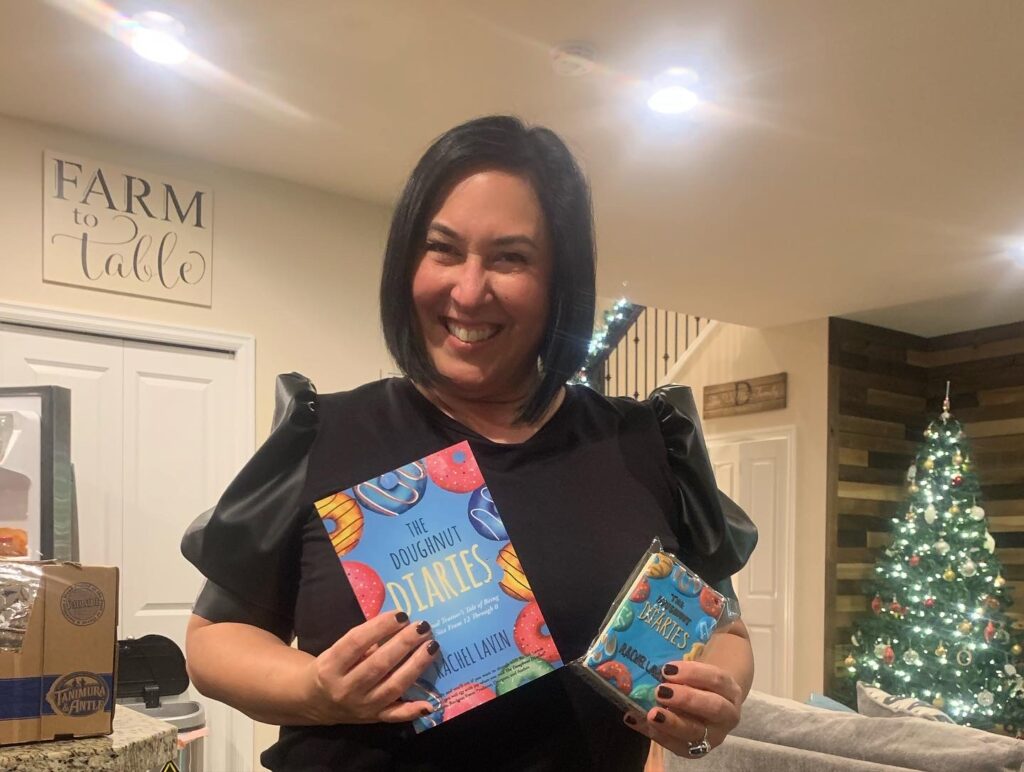
A few days after her 40th birthday, Rachel Lavin found herself alone at the gym, standing in front of a mirror, and she just started crying. Not because she hated what she saw. Because for the first time in decades she was seeing a whole person: a woman who was, in her own words, “beautiful, was smart, was funny, was all the things that up until that point, I just didn’t think I was.” That’s the moment that cracked open thirty years of body image struggles and restrictive dieting, and it’s the story behind her book The Doughnut Diaries.
Rachel is a certified personal trainer, certified health coach, and body-love educator who has spent her career teaching everything from Jazzercise to Central Park boot camps to corporate chair-stretch classes. But even at a size zero, after dropping 50 pounds in front of her entire gym during what she calls “a stupid 90-day challenge,” she was miserable. We talk about why the number on the scale was never the actual problem, the hard boundary she set around who gets an opinion on her body (“It’s my body. It’s mine. It’s not theirs.”), and her three pillars of fitness: nourishment, movement, and rest.
If you’ve spent your whole life waiting to feel confident before you’ll accept your own body, this conversation flips that order, and gives you somewhere to actually start.
Watch this episode
In this episode
- Why the number on the scale was never the real problem, even at a size zero
- The mirror moment, days after turning 40, that ended thirty years of body-image struggle
- How to set a hard boundary around who gets an opinion on your body
- Her three pillars of fitness: nourishment, movement, and rest (and why “rest” doesn’t mean the couch)
- Why confidence has to come before the “perfect body,” not after
Timestamps
- (00:05) Welcome and meet Rachel Lavin, author of The Doughnut Diaries
- (01:49) From Jazzercise to Central Park boot camps: Rachel’s fitness career
- (03:39) Realizing at 11 that her body was “just different”
- (05:20) The mirror exercise, and why so many of us can’t stand to look
- (11:37) The mural analogy: stepping back to see your whole self
- (13:10) The 40th-birthday mirror moment that changed everything
- (16:40) Setting a hard boundary: “My body is none of your business”
- (20:08) Losing 50 pounds in front of the whole gym, and still being miserable
- (22:15) Gender and body image: do men carry it the same way?
- (30:44) Rachel’s three pillars of fitness: nourishment, movement, rest
- (33:06) Where to find Rachel Lavin and The Doughnut Diaries
About Rachel Lavin
Rachel Lavin is a certified personal trainer, certified health coach, professional speaker, and body-love educator. She’s the author of The Doughnut Diaries (2020), which chronicles her more than 30-year struggle with weight and restrictive dieting. Originally from Northern California, she’s lived in Hawaii, Washington, Oregon, and New York City, and now lives in Greenville, South Carolina, with her partner.
Learn more at Rachel Lavin Wellness, and find The Doughnut Diaries on Amazon.
Favorite quotes
“I don’t have a body that just stays naturally thin if I don’t move, if I don’t eat well.” —Rachel Lavin
“It’s my body. It’s mine. It’s not theirs.” —Rachel Lavin
“I’m not even going to use the word ‘perfect body,’ because I promise you, ladies, there is no such thing.” —Rachel Lavin
Resources mentioned
- The Doughnut Diaries: Rachel Lavin’s book, available on Amazon
- RachelLavinWellness.com
Related episodes
- Food, Love, Hate, and Your Body (Shelley Loving): another guest’s journey through a complicated relationship with food and body, pairing well with Rachel’s own decades-long story.
- Transforming Body, Mind, and Spirit (Jennifer Pilates): more on movement and self-acceptance as a whole-person practice, not just a physical one.
Subscribe & connect
If this episode gave you something to sit with, follow Phoenix and Flame so you never miss an episode: all apps in one place, or jump straight to Apple Podcasts, Spotify, Amazon Music, or YouTube. And if it moved you, leave a review; it’s the easiest way to help another listener find the show.
Learn more about Phoenix and Flame, connect with Dana, and listen to more episodes here.
Read the full transcript
[Dana] (00:05)
Welcome to Phoenix in Flame. I’m Dana, and this is my podcast on pushing through and transforming even when you feel like a pile of ash. We have a wonderful guest with us today. Her name is Rachel Lavin. Now, Rachel is a published author of The Doughnut Diaries, professional speaker and body love educator, certified personal trainer, and a certified health coach.
[Dana] (00:35)
Now, although she grew up in Northern California and has lived in Hawaii, Vancouver, Washington, Portland, Oregon, and New York City, she currently lives in Greenville, South Carolina, with her partner. Now, in 2020, Rachel wrote her first book, The Doughnut Diaries, about her own struggles with her weight and restrictive diets, which lasted for over 30 years. As Rachel turned 40, the expression “I got sick and tired of being sick and tired” hit home. And she made a decision to take her power back and heal from decades of negative thinking and self-sabotage. Rachel, welcome to Phoenix in Flame.
[Rachel Lavin] (01:23)
Thank you so much for having me. I’m so excited about this.
[Dana] (01:30)
I am very much excited as well. Now, you began your career as an ACE certified group fitness instructor, teaching all kinds of classes like aqua aerobics, bootcamp, Jazzercise, dance aerobics, stretch and chair classes, it goes on and on. So I’m really interested, kind of bring us in on your journey. Where did it start, and kind of where did you meander along the way, and why?
[Rachel Lavin] (01:49)
Yeah. Well, my very first certification was Jazzercise. So that was my first little part of my journey, part of my story. I had been doing it with my mom for a handful of years, and just people or instructors kept saying, you should do this, you should do this. And although I loved doing it, it was not really something that I gave much thought. I was like, okay, whatever, I’ll give it a whirl. But I ended up loving it, and I taught for seven years, and then I moved to New York City and decided to get a job with a boot camp company, and I taught boot camps out in Central Park. And then I started doing more and more classes for the woman I was working with, and we got into corporate fitness, and I started doing, like we talked about, the chair stretching, because not necessarily, you go into an office building, they don’t wanna change their clothes in front of their coworkers, or they don’t have the time. So we were trying to develop a workout program that would let you stay in your work clothes, not really work up a sweat, but at least move your body, get your body away from your desk. And it was just wonderful. And while I was doing that, I was also personal training and building my business that way. And I finally let go of the Group X around 2011 and just focused solely on personal training.
[Dana] (03:21)
Okay, so where did it fit in? So were you struggling with the weight issue? And you mentioned self-sabotage, negative thinking, this kind of stuff. Kind of give us a chronology of your life and your struggles, and kind of where all these pieces fit together.
[Rachel Lavin] (03:39)
Okay, well, I’ve struggled with that my whole life. I mean, I remember at 11 years old knowing that my body was just different. I was different from my peers. I just had a different body. And I remember as a young teenager, diets were just like they are now. We were inundated with diets on TV commercials and magazines, conversations with other women. So there was always a need for that for me, because I just wasn’t born with a gift of being naturally thin, and early in my life I took that very personally, and I was actually very angry about it, and I felt very betrayed by my body. And now, when I say it to you today, it’s an acceptance. I don’t have a body that just stays naturally thin if I don’t move, if I don’t eat well, it just doesn’t. So I’ve come to terms with that, I’ve accepted that, and that has been really this whole journey since I was 11: feeling all those negative feelings, gaining and losing weight countless times, because I literally tried every fad diet out there. I restricted most of my life up until very recently, actually, about five years ago. So to have the feeling of looking in the mirror and being okay with my body, accepting my body and loving my body, and just doing my best to take care of it, is such a beautiful gift. I will say that.
[Dana] (05:20)
Well, I’m going to be really interested in hearing how you got to that point. I’ll take a little side note and say, listening to you describe this, it reminds me of a TV show I saw probably a couple of years ago. I think it was, was it Gwyneth Paltrow? And it was, she was doing this show on different types of relationships and different types of body styles and this kind of thing. Well, one of the exercises that one of the therapists was doing, she wanted her client to do what she was doing, which was, she was standing in front of a mirror naked. All she had on to my recollection was just some kind of a little multicolored belt thing that was kind of cute, it kind of just floated around, but that was the only thing. And she was literally standing in front of the mirror buck naked, with the assignment being to look at your body and to accept your body and appreciate your body. Now, I will say her client that she was trying to encourage to do that never was able to do that. Her client was all wrapped up, you could see her body language, she was like closing the folds of her robe together around her neck. She just, her body language was all closed in. She was closing her arms around herself, like as if to hug herself or protect herself. And I’m thinking, how interesting is this? You know, me as a psychotherapist, to watch, all she was being asked to do, and I’m saying “all” in quotes, all she’s being asked to do was stand in front of a mirror and look at her body. And she was having all of this huge resistance, and you could see all the emotion flooding her body. You could see it in her body language, like I described. You could see it in her face, the fear, the just, she did not want to do it. And meanwhile, here is the therapist standing next to her, like I said, buck naked, in front of this mirror, and her therapist did not have what you would call the perfect body, if there’s such a thing, which I don’t believe there is, but us women, when we say someone has a perfect body, we know what each other means. We know what that means, unfortunately. And her therapist did not have one of those types of bodies. Her therapist had an interesting body, and she was standing in front of the mirror in acceptance of herself and appreciating what her body could do. I was stunned by that, that whole, the therapist and also the client. So thinking of that and your journey as well, why do you think we find it so hard to accept who we are?
[Rachel Lavin] (07:55)
Well, I say this a lot, not only from my own experience, but dealing with countless and countless different types of women. I mean, it’s almost like we come out of the womb, like, you must hate your body, you know? And that thought process is just fed on a daily basis. For me, it felt like it was a moment-to-moment basis. So to be able to, because I can relate to that woman who was doing this and all that, I relate to that wholeheartedly, and to be able to look at my whole being in the mirror is, I think, what is different for me. I don’t just see myself as a body anymore. I’m a person, I’m a woman, I am, you know, all those things. And to be able to see that when I look at the reflection in the mirror helped me so much.
[Dana] (09:04)
You know, I’m remembering different people, different women that I have observed over the years. And it seems that, like you said, you looked at your whole self in the mirror, you were not looking just at your body, but you were recognizing your entire personhood, your physicality, but also the spirituality, the emotional part, the mental part, everything that makes you you, all the wonderful bits and pieces and everything like that. I’ve noticed that when people have confidence, something changes, and not only how they see themselves, but how others see them. Have you experienced any of this along the way? And what are your views on the role of confidence, and, like I said, not only how a person views herself, but also how other people view her?
[Rachel Lavin] (09:42)
Well, that is a very beautiful question, because I do believe that I had no self-confidence, no self-esteem in those early years. And I actually didn’t start to acquire it and learn and develop it until I was over 40 years old. So it took me a long time. But now that I do have it, I don’t think I understood, when someone’s like, “just be confident,” it didn’t mean anything to me, because I didn’t understand. I know now that when I had no love for myself, I didn’t know who I was as a person. It is impossible to have self-confidence. But when you do develop those skills, and you learn about yourself, and you let go of this idea of who I think I’m supposed to be, and just accept who you are, I think the confidence really starts to come. And I am so grateful that it has developed even more as I get further along on this journey.
[Dana] (11:07)
I just love that, the way you explained all of that. And listeners, I told Rachel before we started that as we would talk, I would periodically be writing notes. I’m sitting at a table, I have my paper out, and I always have a pen, because I’m just always writing questions, and the whole time she’s talking, things are just pinging in my mind. I’ve got like four things down here just to, Rachel, get your opinion on and kind of toss out.
[Dana] (11:37)
With regarding the acceptance, I know sometimes I talk to my patients and I say, imagine you’re looking at a huge mural in a museum, and you know how they normally say to step back away from the wall, there’s usually like a red cordoned rope so that you don’t get right up on top of the artwork, and you’re kind of stepped back. And that’s how you can, because you have to step back to see the whole entire portrait or whatever it is that you’re looking at, to really grasp the whole thing, to understand what the artist was trying to do. And I think we sometimes have murals, how we view ourselves, as different splashes. Like there’s a red splash and a yellow splash and a black splash and blue and green, all these different splashes. But we walk right up to the black one or the dark brown one and we stick our face right in the middle of it, where it fills our entire vision and we can’t see anything else. It’s like sometimes we need to step back to see all of the different splashes to appreciate that, and I’m thinking that’s what you were trying to say in terms of appreciating all the different aspects of who you were, that you were able to do that later in life. How were you able to get to that point? Because I can explain that to someone, but sometimes they’re like, well, I understand what you’re saying, Dana, but how, how do I do that? How do I get to that point of stepping back and seeing all the different splashes of myself on the mural and accepting all of that?
[Rachel Lavin] (13:10)
Well, I do love that analogy. That is beautiful, and it’s so simple. And I think that’s where the problem lies. We as human beings, we as women who struggle with our body image and loving ourselves, it is impossible to see the whole picture, because our brains and our minds are so filled with the constant barrage of negative thoughts, and they are so loud. Until you learn the skills to quiet them down and even shut them down completely, it’s impossible to see that whole mural. And I was fortunate enough, like literally a few days after my 40th birthday, to have this just beautiful experience where I was able to be alone in a room with myself and my feelings, and just knowing that I’m a 40-year-old woman now, and I just wasn’t happy. I was a size zero. I was a size zero at 40, and I was just miserable, I just wasn’t happy. And after my 40th birthday, I had this experience where I just was at work, I was at the gym, no one was in the room with me, and I was just able to look at myself in the mirror and started just crying, and feeling like all this weight was lifting off, because I was looking at this woman, this 40-year-old woman who was beautiful, was smart, was funny, was all the things that up until that point I just didn’t think I was. And so to have that lift, I’ve never looked back. Never. Even when I have my bad days, even when I have my moments of, I don’t love the size of my body at the moment, but I don’t ever feel like I’m back there, where I feel betrayed by my body, or I feel like it’s hopeless. I know that it’s a moment, and I thought that way about myself for 40 years, so I can’t expect in 11 years for that to just switch off.
[Dana] (15:23)
Wow, that moment sounds so poignant, you know, just very powerful, that you were just kind of just letting things, just letting them go.
[Rachel Lavin] (15:34)
Yeah.
[Dana] (15:36)
You know, people call me the queen of boundaries, and as I’m listening to you talk, I’m wondering what your opinion is on how much of what we deal with as women actually comes from someone else’s opinions, because that’s one of the main things about boundaries: what belongs to us and what does not, what are we responsible for and what are we not. And one of the main things is other people’s opinions and other people’s feelings and thoughts about things, they’re gonna have them, they have a right to them, we might not like them, but we also have our own. What, when you think about it like that, what are your thoughts about your experience, getting to that point when you were looking at yourself like that, and also before, how you felt before, and then after, when you think about your view and how the impact of other people’s opinions had on you?
[Rachel Lavin] (16:40)
That is a big, big question, and I could go off on a tangent about it, but I will say this: that when I decided that I was going to get reacquainted with myself, I was going to love myself and I was not going to look back, the first thing I did was I stopped asking people about my body, because especially being a female in the fitness industry, it was something that people felt comfortable talking about all the time. And I just took it because, while I’m in this industry, I must have to deal with this. But I set, you know, I love your word, boundary, I set a hard boundary that day, and I was like, I am no longer going to accept what people say about my body. It’s my body. It’s mine. It’s not theirs. Being a bigger woman in a bigger body doesn’t mean that I’m not a good trainer. It had nothing to do with that. So that was part of my awareness and my realization, that even when people now, if they’re talking about anything related to what I do, I say, you know what? People carry fat on their body, it has nothing to do with who they are as a person. Like, I need you to understand that. And I really don’t like it or appreciate it or encourage it when my girlfriends or women in my space talk badly about themselves or pick their body apart. But I have to remember that it took me a long time to get here, and I can’t force my freedom on people, they have to get there, and I’m really working hard on meeting them where they’re at. You know, as women, your listeners, I would love it if you could just start to be aware of the things that you say about yourself to yourself, to other people. You’re inviting that negativity in when you do that. And I do understand that there are people in people’s lives, whether it be parents, partners, whatever, that feel like it’s okay to talk to you about your body size or what you’re eating. And I have a hard-stop boundary: it’s like, my body is none of your business. That’s it. And that’s it.
[Dana] (19:07)
I love that. I love that. And I love when you said that you decided that, you know, you reached a point where you just, you made a decision that my body is mine, and other people are going to have whatever opinion that they’re going to have, and you’re going to let them, because they have a right to their opinions, we don’t. That’s one of the things I think we get kind of stuck on, that we keep trying to get people to think positively about us. Who gives a shit? You know what I’m saying? I mean, they are allowed to think whatever they want to think, and we can let them. And it’s just like, but you made that decision, you’re like, okay, I’ve had it, I’m making a decision that I love my body, I love myself, I love everything, I can change something if I want to, but that’s my choice, not somebody else’s, and whatever anybody else thinks, they can think, and that’s not going to change my view of myself.
[Dana] (20:08)
That was awesome. I did want to point out too, that you mentioned, apparently you got some feedback from other trainers and stuff, feeling like your body’s supposed to look a certain kind of way. And I get where you’re coming from with that. But you know what, I would imagine that women who have genetics that just have larger body styles, that they might feel more comfortable with someone that they feel like understands what it feels like to be them. They don’t, really? So do tell, I don’t understand that.
[Rachel Lavin] (20:48)
No, they’re the worst. Yeah. Well, I also have to be honest, the majority of my personal training career was in New York City, and women there are a different animal than they are anywhere else. So this, that last major transformation, when I lost 50 pounds in front of the entire gym, we can talk about that, it was a stupid 90-day challenge and blah, but that’s when I was a size zero. I mean, the constant feedback on a daily basis, “oh my God, she looks, oh now she looks like a trainer,” “oh my God, if you can do it, I can do it,” all those things, and of course that does make sense, I understand how they would think that way, but that’s what I was trying to explain to you: my brain was thinking, I’m still the same person, my body is smaller, but I’m still this, I’m gonna train you the same way I did 50 pounds ago, you know what I mean? But it is such an interesting thing when people see that transformation and they just latch onto you. And it was very weird.
[Dana] (21:32)
Yeah. Hmm. You know, I’m also wondering too, what your thoughts are on the gender disparity, because it seems like, cause you mentioned earlier when you were younger and you felt like even at age 11 you kind of felt like you looked different from the girls around you, and you were kind of noticing it then. And I think a lot of us can look back to when we were in, you know, elementary school and certainly junior high, whoever wants to go through that again, that’s like a hell on earth. So it’s like, but it seems like there’s a different expectation or just something put out there. And I know that males do struggle with different things, because I’ve had them on my podcast, and I’m not trying to demean that or diminish that by any means, but just to suggest and get your thoughts on what you’ve observed, if you think there’s any kind of gender difference in this particular struggle.
[Rachel Lavin] (22:41)
I think the longer I’m in this space, I’m really realizing that men, they feel this way too. So, even though my focus is on women, I think the reason why is that women are so much more emotional than men, and they carry this emotionally. So it’s not just about their body size, it is literally, “I have 20 extra pounds on me, I’m not good enough, or I’m not acceptable.” And I haven’t worked with enough men in this space to see if that is the same thought process, but I know women, and I know that that’s how they think. And so, to be able to help women have a better relationship with themselves, doesn’t mean I won’t help a man, but I just think that’s the difference. I think they just take it on emotionally, I’m not sure that men do.
[Dana] (23:45)
I could see that. I could see how a woman would derive some conclusions that she would take. If I’m hearing you right, Rachel, that if they feel like they’re carrying any extra weight, or carrying it, if their body is carrying it in places that they don’t really want it to be, that they would draw a conclusion about their worth as an individual. That they’re making that conclusion, whereas a man might notice and not like it, and want to be different, but he might not equate it with low self-worth. I don’t know, I could be totally wrong about that.
[Rachel Lavin] (24:22)
That could be too. And I think the interesting thing is, like, any time you’ve seen a diet ad for whatever, a plan, a product, they always show a man and woman side by side, and the man shrinks like this and the woman doesn’t, right? So how are we as women supposed to see that and just be like, this is not fair, this is not right, how come it’s so much easier for men? So maybe that’s a little bit of a stigmatism in my mind too, and maybe I need to let that go. But I think, like I said, I think it’s just so emotional for us women when we are trying to achieve the body we want. I’m not even going to use the word “perfect body,” because I promise you, ladies, there is no such thing.
[Dana] (25:05)
Well, yeah. And to that point, Rachel, I can remember, and I’m not sure when you were born, I was born a while ago, so I remember being raised up, and there was this thing, it sounds crazy to listen to it now, but it was a thing, it was called heroin chic. And the women who were supposed to be what we looked at, we were young girls growing up, we didn’t know, we were looking at the media, like they do now, to think, what are we supposed, what’s attractive, what’s considered ideal, what do I want to look like? And they paraded out these super, super skinny women who were so skinny they looked like they were on heroin, and to the point where they called it heroin chic.
[Rachel Lavin] (25:29)
Oh yeah, I remember.
[Dana] (25:32)
And you were supposed to have, that was before the breast augmentation, that was before all of that stuff, you basically were supposed to look like a twig.
[Dana] (26:01)
And so I’m wondering if you’ve noticed any, if you think it’s helpful or not, or just different, that it seems like the young women now, they have more examples of curves and acceptance. I think of the Kardashian family, and of course they’ve got a lot of interesting things going on there, but we’re talking about, you know, the curves that they have, and other women like Lizzo, and other women that are out there saying, you know, I have curves and I’m beautiful and I accept myself, and this is awesome. That’s different. That would have never, the Kardashians back in the like 1960s and 70s, would have never, that would have never happened. So do you think that’s been helpful or not, or what are your thoughts on those changes?
[Rachel Lavin] (26:59)
Well, I go back and forth, because I don’t know if you remember back in our day, there was that plus-size model, her name was Emme. So she broke that mold, right? She was our first plus-size model. And now we have Ashley Graham, and like you said, the Kardashians and Lizzo, and there are still women out there saying, well, I don’t know if they should be our role models, but I think the sad thing is that we’re missing the point. The point is that we all come in different shapes and sizes, different colors, we do not have to look the same to be beautiful, to be intelligent, to be a role model. We don’t. And that, to me, is what’s frustrating, because if that’s what you want to depict, that’s because that’s what your body looks like. When I was talking to you earlier about, I wasn’t born with a gift of natural thinness, Kate Moss was, you know? And I don’t have the same body as Jennifer Lopez, would love to have her butt, don’t have it, you know what I mean? So I just want women to start accepting who they are and do their best to take care of that body, that’s all we can do. We make this so hard, we make this so hard when, if we just simplify it: accept our bodies, take care of it the best we can. If you want to change your body, the only way to do that is through strength training, creating muscle changes the shape of your body. But you can’t diet yourself into JLo’s body or a Kardashian’s body. You can’t do that.
[Dana] (28:47)
Well, and you know too, we were talking earlier about confidence, I’ve always been an observer of people, I guess that’s kind of what led me into my field of psychotherapy, I’m just naturally a people watcher, I just love to watch people. And so I was doing that for quite some time, and I wanted to focus on women. And particularly, I was a young woman at the time, and I was looking at other younger women, and who seemed to be quote “popular” unquote, and who wasn’t. And I wanted to try to, what I kind of like deconstruct it, to figure out what are the components here, what’s going on? Because I would see a woman, a young woman, that was popular, but I would see other young women who was, who were physically more appealing, okay, maybe other women were thinner or had this, or had larger breasts, or had a whatever, but they weren’t the ones that were popular. So I started breaking it down to figure out what exactly is creating, and when I say popular, basically I mean a situation where other people are drawn to them like a moth to flame, okay, other people want to be around them, right? You know what I figured? You know what it was? It was confidence. It was the young women who owned their own self, their whole entire self, and they were good with all the parts of themselves. They owned everything. They were comfortable with their own everything. And so, since they were comfortable with it, so was everybody else. And everyone just relaxed and was drawn to them, because she wasn’t like the ones I was watching, they weren’t neurotic about anything that they perceived as a weakness. They accepted the weaknesses, they didn’t really see them as weaknesses, they just saw them as parts of themselves. And so the more they were just relaxed with the whole entirety, everyone was just kind of drawn to them because they were just so calm about it. That’s what I noticed was the confidence factor.
[Dana] (30:42)
Now, before I let you go, I wanted to ask you a couple questions and also wanted to make sure that you had some time to briefly chat about your three pillars of fitness. I’ll let you tell what they are. What are your three pillars of fitness?
[Rachel Lavin] (30:44)
Yeah. Well, we’ve been kind of talking about that this whole time. I believe that it’s important to move your body. It’s important to nourish your body. And it’s really important, especially as we age, to rest our body. And that really doesn’t just mean sitting on the couch all day, and if that’s what your rest day looks like, and mine has many times, that’s fine. But it could mean just like taking a break from the weight training and go take a walk, or go take a family day at the beach, and just not think about your weekly routine, because I have found that when I started implementing that, when Monday comes, I’m ready to go and I’m ready to take on the week. Sunday is my day, for me it’s my day to rest. So I love that. And I also love that I eat foods that make Rachel feel good, even if people out there swear by them and say they’re a superfood, I love to use the example of kale. I never, ever, never ever want to eat it again, and I don’t, I don’t. There are so many beautiful other lettuces out there that make me feel good. And as far as movement, that has changed throughout my life. Strength training has been a staple for a long time, but my body doesn’t respond to taking a class the way that it used to in my 20s, I don’t enjoy it anymore, so I just don’t do it. I like to go to the gym, it’s kind of like my therapy. I get down there, if I get lucky enough to have the gym by myself, it’s even better.
[Dana] (32:36)
That is awesome. Rachel, thank you so much for coming and sharing all of your experiences and your thoughts, and you know, the wisdom that you’ve gleaned throughout the years, and sharing all of that with my listeners, because I know there’s listeners that are on their journey, at different stages of their journey, and they can really resonate with what you’ve been saying. Thank you so much for being on Phoenix in Flame.
[Rachel Lavin] (33:01)
Well, thank you for having me and giving me the opportunity to spread my message. I really appreciate it, Dana. Thank you.
[Dana] (33:06)
Well, speaking of spreading your message, we need to make sure that we get people to your website. Is that where you want them to go, rachellavinwellness.com?
[Rachel Lavin] (33:08)
Yeah, Rachel Lavin Wellness, but I’m also on social media under that, Rachel Lavin Wellness. And then my book is available on Amazon, The Doughnut Diaries.
[Dana] (33:32)
And I realize I’ve been mispronouncing your last name this whole time, I apologize for that. It’s Lavin, not Laban. Okay, so The Doughnut Diaries is your book, and RachelLavinWellness.com, and guys, I will put all this in the show notes, in case you’re out walking or doing something outside, listening, or driving and listening to the podcast, no worries, it’s gonna be in the show notes.
[Rachel Lavin] (33:38)
Oh, it’s fine, you can really pronounce it any way you want, I don’t take it personally.
[Dana] (34:02)
Thank you, Rachel, so much.
[Rachel Lavin] (34:04)
Thank you. Have a great day.
[Dana] (34:07)
Okay guys, I know that you have heard so much today from Rachel that has been amazing and helpful, and you know what, maybe you’re thinking, okay, I have a friend, or I have a coworker, or I have a relative that would love to hear what Rachel and Dana talked about today. Please share the podcast, put it on your favorite social media platforms, copy and paste the podcast link in text and email, spread it out there, we need to grow and spread our Phoenix and Flame community, we reach out to one another. And we also mentioned earlier about boundaries, and how I’m the queen of boundaries, you can go to danaskaggs.com and find out all about that, if you have boundary issues and you want to learn more about that, that’s available as well. I hope that you’ve had a wonderful day, I hope the rest of your day goes fantastically. This is Dana on Phoenix and Flame.
Are your work boundaries supporting you—or quietly draining you?
Take my free Work Boundaries Quiz and find out where you stand.