
First aired September 6, 2026
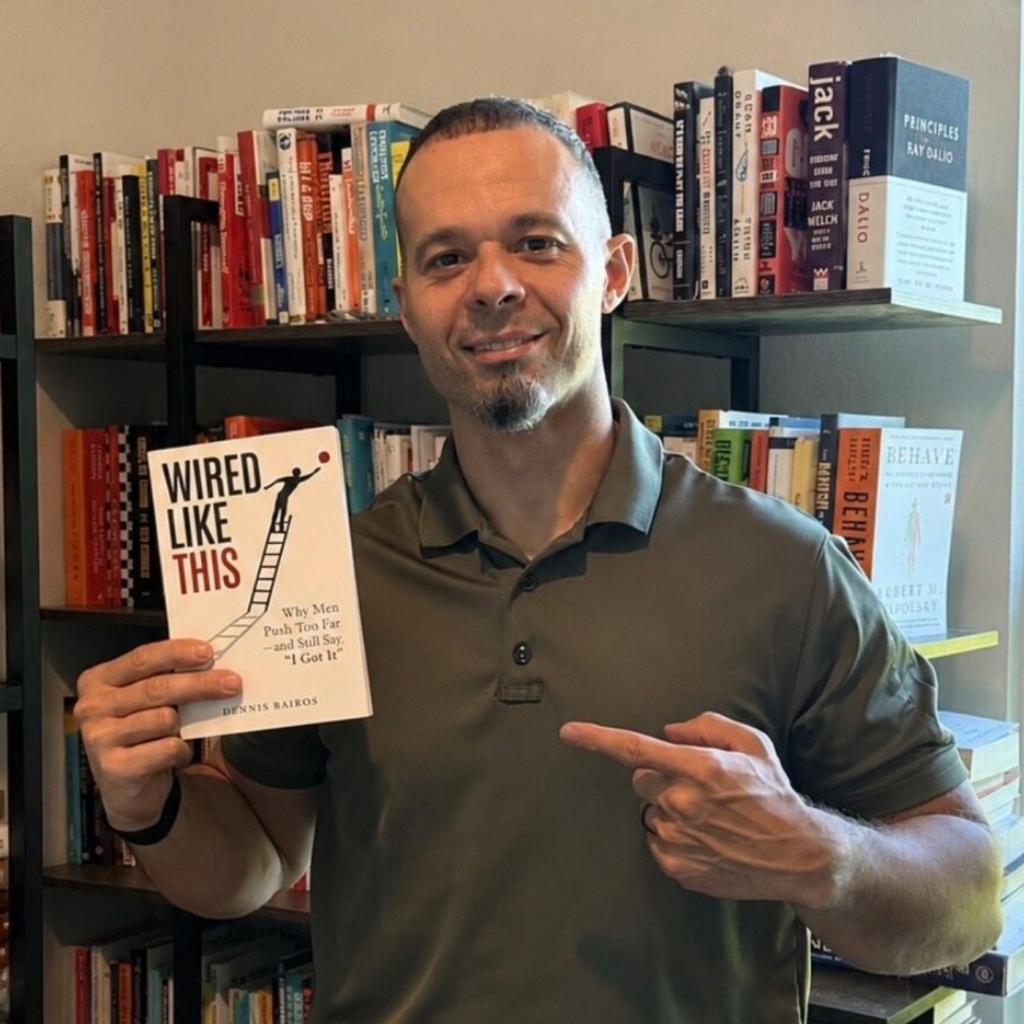
Dennis Bairos oversees more than 29 fitness locations across Texas, and somewhere between the grand openings and the late-night emails, he noticed a pattern: he was the guy who’d rather miss a flight than admit he needed help, the coach whose sideline energy made his own wife ask if he was okay, and the traveler who’d rather squeeze in one more phone call than let 20 free minutes in a rental car go to waste.
That pattern became his book, Wired Like This: Why Men Push Too Far and Still Say, I Got It!, a look at the small, everyday decisions at home, at work, and on the sideline of a kid’s game that shape how men actually behave, often without them noticing.
We talk about why “I got it” might be the most dangerous phrase a man can say, the difference between healthy work ethic and ego-driven burnout, why men go all-in on a hobby and then abandon it completely, and how his wife became the one voice who could see what he couldn’t.
Watch this episode
In this episode
- Why “I got it” might be the most dangerous phrase men say, and the ego hiding underneath it
- How Dennis’s competitive, all-or-nothing wiring showed up coaching his kids’ T-ball team, and the moment his wife had to tell him he’d gone overboard
- The real story behind missing a flight because he couldn’t stop multitasking, even for a 20-minute drive to the airport
- Why work ethic can be a genuine skill and a trap at the same time, and how to tell the difference before it becomes burnout
- What’s actually happening when a man goes all-in on a hobby, buys all the gear, and then drops it completely a year later
- How framing “asking for help” as the next level of leadership, instead of a weakness, changes the way teams operate
- Why a leader’s pace becomes part of their identity, and the hidden cost that pace puts on everyone who reports to them
Timestamps
- (00:01) Welcome and guest intro: meet Dennis Bairos, author of Wired Like This
- (00:57) His background in high-growth fitness leadership, and how that pace carried over to parenting
- (03:51) “Stop half-assing it”: the moment Dana’s own son called out her push, push, push mentality
- (05:54) Is “I got it” a male trait, or does Dana see it in women too?
- (08:38) The fear of slowing down: work ethic, ego, and the competition to be first in, last out
- (12:06) The missed flight: a real-time example of multitasking costing more than it saves
- (14:55) Why “I got it” might be the most dangerous thing men say
- (18:25) Reframing asking for help as the next level of leadership, not a weakness
- (22:13) What his wife saw in his coaching that he couldn’t see in himself
- (24:52) The T-ball season that revealed his coaching had gone overboard
- (27:13) Why men go all-in on a hobby, then drop it completely
- (33:22) The airport conversation that changed how he leads: why a leader’s pace becomes their identity
- (36:53) Where to find Dennis, his book, and his Instagram
About Dennis Bairos
Dennis Bairos is the author of Wired Like This: Why Men Push Too Far and Still Say, I Got It! A husband and father of three, he oversees more than 29 fitness locations across Texas as a senior leader in high-growth, high-volume organizations. He writes about the small, everyday decisions at home, at work, and on the sideline of a kid’s game that shape how men actually behave.
Connect with Dennis on Instagram or LinkedIn. His book, Wired Like This, is available exclusively on Amazon.
Favorite quotes
“I got it” might be the most dangerous thing men say. —Dennis Bairos
“When your pace becomes your identity, the people who follow you don’t just see the results — they see the costs.” —Dennis Bairos
“You will be more successful, and looked at as someone that’s admired a little bit more, because you took that extra step and showed courage to ask for help.” —Dennis Bairos
Resources mentioned
- Wired Like This: Why Men Push Too Far and Still Say, I Got It!: Dennis’s book, available exclusively on Amazon
- Dennis on Instagram: @keep.the.edge
- Dennis Bairos on LinkedIn
Subscribe & connect
If this episode gave you something to sit with, follow Phoenix and Flame so you never miss an episode: all apps in one place, or jump straight to Apple Podcasts, Spotify, Amazon Music, or YouTube. And if it moved you, leave a review; it’s the easiest way to help another listener find the show.
Learn more about Phoenix and Flame, connect with Dana, and listen to more episodes here.
Ready to find your own voice on stage? Dana’s a big fan of Mic Drop Academy, a public speaking and group coaching program built for women. Watch the free webinar, join a workshop, or dive into the bootcamp to build the confidence to speak up and be heard. (These are affiliate links — Dana may earn a commission at no extra cost to you.)
Read the full transcript
[Dana] (00:01)
Welcome, friends. Whether you’re out on a walk, running errands, or relaxing at home, it’s wonderful to connect with you. Joining us today is Dennis Bairos. Dennis is the author of Wired Like This: Why Men Push Too Far and Still Say, I Got It! He’s a husband, a father of three, with a background in senior leadership. He writes about the small, everyday decisions at home, at work, on the sideline of a kid’s game, that shape how men actually behave. Dennis, welcome to Phoenix and Flame.
[Dennis] (00:47)
Yeah, thanks for having me. Guilty — yeah, all of that’s correct. I did write that book. Happy to be here, and looking forward to the conversation.
[Dana] (00:57)
This is fantastic. First of all, I’m interested in a bit of your background. You said you were in senior leadership — since I do a lot of work in the corporate space, helping people with burnout, that was one of the things that drew me to you: the masculine, the male mindset that could possibly trip somebody up at work. I work with high performers, and they say the things that are in your book. So I want to create some space for you to share — what experiences have you had in senior leadership, what have you noticed there, and also with your family, and how these things helped you arrive at writing a book?
[Dennis] (01:47)
Yeah, so I’ve been in the fitness industry for quite some time — practically my entire career. Most of the organizations I’ve been with, including the current one, have been really high-volume, high-growth companies. I currently oversee over 29 locations here in Texas, big-box fitness spaces, so really rampant growth. Most of my career, I’ve had to move pretty fast — it’s nonstop. I’ve had to work a lot, and most of it is self-induced, just me trying to keep up and trying to be a high performer myself. I think that’s natural for me — I’m a natural leader, so I’m always taking probably more ownership than the average person. And that’s carried over to my family and my children.
I noticed early on that I brought that over to my kids as well. Once they started getting into youth sports, that drive, that push, the long practices, the long hours — it’s funny, on a podcast last week I was asked, “do you feel like you’re bringing over your own competitiveness from your past as a child competing in sports?” And I thought about it for a second — I don’t think so. I don’t have this unsettled, failed athletic career I’m trying to settle through my children. I think it’s just natural for me to push, to teach kids that if you want to get better at something, you’ve got to keep practicing, keep moving. I’m kind of an all-or-nothing person. I don’t watch many sports, but the ones I do, I’m all in, a diehard fan. That’s really how I run my life — it’s very much natural.
[Dana] (03:51)
I love this description. I’m taking notes as you’re talking, because I don’t want to interrupt you. I’d like to be able to say the same — no, I’m a very competitive person. I get bruises playing musical chairs, and that’s not hyperbole — I literally had bruises from my shoulders to my ankles playing musical chairs one year at a fall festival at my church. So I’m thinking of the phrase, “if you’re not bleeding, you’re not playing.” I have three kids as well, and my husband is also a very competitive person. And my youngest son confronted me, appropriately so, one time — I’d said to him one too many times, “stop half-assing it,” and he called me on it. I feel like it was appropriate, because I was so in my own head about push, push, push, push, and he’d had it — I’d gone too far. I think that’s a lot of what you’re talking about in your book, and I want to hear more.
Your book is focused on men, and I want to ask — if your experience has been, not necessarily with your daughter, but with coworkers, friends — do you feel like this can be a personality style? Have you run into men who didn’t have this “I got it, I’m not going to use GPS, I’m going to figure this out” kind of drive? How much of that do you feel is a male trait, which I think a lot of people would agree with, and have you seen these traits in some of the women you’ve interacted with as well?
[Dennis] (05:54)
Certainly. From a female perspective — my wife and I, the dynamic between us — my wife works incredibly hard, works remote, homeschools all three of our children, works out every day, but she’s got this self-regulation in her that I don’t seem to have, or at least mine doesn’t work the same way. She’ll come up with reasons to sleep and the need for sleeping, and I come up with reasons not to sleep. Even though I have a fitness-minded background and know the importance of it, for whatever reason, I can’t seem to sleep past 6 a.m. on a Saturday. So I see similarities across the board.
What’s interesting is when I released the book, I started getting calls and texts, or I’d run into people — men who I’d think have completely different personalities from mine. Guys who don’t have children, don’t participate in sports, aren’t ultra-competitive — they’d read my book and tell me, “we’re a lot alike.” I found that interesting. There are so many patterns and similarities, whatever it may be, male or female — I’m focusing on the male perspective because that’s who I’m mostly around, but at the surface it may look a little different, while deep down there are drives in people that are very similar.
[Dana] (07:37)
I get that. You pointed out something in your book I thought was really interesting, especially given my exposure to high performers — I’ve had them in my office on FMLA, having panic attacks, because they just push, push, push and don’t know how to set boundaries. I’m known as the Queen of Boundaries, and they didn’t know how to set them, they were just pushing. There’s this idea in your book — this feeling that if you slow down, if you’re not the first one there, not the first one with the answer, if you bring it down from 85 miles an hour to 55, you’re simply going to lose out, someone else is going to get there first. I think that’s such a common experience. Tell us more about your experience with that, people you’ve seen, and what’s in your book about it.
[Dennis] (08:38)
Yeah, I can offer two perspectives. One is, as I grew up, work ethic was, and still is, really my main skill. I think that for people like me, we believe that if you work harder than most people, you’re going to be much further ahead. I think that can be true in many cases, and it carries on naturally for me. The other side of it is the ego and the pride — I think that still exists in so many pieces of business and leadership. When I travel a lot for work, and we do grand openings for new locations, there’s a lot of executive leadership there, peers of mine, and there’s almost this competition of who’s going to leave first, who’s going to stay later. It’s so silly, but it drives people — who’s going to be the first to leave, who’s going to be last, who’s putting in longer hours. I think that exists, and subconsciously it fuels exactly what we do in some cases.
So I think work ethic is still a main skill, a trait that carries most people further than others. And there’s a lot of talk and a lot of opinions being thrown around about younger generations and how their work ethic is lesser or whatnot, so I think it’s even more amplified now, trying to show younger generations that you do need to put in the work. But you’ve got to find the balance, and avoid that hot word: burnout.
[Dana] (10:40)
That’s a big deal. I love the word “balance,” because that’s it, in a big way. It’s sort of like if you go too far with push, push, push, push, you’re going to burn out if you add too many things. But on the other hand, if you don’t have some kind of work ethic, then yes, other people are going to perform better than you, and they’re going to get the raises, the promotions — that’s just how life works. It’s trying to find that balance.
You mentioned something in your book about the cold plunge, and I love this example. I’d like to hear you talk about how we sometimes add things like that, thinking, “this is going to give me the edge, this is a good idea” — and there’s always another good idea around the corner. I’m interested in your thoughts about the short game versus the long game, because in terms of burnout, how many things can we add that make us look fantastic in the short game, but we’re not going to last long doing all of that? What was your experience, and your thoughts, on the cold plunge and cracking that ice outside?
[Dennis] (12:06)
Well, I’ll give you a great example — I do write about this. I consider myself not a professional multitasker, but certainly someone who just lives on that most of my days and weeks. I’m conscious about it — I’m like, hey, Dennis, you’re doing too much, you should stop. But I’m just wired like that, where I have to find every opportunity to use up my time. Not long ago, I was traveling for work, heading to one city for an interview, then right back to the airport to another city, where I’d be for a couple of days. I’m in the rental car driving to the airport, and I thought, I’ve got about 20 or 25 minutes, I need to make a couple of calls. When I’m in work mode, there’s no podcast, no music — I’m just trying to find every single thing I can do throughout the day. So I take two calls, pull up to the airport, disconnect the Bluetooth, put my headphones in, wave the rental car woman off, start walking to the terminal.
I get to TSA, grab my briefcase, and I’m like, wait, where’s my carry-on? I left it in the car. I’m walking back, finally finish my phone call, of course — call my wife, let her know. I said, “hey, I left my carry-on, just a heads up.” She’s like, “are you going to make it?” And without a doubt, I’m like, “yeah, I’m going to make it, it’s only a five-minute walk.” I get back and the car is gone, nowhere to be found. I’m sitting there waiting, waiting, waiting. That’s a mistake I often make, and I’ll reflect on it, but it’s sometimes hard to peel back — the multitasking, trying to cram everything into every minute. It cost me: I missed my flight.
[Dana] (14:16)
Oh my gosh, that is such a useful and practical example. I’m sure listeners right now, or viewers on YouTube, are thinking, “yeah, I’ve done that, I know what that’s like” — like spinning so many plates that they just start dropping. You write that “I got it” might be the most dangerous thing men say. Talk about that — what do you mean, and why do you feel like that could be the most dangerous thing men say?
[Dennis] (14:55)
I’ve seen it in a couple of different ways. Interestingly, I actually had somebody come to me after reading my book, thinking the “I got it” phrase was something different than I intended, but I’ll expand on that. I think there’s certainly a lot of ego that plays into it, and there’s a sense of security for others. For example, my wife, since we moved to North Texas, has become this expert storm tracker — I’m not even kidding, the minute we got off the plane and had our first thunderstorm, she started following all the experts. It’s funny, because she knows way more about storms than I do now, yet she’s still much more bothered by it. I ignore all of it — if it’s going to rain, it’s going to rain, we’ll deal with it. So I’m naturally the person who says, “we’ll deal with it when we get to it, it’s not a big deal, we’ll be okay.” Sometimes I say that without even consciously meaning to — it’s just a habit for me to repeat back. Same thing with traveling a lot — I write about this in the book — I’ll think, “hey, I’ll make my flight, when I get there, I get there, it’s no big deal.” I say that naturally, and I think it hurts me sometimes, for sure.
The other side of it, and the perspective somebody pointed out to me, is more of a growth-mindset miss. I think people, especially in the leadership world, feel like they have to put out that they have all the answers, all the solutions. So I hear a lot of guys say “I got it,” meaning “I understand the objective, I understand what I need to do” — and it’s really not happening. I think they’re sugarcoating what’s actually going on, and they’re afraid to say, “hey, I don’t actually have it, I need more clarity on this, I need to learn more about this.” So it can hit in a couple of different ways, and I’m seeing that in leadership a lot as well.
[Dana] (17:26)
That makes a lot of sense, and I’ve seen this too, heard people talk about it — this fear of admitting they don’t know how to do something, because if they admit that, that’s failure, and they might be passed over for a promotion, someone else might get ahead of them. I’m wondering if you have any insight on how we could create an environment in the workplace that would allow men to admit, “look, I’ve got this part on lock, but I don’t know much about this part over here — can we team up, can you help me?” What are your thoughts on phrases, words, an atmosphere that could move things in a better direction?
[Dennis] (18:25)
Yeah, what I try to do, especially as a leader and also as a father, is explain: hey, I expect you to be as resourceful as you can. I admire that, and you’re going to get a lot of credit for being the person who just figures things out and doesn’t always have to ask for help. You’re going to be more successful than the average person if you do that. However, when you get to the point where you can’t figure it out anymore, where you’ve exhausted the resources, you have to be able to pause and think, “who else can I reach out to, what kind of expert can I go to?” That’s the next level. Framing it that way — that you’ll be more successful, more admired, because you took that extra step and showed the courage to ask for help — has helped others in my field, and with my children as well.
[Dana] (19:38)
I love this example. I’m thinking about how teams work, from a psychological perspective — that could even offer an opportunity to lift up a teammate and help them feel like they have something to contribute, something you need, because you’re going to them saying, “hey, I feel like you’re an expert in this area, I’m not — can we have coffee for twenty minutes and let me pick your brain?” That seems like it would really help the whole team environment, help everyone feel a little more appreciated and acknowledged for what they know.
[Dennis] (20:17)
Sure. Yeah, I use the term “level up” a lot, and being a difference maker. Framing it that way — most people are going to do what you’re doing, they’re going to figure it out, do all the research they can, but once they get to the point where they can’t do it anymore, that’s where the next level up happens, that’s where changes really start. And also explaining that the pride sitting in the way, thinking “if I go to this person for guidance, they’re going to think of me as lesser or weak” — trust me, they’re going to be thinking more about how good it feels that you went to them. So it’s a mindset shift, and it’s been a key unlock many times in my career.
[Dana] (21:12)
As you’re explaining this, I’m thinking about the word “balance” you used earlier, and about different personality styles on teams. On one end you have someone with a lot of pride who’s afraid to admit they don’t know the answer — after a while, you can’t trust that person, because you know they’re going to go too far, they’re going to say “I got it” when they don’t, and you’re wondering when that’s going to play out in front of a client. On the other end, you have people who won’t ever take initiative, maybe because they lack confidence, and they’re always asking “how do I do this,” very dependent on those around them. That doesn’t work either. So I love the balance you’re talking about.
Now, your wife is a recurring voice in your book. What do you think she saw in you that you couldn’t see?
[Dennis] (22:29)
It’s interesting — she often calls me a unicorn, and when I came up with the idea for the book, she said, “Dennis, this isn’t going to hit home with anyone, you’re unique, I don’t know anyone like you.” I was able to convince her otherwise, because I’ve had so many people respond saying, “I’m just like you, I do the same things, maybe a little differently.” She only sees what she sees. The biggest part I got from her was centered around the youth coaching piece — she was able to bring to light that I visibly appeared more bothered coaching my kids than other coaches did. We’d get in the car, and she’d say, “are you okay? I could tell you were pacing, getting louder than you normally do — you’ve got to chill.” I’d brush it off at first, but it continued, and it kind of snowballed into other stories.
I’m so passionate about coaching, leading, sports in general, and developing children, that I would have just kept going in that direction — to me, it was normal. I see an opportunity to coach a child, I do it. I see an opportunity to address a referee, I do it. That’s what I signed up for as head coach, that’s my job. She was able to frame it differently for me: “look, you’re acting a little different than other coaches.” That’s probably been the most impactful thing for my life, and my parenting — she was able to offer that lens.
[Dana] (24:30)
When she was making that observation, what do you think she was actually observing? You said she said you act different from other coaches, that you seemed more bothered — with some hindsight now, what do you think was going on with you that was causing those behavioral changes she noticed?
[Dennis] (24:52)
Starting off with, say, T-ball, five or six year olds, maybe a little younger — I noticed most coaches were very hands-off, just high fives, “you’re doing a great job,” very little direction given, which is fine. But I started to notice children who signed up for T-ball would give it a year and not come back, because very quickly in baseball and other sports, kids get exposed — they’re a step behind other kids, and it’s not fun anymore because they’re not playing well, they’re getting embarrassed.
I spent a lot of time with my kids playing in the backyard, put in that extra work with them, and saw the difference. Parents started coming up to me saying, “how much does your kid practice, they seem like a natural” — and I’d get offended, I’d say, “my kid’s not a natural, I know where he started, I put in the extra work with him.” I saw the difference between a child who just goes home and doesn’t practice and one who shows up for practice once a week. So my first year of coaching, that carried with me — I continued to be that coach who provided more development, more direction, constant feedback. But then it started to go a little overboard — raising my voice, not necessarily at the kids, sometimes directed at the environment or the other coaches. I saw it work for my child, and it just naturally progressed. That’s when she started to notice, “hey, I think you’re going a little overboard.”
[Dana] (26:56)
That makes sense, I totally understand that. So to that point — thinking about coaching as a hobby, or other hobbies men get involved in — what do you think is actually going on when a guy goes all-in on some hobby? We all know guys who go all-in on some hobby for a few years, buying all the stuff, looking it up online, all the things, and then they just drop it. All of a sudden, they drop it, and now there’s a garage full of equipment, all this time and money allocated. What’s going on at that point, when you see a man doing that?
[Dennis] (27:47)
For me, the reason we go all in is it becomes an identity — this is who we want to be. I think it’s a way to stay competitive, a way to latch onto something. Once you realize this isn’t the identity you want anymore, or it’s not working, you completely drop it — it’s almost like you want to forget it ever happened, and you latch onto something else. There’s some competitiveness to it, some drive — you start a new hobby, you see where you can get to with it. But for most, I think it’s an identity thing: I want to be the golfer, or the car guy, or whatever it may be. That’s mostly where it comes from.
[Dana] (28:50)
So then why do they just automatically stop? What happened to that need to identify with it?
[Dennis] (29:00)
Again, for me, it’s realizing it’s either not working, or it becomes something you feel you failed at — you never got to the level you wanted to be. For example, with golf: I started golfing myself, and my son naturally picked it up. As soon as I realized this wasn’t going to be something I’d do for a long time, or reach the level I wanted to, and now my son’s into it — it automatically changes, now it’s about my son. So I think it’s a little bit of giving up, realizing this isn’t going to be something I’m going to be amazing at, so why not cut ties with it now. It loses its luster — it’s not as sexy as it was in the beginning.
[Dana] (29:57)
It’s not as novel anymore.
[Dennis] (29:58)
Right — and maybe also, reminders from the wife that you’re spending too much money on something, that you’ve gone overboard, help too. So I think for me it’s mostly that I’m not getting to where I initially thought I would, and so why don’t I cut ties.
[Dana] (30:20)
I can totally understand that, and again, back to balance — I can see how in some instances that makes total sense, but in other cases, if somebody had a habit of doing this over and over, with an expectation of themselves as being “a-plus” at something, the whole perfectionism thing — if they’re not a-plus, they won’t have anything to do with it.
[Dennis] (30:45)
Yeah, well, and then there’s also my obsessive personality and nature, where I want to be an expert at whatever hobby I have. I mention in the book that I was a wannabe wine connoisseur at one point, pairing meals and all these things, and fast forward a couple of years, I don’t even drink it anymore. But at the time, I was really excited and passionate about it, wanted to learn everything about it. So I think that initial burst of energy that goes into learning something new is what carries on and creates the habit, or the obsession, or whatever it is. I don’t know if it’s like that for most, but for me, for sure, it’s that initial burst of energy that also triggers the all-in approach.
[Dana] (31:42)
As you’re explaining that, I have an observation and a question. The behavior pattern you’re describing, being drawn to something novel, wanting to learn something new — that’s very common for people with higher levels of intelligence, because they learn quickly, then get bored easily, and want something new. That’s fabulous, but I’m also trying to lay that over the business realm. What’s your experience been with men and how they can satisfy this need to learn more, to do more, this wiring toward pushing, without burning out? How do they find that balance when they’re in a workplace, in leadership, maybe smarter than the average person in the room, or in a room full of very smart people, and wanting that novelty — how do they not take that too far, set that boundary? And along the same line, what if their employer wants them to stay in one particular area because they’re fantastic at it, and they start getting burned out because they want something new? What’s your experience been with men along these lines?
[Dennis] (33:22)
I’ll comment on your first point. It’s a little easier in leadership to reflect on this, but one of the biggest lessons I’ve had over time — I used to be the guy sending out emails at midnight or 4:30 in the morning. I still occasionally do, not intentionally, just catching up, or getting up early. What most leaders don’t realize is the impact that has on the recipient of that email — some are going to think, “my boss is emailing me at midnight, now I need to respond.” One of the biggest learning lessons I had was at an airport one day — I often talk to other business travelers, and that day I happened to be on a midday flight, which I almost never do, usually a 6 or 7 a.m. flight, I don’t like flying anything later than 9 a.m., it feels like I’m losing time. I started chatting with a guy and said, “I normally do early morning flights,” and he looked at me and said, “I never do early morning flights — I used to, when I was younger.”
We got into a conversation, and he basically told me that, especially as a leader, when your pace, your work ethic, becomes your identity, the people who follow you, who work for you, don’t just see the results — they see the costs. They start to internalize, “I don’t know if I want to do what he does, I don’t know that I want to be sending emails at 4 a.m., jumping on a plane at 6 a.m. every Monday.” That had a profound effect on me, realizing my pace was potentially putting a damper on others, especially the people who report to me — I don’t want them to feel like they have to catch up. That’s been a huge shift for me.
As for the novelty piece — I do move on from things pretty quickly, but I have seen others who want to move from one thing to the next, and I can say that I do complete my work, complete my projects. I put excellence and doing things well over quantity, so I’m not someone who wants to move on to the next job or anything like that — I truly want to master my craft in whatever environment I’m in now. But I have seen several people who want to move from one thing to the next.
[Dana] (36:13)
Yeah, again, back to balance, trying to figure that out — it’s a minefield sometimes, and it’s about choices, figuring out how to do it the right way. We are unfortunately out of time today, but Dennis, I know the listeners and viewers want to know how to get a hold of you, how to learn more about you and your book. And since I have the book right here, I’m going to show it — anyone on YouTube will be able to see this. I love it. So, is there a website you’d like them to visit? How would you like them to access you?
[Dennis] (36:53)
The best way would be Instagram. It’s funny — before I wrote my book, I hadn’t done a Facebook post in seven years. I naturally don’t have a large audience, I was very rarely on social media, just focused on parenting, work, and taking care of myself. Then I wrote the book and realized I’ve got to market this thing, so I started an Instagram page, and I’ve been having a lot of fun with it, trying to keep it light and post content that adheres to a lot of different audiences. It’s “keep the edge” on Instagram — keep dot the dot edge. That’s the best way to find me. And the book is available exclusively on Amazon, so that’s the best way to catch me.
[Dana] (37:53)
Fabulous, got it. And that’s all going to be in the show notes. Dennis, I really appreciate you spending your precious time, your knowledge, your wisdom, your experience, your stories with myself and all of my listeners and viewers. Thank you very, very much.
[Dennis] (38:12)
Yeah, thank you so much for having me, and appreciate your time as well. Take care.
[Dana] (38:16)
Now, listeners, viewers, I know you’ve heard multiple things today that made you think, “I have a friend, a family member, a coworker who needs to hear exactly what Dennis is saying.” Take this podcast episode, copy and paste the link, send it in a text, send it in an email, post it on your favorite social media sites, so we can grow our Phoenix and Flame community and let people know: you are not alone. I hope your day has been great. I hope the rest of your day is fantastic. I’m Dana, on Phoenix and Flame.
Are your work boundaries supporting you—or quietly draining you?
Take my free Work Boundaries Quiz and find out where you stand.