First aired November 4, 2024
My guest Kim Mosiman was trying on dresses for a wedding, couldn’t find a single one that fit, and did what a lot of us have done: sat in the dressing room and cried. “How did I get here?” she remembers thinking. “How did I get to this place where I couldn’t choose what I wanted to wear?” If that sentence just landed in your chest, you’re exactly who this episode on reclaiming your health is for.
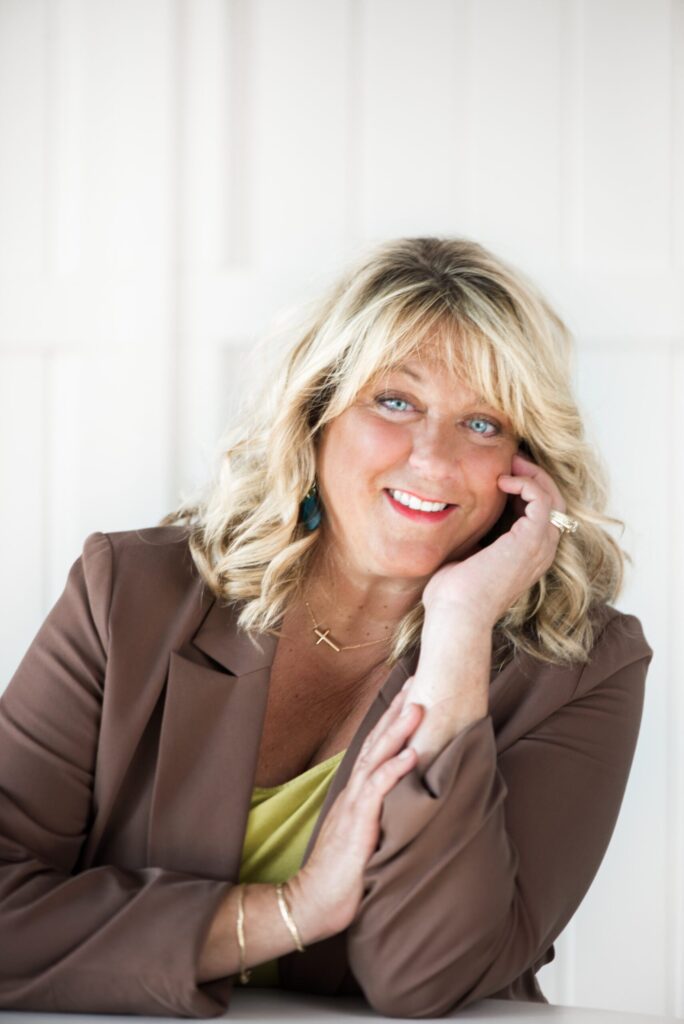
Kim is a nutritionist with certifications from Precision Nutrition and the Institute of Integrative Nutrition, and the author of Reflections of Joy. She’s also, as she puts it, smack in the middle of her own second act: her kids are grown, she closed the boutique gym she ran for seven years back in 2017, and in 2021 she and her husband sold the business they’d built together over 34 years. In between, she became her own client again, gained the weight back, and had to relearn everything she used to teach. We talk about what she found on the other side of that.
You’ll hear Kim’s small, unconditional daily checklist for a healthy second act (it’s shorter than you’d think), her batch-cooking trick for getting dinner on the table in under 15 minutes, and the difference between body positivity and what she calls body responsibility, a distinction worth sitting with no matter what decade you’re in.
Watch this episode
In this episode
- Why “how did I get so caught up in a life full of checklists and expectations?” hits so hard, and Kim’s much smaller replacement checklist
- The dressing-room breakdown before a wedding that led Kim back into a fitness program, “if I can’t do it, I’ll quit”
- Non-scale victories: the progress the mirror and the scale can’t show you
- Body responsibility vs. body positivity: why every body is beautiful, and every body still deserves care
- The batch-cooking routine that turns “I don’t have time to eat healthy” into dinner in under 15 minutes
- Kim’s book chapter “Let Go”: releasing expectations, status quo, and fear to write your own second act
Timestamps
- (00:01) Welcome and guest intro: meet nutritionist and author Kim Mosiman
- (02:06) From overweight and “too busy to exercise” to opening her own boutique gym
- (06:58) The dressing-room breakdown before a wedding: “how did I get here?”
- (09:33) Her book Reflections of Joy: learning to love the woman you see while becoming who you’re meant to be
- (10:18) Non-scale victories: what the mirror can’t show you
- (11:09) Closing the gym, becoming her own client again, and gaining the weight back
- (15:32) Kim’s small, unconditional daily checklist: water, movement, real meals
- (19:39) “How did we get so caught up in a life full of checklists and expectations?”
- (21:05) Her book’s final chapter, “Let Go”: releasing expectations, status quo, and fear
- (26:33) Why you have the right to retrain what people expect from you
- (30:09) The batch-cooking trick that gets dinner on the table in under 15 minutes
- (33:33) Body responsibility vs. body positivity: every body is beautiful, and still deserves care
- (35:54) Where to find Kim Mosiman and her book, Reflections of Joy
About Kim Mosiman
Kim Mosiman is a nutritionist with certifications from Precision Nutrition and the Institute of Integrative Nutrition. She ran her own boutique gym for seven years before closing it in 2017, and in 2021 she and her husband sold the business they’d built together over 34 years. She’s the author of Reflections of Joy, documenting her journey of reclaiming her health after years of unintentional neglect.
Learn more at KimMosimanWellness.com, or find her book Reflections of Joy on Amazon.
Favorite quotes
“How did I get here? You know, how did I get to this place where I couldn’t choose what I wanted to wear?” —Kim Mosiman
“I am smaller than I was six months ago. I am stronger than I was six months ago. So who am I to pass judgment on the woman that I am today? She’s still amazing.” —Kim Mosiman
“Body responsibility to me means that no matter what my size, I’m still doing good things for myself so that I can be healthy.” —Kim Mosiman
Resources mentioned
- Reflections of Joy: Kim’s book on learning to love the woman you see while becoming the one you’re meant to be
- KimMosimanWellness.com: Kim’s website and blog
Related episodes
- My Life: The Rewrite!: another guest’s story of rebuilding after the version of life she thought she’d have didn’t happen, right alongside Kim’s second-act reinvention.
- The Courageous Life: Crafting Your Own Terms: more on letting go of the expectations that no longer fit, the exact territory of Kim’s “Let Go” chapter.
- Intentional Optimism: Embodying Hope, Presence, and Resilience: pairs with Kim’s bite-sized, intentional approach to daily choices instead of an all-or-nothing overhaul.
Subscribe & connect
If this episode gave you something to sit with, follow Phoenix and Flame so you never miss an episode: all apps in one place, or jump straight to Apple Podcasts, Spotify, Amazon Music, or YouTube. And if it moved you, leave a review; it’s the easiest way to help another listener find the show.
Learn more about Phoenix and Flame, connect with Dana, and listen to more episodes here.
Read the full transcript
[Dana] (00:01)
Welcome friends. I hope you’re having a fabulous day. I’m Dana and this is my podcast and I am so excited about our guest that we have today. Her name is Kim Mosman. Kim is a nutritionist with certifications from Precision Nutrition and the Institute of Integrative Nutrition, but she is also a woman. smack dab in the middle of her second act. Her children are grown, living lives of their own. She closed her small boutique gym in 2017 and worked with her husband in the service industry until 2021 when they sold their business of 34 years. She thought she was ready to fade away into the sunset, but God had other plans and inspired her to document her journey as she reclaimed her health after years of unintentional neglect. Kim, welcome to Phoenix in Flame!
[Kim] (01:07)
Thank you. I’m so glad to be
[Dana] (01:11)
This is going to be so interesting because you also have a book that I have read, not the whole thing, but most of it, Reflections of Joy that we’re going to bring up and talk about that I have thoroughly enjoyed starting to read. So one of the reasons why I wanted to have you on Phoenix in Flame was because you’re just talking about to so many of us women of where we are in life and what feels like to be here and how we got here and all the baggage, all the things, the expectations and things that have kind of accumulated along the way and what do we do about that? And you just seem to be so real about experiencing all of that. So just kind of start wherever you would like in your story because we’re all going to kind of weave in and out anyway about kind of what you experienced in the past and what you’re going through now. So just tell us a little bit about yourself Start wherever you would like to start.
[Kim] (02:06)
Okay, well, as you mentioned, I owned a gym and I decided to open that gym after I cut the fitness bug. I had been overweight after having two kids and just living life, too busy to exercise, too busy to do all the things. And so I joined a fitness challenge and lost some weight, but I lost more inches and I gained a ton of confidence just because. I could finally do things I had never been able to do before. was kickboxing and I was lifting weights and I felt strong. And I just caught the bug. And with the blessing of my family, I opened a gym of my own, received certifications. I was a personal trainer and a nutritionist. And I tried to mimic that same, wasn’t a competition gym, while it was. People came in, took a picture and went through nine weeks of exercising and nutrition and being a part of a group. And then we took pictures again and there was always a winner. And it was so empowering for me. And I felt like I had finally found my purpose. And I learned how to coach people. I learned how to be a friend, how to be a support. And we do that as women, I think, in our marriages and once we have children. But we don’t always do it in the outside world in our work settings. And so I quit my job. I was working with my husband, so it was easy to quit that and open this gym. And it was so incredible. People would come in in this terrible state of dis-love, if you will. You know, how we get as women, you gain a few pounds or maybe your favorite outfit doesn’t fit the way that it’s supposed to, or you try to lift that 50 pound bag of dog food and all of a sudden realize, oh my gosh, I should be working out. And so they would join the gym, ignore the picture that I was taking. You know, some of them cry while I was taking the picture, just hating who they were.
[Kim] (04:09)
But I could see the value in them and I could see the desire in them and I could see the beauty that was shining through the baggage that they didn’t want to see. So, yeah, it just, I had seven incredible years working with people, seeing what they couldn’t see before they could see it. It’s amazing. As you know, working with people, when they’re in the midst of a struggle, sometimes you see the breakthrough before they do.
[Kim] (04:39)
Um, you know, it’s hard to keep it quiet sometimes,
[Dana] (04:42)
Yeah, you see that potential and they don’t even know what what’s getting ready to come their way. You know, I’m listening to you describe this and I’m I’m thinking of sometimes and I’m just honest on my podcast. I’m just very transparent and real. And that’s just kind of how it is. And I I remember fairly recently, actually looking out the window of my house and there’s a woman that there’s several women actually, then they they walk through our neighborhood.
[Dana] (05:12)
and quite religious about it and I’m very proud of them. At the same time, when I see them, it automatically I get these feelings like you should be doing that. You should go work out. What’s wrong with you? Look at them out there. Look at them out there doing that and you’re not doing anything. Don’t you need to go do something? And then on the onslaught, the mental onslaught begins. I’m just kind of wondering when you’re interacting with the clients that you had in the gym, you know, what you heard from them of what their struggles were and keeping in mind like that, how, how did they finally walk through the doors? Because there’s a difference. There’s like this disconnect between us women. Like you said, we’re can’t pick up the stuff we used to pick up or we’re feeling like our clothes are too tight and we got that bra hangover thing going on or you know, whatever, just trying to walk and our thighs are rubbing and chafing and you know, it’s
[Kim] (06:04)
Mm-hmm.
[Dana] (06:12)
I was at the beach recently and I’ve always had like beefy thighs. That’s just how my body was built. I wondered, know, am I going to be able to walk on the beach this year without my thighs just like chafing and rubbing and you know, the humidity gets up there and then you can’t, they’re just like rubbing off. It’s a thing, right? It’s a thing. We experienced this kind of stuff. And so I was just kind of wondering from your perspective, what kind of mental challenges did you hear from your clients and also how do you think, how do they walk through the doors? What, from your perspective, what actually got them to do the effort to get in their car and drive to the gym and walk through the doors?
[Kim] (06:58)
Right? I can tell you my own experience because I was in that exact place. I had been trying on dresses, had to go to a wedding and nothing fit. And I just sat in the dressing room, finally when I found a dress and just cried. How did I get here? You know, how did I get to this place where I couldn’t choose what I wanted to wear? I had to settle for something that fit. And I cried all the way home. And someone I knew had gone through a program. She had good… Success and so I signed up and you know to be quite honest. I thought I’ll sign up if I can’t do it. I’ll quit and And I didn’t I signed up with a girlfriend sometimes having that person that you have to pick up at five o’clock in the morning helps and We went through the program together, and I had I had been a smoker in my previous life I was six months from my last cigarette when I started this And I was terribly deconditioned. And you just go through it one day at a time. And you eat a little bit of humble pie. I mean, I can’t do what I could do. But quite frankly, everybody in group fitness anyway, they shouldn’t be focusing on themselves, not on what I can do. And after those first couple classes where I noticed that no one was really paying attention to me, it made it easier to go. And I mean that in the very best way. Like no one was looking at me saying, look at that girl. Right. I had an instructor who was very helpful and very encouraging. And I tried to be that same person, but every day that went by where I made it, made it just a little bit easier. And, and in my book, I tried to address those women who are terrified to go to a gym. You know, what can you do first? What can you do to take those first couple steps so that you know, when you walk in the gym.
[Dana] (08:28)
Got you, got you. Understand.
[Kim] (08:53)
you’re not going to feel like everyone’s watching you, right? Because any good person in a gym should never look at you and comment anyway. They should be happier there, just like you said.
[Dana] (09:03)
That’s right. If they’re looking at you having some kind of nasty thoughts, then that’s they’ve got a problem of their own, right? And I’m thinking that’s it. You know, and I wanted to bring up you, the way you describe your book, I thought was fantastic. It’s the course, the title of the book is Reflection, Some Joy. And listeners, don’t worry, I’m going to have this in the show notes. Don’t be concerned if you’re out walking or if you’re on if you happen to be on a treadmill right now as you’re listening to the podcast, it’ll be the show notes. So no worries there. So you can go get Kim’s book.
[Kim] (09:09)
You’re right, shame on them.
[Dana] (09:33)
But how you describe it is learning to love the woman you see while becoming the one you’re meant to be. I just love that because I think so much focus is on how we need to change, what we can do to get better. And not that that’s, I mean, that’s kind of what we’re talking about in terms of being in the gym and that’s fabulous stuff. But I love the way you give equal space to learning to love the woman you see.
[Dana] (10:04)
and the woman you see in the mirror right now. So how did you come about that particular focus and that balance as you were kind of going through the process of deciding to write a book?
[Kim] (10:18)
I saw it every day in the gym, like I said before. People would come in, they’d be frustrated with themselves, they’d step on the scale, that was their only, you know, the only way that they verified their good work is if the scale went down. But I could see them hold a plank longer. I could see them pick up heavier weight. I could see that their pants were baggy on the backside. Things that… that they didn’t know because they didn’t have, you can’t look at yourself in the mirror today and take that snapshot and refer back to it later on, right? Most of us still just look in the mirror and we see the bulge on the backside under our bra, or we see the dimples in our rear. Okay, but you can’t see the fact that the bulge is smaller or that there are fewer dimples, you know? So.
[Dana] (10:49)
Right.
[Kim] (11:09)
So after seeing that and after acknowledging it, and I think helping people overcome and look for non-scale victories, I closed the gym because my husband had slowed down in his work and I wanted to spend time with him. And I really became my client and I slipped into some bad habits and I gained weight. And it’s easy to be fit when you’re an instructor and you’re working out with people and you’re lifting weights with people. It’s easy just to kind of get
[Dana] (11:17)
Hmm?
[Kim] (11:39)
lose those habits of exercise yourself. And I was thin by default. And then after I closed the gym and the habits were no longer there, I gained some weight myself and I caught myself really not loving myself again. And it took, was a long road back, but, and, and just like you said, we can have goals and we can have things that we want to do and we can be in the process of change. But it doesn’t mean that today is bad or that today is not a victory, if you will. As I sit here talking to you right now, I would love to lose some more weight. I would love to be stronger. I would love to be able to chase after my little grandkiddos and not get winded, you know? But that, but I’ve made progress. I am smaller than I was six months ago. I am stronger than I was six months ago. So who am I to pass judgment on the woman that I am today? She’s still amazing. She’s still incredible. She’s still doing the right things for herself. And I think it becomes harder and harder because every day we pick up our phones. And, know, like when I was a girl, you used to get a magazine once a month and that was your comparison, but it was once a month and you’d read it and you’d move on. Now we have these images in front of us every single day. Someone telling how we should do it, how we should look, know, what’s wrong with the world the way it is. Maybe you’re a vegetarian, there’s somebody out there telling you that that’s not the right thing. And I think we just have to refocus on ourselves. And so through the process of learning to love yourself, I hope that women will look in the mirror and really look at themselves, not just do that passing glance where.
[Dana] (13:17)
Mm-hmm.
[Kim] (13:32)
They see that they still might have a double chin or they’re a little droopy here. But instead, because they’ve really looked at themselves and they’ve really loved themselves, they notice that, oh my gosh, there’s my bicep or oh my gosh, you know, my pants are baggy. What a wonderful thing to look at yourself with love instead of as a critic.
[Dana] (13:55)
Absolutely. You know, as I’m listening to you talk and I’m thinking about what you’re saying, I’m thinking about my experience, I’m thinking about other people that I know, other women, their experiences that they’ve shared with me. I’m thinking about how so often that we love ourselves with conditional love. It’s like, I will love myself if or when I’ll love myself if, like you said, I can see a certain number on the scale. or I love myself when I can fit into these pants, or I love my… We set ourselves up very conditionally. And it reminded me of a quote from Carl Rogers, who was a forerunner of psychology. And let’s see if I can get the quote right. It says something like this. The curious paradox is that when we accept ourselves just as we
[Dana] (14:53)
then we can change. And that because the paradox is it seems like we have this long list, this checklist of things that we have to meet before we’re willing to accept ourselves. But the problem is we don’t ever seem to get to the bottom of that checklist. So from your experience, from your own walk and the women that you’ve walked with, what’s most helpful to be able to just away with a checklist and just say, know what, no, I accept myself right now, regardless of anything else. I just, give myself that acceptance and then by extension,
[Kim] (15:32)
I have a different checklist and it’s much smaller and it’s the things that I do unconditionally every single day. I wake up, I promise myself that I’m going to drink water more than anything else. I promise myself that I’m going to move in some way that’s just not up out of bed and down into a chair, whether that’s walking or swimming or lifting weights. I’m going to move in some way that has purpose and the purpose is to be more healthy. I eat three meals and two snacks a day. It’s an unconditional. For me, it doesn’t mean that it’s right for you, but that’s what works for me. I eat more vegetables than I do anything else because I feel better like that. I do eat meat. do, you know, and I write every day. And in that writing, I pray. And those are my unconditionals. So my list is very small and it’s easy for me to check them off and I don’t put time limits on it. If I go for a walk after dinner but all I can fit in is 15 minutes, that’s okay. I’ve satisfied that criteria for me. I’ve taken the things out of my closet that don’t fit because too much of life is a disappointment and so. I wear, the things that are hanging in my closet fit me and they make me look the way that I want to feel. They don’t make me look the way I want to look. I’m trying not to compare. I want to feel pretty when I walk out. want my husband, I want to know that he thinks I look pretty. And I know that that sounds silly. Yeah. You know, and, and so I just taken out the things that can make my life a disappointment
[Dana] (17:13)
No it does not at all.
[Kim] (17:25)
I don’t know. I know that it sounds simple, but so often when I had the gym, people would earn, they’d want to earn their date night or they’d want to earn their pizza on Friday night or they’d want to earn the right to have a drink. That’s not the way life is supposed to be. We’re meant to enjoy life and try to be healthy for the right reasons, not skinny because we want to look a certain way. And I would just encourage people to focus more on what they can do, what they can have, what’s going for them, what they do like about themselves, rather than all the things they want to change or they can’t have or they shouldn’t do. Just that simple switch towards what I get to do rather than what I don’t get to do makes all the difference for me and for my transformation.
[Dana] (18:22)
I love that. I love the way you’re talking about how you go through your closet and you’re just you’re over just being full of disappointments and stuff like that. I wanted to point out that you said that you talked about being in the middle of your second act. I think your book is geared toward and a lot of and a lot of my listeners, you know, we are possibly in that second act. And I think I can only speak for myself, but I one of the things I’ve learned along the way is that I’ve lived long enough to know life goes too fast. You know, I’m a Gen X person and it’s just, it’s too fast and you realize, and nobody got time for that. You know, it’s just like, I don’t have time to be focusing on the disappointing things. It’s just, you don’t It’s not like when we’re 20s and we feel like our whole entire lives are stretched out in front of us. You don’t have that sensation. It’s a different sensation, but I think it can be a good one because it’s like, well, we realize what’s the tedious, silly things, and we’re just not going to mess with anymore. There’s a good drop it. It’s just like, it’s not worth it. Now, you had said something in your book that I was
[Kim] (19:31)
Yep, I agree 100%. No.
[Dana] (19:39)
spoke to me and I made a I checked it I underlined it and then I made a note. So and I wanted to bring it up to get your thoughts. You said how did we get so caught up in a life full of checklists and expectations? And that just like hit me straight in the chest. I’m like if that didn’t explain me right between the eyes when I read that I’m
[Kim] (19:44)
Okay, good.
[Dana] (20:07)
Oh my gosh, that is just caught up in these never-ending to-do lists of, you have to do this and check, check, check, check, check, check, check, check, check, just wrapped up spinning plates, spinning plates, and running around. The note that I put on here was this. I find myself trying to push to the next chapter as opposed to slowing down and absorbing the content of this page.
[Kim] (20:36)
I love
[Dana] (20:37)
that’s what my personality is like to just lean forward, lean forward, lean forward, go what’s in the next chapter, what’s in the next chapter and meanwhile the beauty of this page is escaping me because I’m not being mindful and I love mindfulness. I preach it, I preach it to my clients, my patients but it’s sort practicing it, talking about it, and practicing it are two different things. So was just kind of wondering what what you were thinking of when you were in that part of your book when you were talking about how do we get so caught up in this life full of checklists and expectations.
[Kim] (21:05)
Exactly. The first part of my life was full of checklist and expectations. I think it is for not only women but men. We leave high school and we leave the care of our parents and we move on to our own life and there’s all the things that we want to do, right? But then there’s the burden of existing and being responsible and paying the bills and then maybe you get married and maybe you have kids and… then you want a promotion. And life is just constantly someone else saying, do, do, do, you know, and, you want the experiences, but they go so fast, like you said. And I have the grand privilege to be a new grandmother and watch my sons become parents. And it hit me, like you said, square in the middle of the forehead. how they don’t have a clue how fast this is all gonna go. And they’re gonna blink and they’re gonna be 57 years old and they’re gonna be watching their sons or maybe their daughters someday go through the same thing. Life has moved entirely faster than I ever dreamed it would. And my mom used to tell me every year goes faster and I didn’t believe her. But I’m trying to be more intentional with my time. And part of that is giving up some of the checklists. I’m the key checklist maker now, right? I don’t have a boss. And I’m trying to let go of some things. One of my chapters, the very last chapter, is called Let Go. And I talk about letting go of expectations, and letting go of status quo, and letting go of fear. and really just allowing the second act of our lives to be intentional and full of experiences and certainly not irresponsible. We still have things we have to do, but maybe allowing ourselves a little bit more free space to become who we always dreamed that we could be or explore who we might be, you
[Dana] (23:35)
I love them. Yeah, those new new vistas, new possibilities. There’s a there’s a verse in the in the Bible that says something like our life is like vapor. Here today and gone tomorrow. And it the older that I get, the more I’m realizing the truth of that. And it’s like, if this is the if this is the truth, and I believe it is, then why why get caught
[Kim] (23:40)
Mm-hmm.
[Dana] (24:05)
in nonsensical irrelevant things, but it takes intention for us to be able to cull apart what matters and what doesn’t matter. And I’m thinking about what you’ve said about expectations. And I think doing boundaries work that I do with people dividing up between like self expectations versus expectations other people have of us and kind of challenging both. If someone else expects something from us, what do we feel about that? Do we agree with it or not? And what about, like you were mentioning earlier, those expectations we have for ourself? And getting, like you’re saying, that point in our life where we sort of challenge that and say, okay, is this an expectation that I want to continue to have for myself or not so much? Is that chapter gone and I’d like to move on to something else?
[Kim] (25:01)
Right. And you hit you. It’s like you were eavesdropping on the conversation I had with my husband last night over dinner. The expectations that everyone in my life has for me right now. I created those. I, I created those when my sons were young and my husband was working. We, we owned business and he was working 60, 70 hours a week. The expectations that they have for what Kim will do.
[Kim] (25:31)
was born a long time ago by what I was willing to do during a time of need. And I wouldn’t, I don’t, I don’t begrudge them for those times, but those times are over. And today, you know, there’s two people who live in this house and no one’s expectations have changed, including my own. I, I, my family gathers, I spend my time in the kitchen because I want things to be just right for them because I’m so glad they’re home. What does just right look like? You know, maybe now at my age and they’ve got families and I have grandkids, maybe just right means ordering food in and just playing, you know, just spending time together. Our just right has to change and our expectations for ourselves have to change as we move forward. I just think we have to constantly reevaluate where we are in life and what’s right for us. Just because you chose it when you were 20 doesn’t mean you’re right when you’re 57.
[Dana] (26:33)
Absolutely, 100%. Kim, they just hit the nail on the head. And you brought up another boundaries kind of tenet is that we train other people what to expect from us, which I consider that good news because if we trained someone to expect a certain thing, then that means that we have the ability and the agency to retrain. Of course, that’s difficult, right? Because we’ve trained them to expect A, B, and C. Now we’re going to flip over to D, E, and F. And of course, they’re going to be kind of surprised by that, maybe not very happy about that. But the opportunity, though, is there for us to acknowledge we’re the ones, like you said, that trained them. So I decide this is a new chapter. I don’t want to keep doing that. The dynamic is different. The landscape is different. So I’m going to behave differently. And it’s going to take them a while to catch on. But if we’re consistent with then they will change and we have the right to change our behavior pattern.
[Kim] (27:36)
Yes, I agree. But I think I’m just going to jump in real quick. I think we have the responsibility to be upfront. So many of us get into that place where we’re maybe at an impasse and we just think they should know us. I can’t change who I am and not say, hey, I’ve been thinking about this and I’d like to try this. You know, I always believe that confrontation can be
[Dana] (27:51)
Mm-hmm.
[Kim] (28:05)
pushed to the back burner as long as we’re upfront and honest with the people that we love. So I think if you want to make a change, just make sure you tell somebody.
[Dana] (28:12)
We Yeah, and again, we’re just resonating a whole lot today because that is another boundaries thing is that other people can’t read our mind. And so it’s our responsibility to communicate to them. Like you said, if we’re going to make a change, they don’t know they can’t read our mind. So it’s our responsibility to respectfully communicate that to them. So and you know, we can’t read their mind either. So if they’re upset about something, it’s their job to tell us because we can’t read their mind about that. So the communication becomes amazing.
[Kim] (28:23)
Right. And that happens too when people are trying to change and lose weight. One of the things I noticed a lot in the gym as if one person is on board and making a huge lifestyle change and they don’t bring their spouse or their partner or their family along with them, there’s going to be conflict. So let’s keep everything that is not. And I’m not saying either that if I can decide I’m going to start this new eating plan exercise plan, husband has to do it too. That’s not what I’m saying. But I have to understand that just because I want to change, he doesn’t have to. And we’re still going to be OK together.
[Dana] (29:26)
Got you, got you. That makes a lot of sense. And I’ve heard that before. I’m glad you brought that up. Now I’ve got a question for you. So as a wife, mother and business owner, what would you say to the woman who says she doesn’t have time to cook healthy food and exercise or work on her health because she’s got too much going on and nobody got time for all this other stuff. She can barely stand up and get her teeth brushed and get out the door and come home and fall on her face.
[Kim] (29:30)
Mm-hmm.
[Dana] (29:56)
and she’s running around all this stuff, she doesn’t have time. What do you say to this woman out there who’s spinning all these plates and she says, I don’t have time to cook healthy food, I don’t have time to exercise, I don’t have time to work on myself. What do you say to
[Kim] (30:09)
I would say that we have time for what’s a priority to us. And I would say to most of the people that I know right now, how are you spending your free time? Because so many of us, so many of us go to bed with a phone in our hands and we scroll for an hour’s time and we wake up and they scroll for an hour’s time. Or, you know, lunch break is spent. There are windows of time that we are filling with Gawking these days and watching someone else’s life go by so I do believe there is time now There are those women who are chasing after lots of little kids and still have a full-time job And they still want to go to church and they still want to volunteer and they still want to do all the things I Understand their lives are very busy, but I also feel like there are ways where you can cut out you can you can cook good food But I might cook I might cook a pot roast today knowing that I want leftovers for tomorrow and those leftovers might be fajitas because my husband doesn’t want to eat the same thing the same day. So I think you can be intentional in ways to cut back on some of the everyday necessary tasks so that you can have a little bit of time for yourself.
[Dana] (31:27)
I like that. What I’m also hearing you say in the priorities is like maybe allowing space for meal planning, like, you know, because thinking it out, because what you just said, like pot roast on one day could turn into the leftovers could be fajitas the next day. So just a little bit, if I’m hearing you right, just a little bit of intentional planning can can make so much thing, everything easier. It makes shopping easier, it makes cooking easier, and it makes all that easier, but it just takes a little bit of intentional planning. Okay, what am I going to do and how’s what? And just like 20 or 30 minutes a week can be like really helpful. I think that’s…
[Kim] (32:06)
Well, when my boys were home, I used to spend two hours every Saturday and I would cook three different proteins and I would cut up all the vegetables and I store them in a big plastic tub with white paper towels down to make sure they stay fresh. You know, I just, had, I’d cook rice or oatmeal or beans or something. So when we had those days where everyone was running in last minute and our choice was either to go through a drive-through or order a pizza.
[Kim] (32:36)
Instead, we could open the refrigerator and you could choose, you know, do I want chicken or steak or, you know, taco meat? And do I want it hotter or do I want it cold? On a salad or in a fajita? You know, what do I want? But we could always have dinner on the table in under 15 minutes and we could enjoy it together. And it’s, there’s so many different resources out there on how to bulk
[Dana] (32:55)
Nice.
[Kim] (33:01)
for these young, busy fam and not even young, busy families. I mean, you could be an empty nester and still want the same freedom. So, I just think you have to plan and you have to be intentional.
[Dana] (33:08)
Mm-hmm. I like that. Now I got one last question for you. So in your book, you talk about body responsibility. So how does that differ? We hear a lot about body positivity these days. And where do you stand on the belief that every body is beautiful?
[Kim] (33:33)
I do believe every body is beautiful. Where I struggle with body positivity is not in the sentiment of it, but in the irresponsibility that we can reach any state. Body responsibility to me means that no matter what my size, I’m still doing good things for myself so that I can be healthy, so I don’t become a burden on my family or in the healthcare system. Even if a woman or a man has 100 pounds to lose, they can still be doing things responsibly. They can be walking. They can be making sure that they have regular visits with their doctor. They can be eating good foods and trying to make a difference in their health. just don’t think, sometimes I think body positivity just means I can throw my hands up in the air and I’m good. Yes, you’re still beautiful. Yes, you’re still worthy of all the goodness that the world has to offer, but we have a responsibility to be healthy.
[Dana] (34:42)
I like it.
[Kim] (34:42)
And today, I think that we hear the word. I don’t even know if… There are some very important figures in our world who like to throw out words like shame or I felt terrible about myself or I felt other people looking at me that way. And we can all relate to ways that we feel disappointed in ourselves. But I think that as we start to turn… the page and we start to look at ourselves with love and we start to appreciate the progress that we’re making. We can start to drown out those words like shame and I just, think women need hope. I think men need hope. I think that we have to love ourselves and we have to start making progress towards better things without a quick fix and without a… the sense that other people won’t love us if we’re not a certain way.
[Dana] (35:49)
I think that’s a big thing right there and we could probably talk 30 more minutes just on that topic alone. So Kim, definitely I’m going to put your book Reflections of Joy in the show notes. What is the best way that my listeners can reach you if they want to know more about you? they want to kind of what website is their website you want to send them to? Where can they
[Kim] (35:54)
Yes. Yes, I think Mm hmm. Yep, I can be found at Kim Mosman Wellness Dotcom. My periodic it was hard to write and keep up with my blog when I was writing a book, but there are some new entries in there now where people can learn a little bit more about me. I am on Instagram and on Facebook. It’s just Kim Mosman and try to keep it simple so that people can reach out wherever it works for them.
[Dana] (36:41)
Fabulous, fabulous. Kim, I just appreciate your time today. And for those listeners, you don’t know this, but Kim and I, we were dealing with some technical issues before the podcast even started. And we both, I want to give us both kudos. We were both just patient and we just kept at it and we kept at it. We wanted to make sure that this podcast happened and it did. And I appreciate your patience with that and your persistence and your resilience with that to keep going. Thank you for your expertise, the time that you spent to write that book, to help women out there in that second act of life trying to face things. Thank you for the time that you spent today and the energy that you brought to myself and my listeners. Kim, thank you so much.
[Kim] (37:26)
Thank
[Dana] (37:28)
Listeners, know that you have heard Kim say things today that you’re thinking, oh my gosh, I have a best friend, I have a coworker, I have a family member that absolutely needs to hear what Kim has to say. Please take this episode and copy and paste the link in text and email. Put it on your favorite social media sites so that we can grow the Phoenix and Flame community, letting people know you are not alone. I hope you’ve had a wonderful day so far and that the rest of your day goes fabulously. I’m Dana on Phoenix and Flame.
Are your work boundaries supporting you—or quietly draining you?
Take my free Work Boundaries Quiz and find out where you stand.