
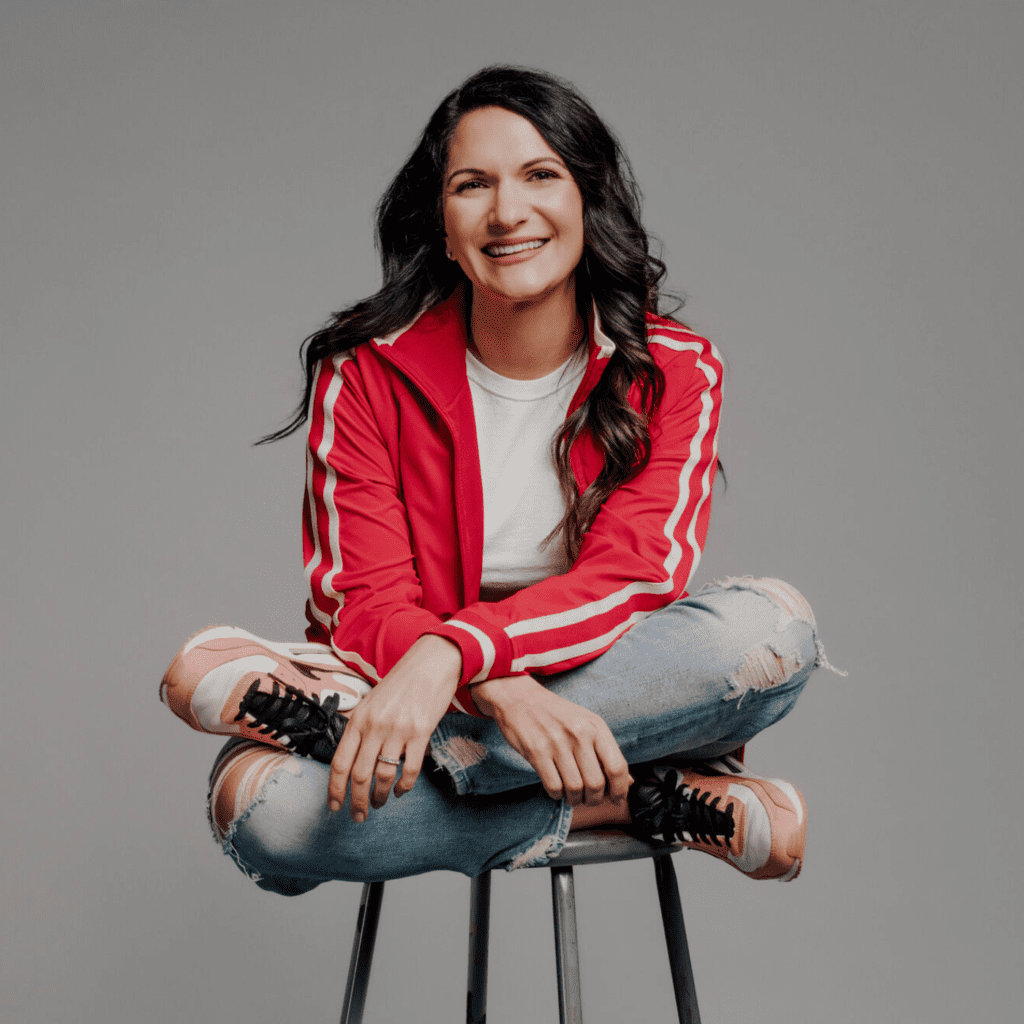
First aired January 11, 2026
Stand in the doorway of a networking event with a thousand strangers inside, and tell me your palms don’t sweat. Mine do. So do my guest Amy Siegfried’s, and she’s spent more than 20 years teaching people how to network with confidence anyway. Amy calls herself a recovering “awkward kid” who tried to buy the right shoes to fit in and it never worked, until she stopped performing and started being honest about what she didn’t know: no friends in a new country, a scared dad back home, zero clue where the grocery store was. Turns out vulnerability, not polish, is what actually makes people want to talk to you.
Amy has built her career around exactly that: corporate networking on a national stage, living and working abroad, starting two companies, and becoming, by her own account and mine, a genuine master of small talk. We talk about why “just start” beats waiting until you feel ready, why networking works better as a relationship than a transaction, and the one question (“what do you do?”) she tells everyone to retire for good.
You’ll walk away with Amy’s go-to icebreaker for any room, the game she plays with herself at giant networking events so walking in doesn’t feel like walking the plank, and a boundaries lesson about her own calendar that changed how much of herself she gives away.
Watch this episode
In this episode
- Why “just start” (a LinkedIn comment, a DM, a simple question) beats waiting until you feel confident enough to network
- The reframe that turns networking from a transactional ask into a two-way relationship
- Amy’s go-to icebreaker to replace “what do you do,” and why it opens better conversations
- How to walk into a room of strangers without wanting to bolt, including the game Amy plays with herself at 1,000-person events
- Why comparing yourself to “the popular ones” in the room is the wrong move, and what actually draws people in
- The boundary Amy put on her own calendar early in her career, and why “someone else’s boundaries are not your boundaries”
Timestamps
- (00:01) Welcome and guest intro: meet networking expert Amy Siegfried
- (01:54) The awkward kid who became a “master of small talk”
- (02:56) Moving to Singapore, starting over, and how vulnerability built her first friendships
- (05:09) An MBA at Notre Dame during COVID, and the classmates who said she made the biggest impact on them
- (07:05) Finding the courage to be yourself when vulnerability freaks you out
- (07:08) Why “just start” beats waiting to feel ready
- (12:24) Networking versus comparison: focusing on the other person instead of your own insecurities
- (17:04) The two-way street: why networking isn’t a transaction
- (19:44) The “popular kid” theory: why comfort with yourself, not achievement, draws people in
- (25:07) What to do when you’re standing in the doorway of a room of a thousand strangers
- (27:41) The one question to ask instead of “what do you do”
- (31:54) The boundaries Amy has learned: “me time,” and why someone else’s boundaries aren’t yours
About Amy Siegfried
Amy Siegfried has spent more than 20 years effectively engaging with millions of people to build confidence, foster connections, and facilitate meaningful collaborations, from corporate networking on a national stage, to living and working abroad, to starting two successful companies. She has also worked as an adjunct professor, teaching students how to build genuine connections instead of hiding behind a text message.
Learn more at Amy’s website, or connect with her on LinkedIn.
Favorite quotes
“The answer is no, unless you ask.” —Amy Siegfried
“It’s not a network, it’s not a business card exchange. It’s a relationship building opportunity.” —Amy Siegfried
“Everyone is good at something. Everyone has something to offer.” —Amy Siegfried
Resources mentioned
- NetworkOfChampions.com: Amy’s list of 45 conversation starters, categorized for icebreakers and follow-ups, built to replace “what do you do?”
- AmyBSiegfried.com: Amy’s website
- Amy Siegfried on LinkedIn
Related episodes
- Curiosity: The Bridge to Connection: pairs with Amy’s advice to ask better questions instead of leading with “what do you do”
- The Art of True Connection in a Lonely World: expands on the vulnerability-builds-connection theme Amy lives out through her own story
- Why Successful Entrepreneurs Set Boundaries: a natural follow-up to Amy’s “me time” boundary and the line between generosity and burnout
Subscribe & connect
If this episode gave you something to sit with, follow Phoenix and Flame so you never miss an episode: all apps in one place, or jump straight to Apple Podcasts, Spotify, Amazon Music, or YouTube. And if it moved you, leave a review; it’s the easiest way to help another listener find the show.
Learn more about Phoenix and Flame, connect with Dana, and listen to more episodes here.
Read the full transcript
[Dana] (00:01)
Welcome friends, whether you’re out on a walk, running errands, or relaxing at home, it’s wonderful to connect with you. Joining us today is a fellow Mic Drop Academy graduate, Amy Siegfried, and I am very excited to have her here. Before we really invite her on, I need to tell you a little bit about Amy. For more than 20 years…
[Dana] (00:31)
…she has effectively engaged with millions of people to build confidence, foster connections, and facilitate meaningful collaborations. From corporate networking on a national stage, to living and working abroad, to starting two successful companies, her experience has honed her ability to become a master of small talk, creating a profound impact. Amy, welcome to Phoenix and Flame.
[Amy] (01:03)
Thank you for having me, I’m so excited to chat with you.
[Dana] (01:07)
This is really interesting, the whole idea of collaborating and conversing and being able to connect with people, it’s really a huge deal. I hear it so much of the time when people are talking to me, whether personally or in my office, they have a lot of hitches in their get-alongs, a lot of anxieties, a lot of these narratives going on in their head that’s preventing them. So let’s just rewind, tell us a little about yourself and how you got to this place where you’re so interested in spending your time helping people make these networking connections.
[Amy] (01:54)
Well, thank you for having me, I’m excited, and I would say to really start off: this was not my bag, right? I started off as that awkward kid, like so many of us are, just trying to do the status quo so I could fit in, like could my mom maybe buy me the shoes that look like the thing they need to be, and that wasn’t happening. This is not something I was successful at, connecting with people when I was younger, and it really started…
[Amy] (02:23)
…slowly but surely as I started being myself, as I worked through my career and started being myself, more people resonated with me and we connected. I’ve moved quite a bit, but I spent a majority of my years, college and post-college, in Phoenix, Arizona. Then my husband and I moved to Singapore, where we had to start all over, new cultures, new people. It was one of those where you kind of get to reinvent yourself because nobody knows who you are, who you were, but also you’ve got to go be you. So once again, when I was myself and vulnerable, and vulnerable doesn’t have to mean talking about our feelings of our youth and breaking down on the couch, vulnerable is saying, “Hey, we’re in Singapore, I don’t have any friends, I’m scared my dad is sick.”
[Amy] (03:15)
“I don’t know where to go get groceries, I hate being here by myself when my spouse is traveling, I can’t figure out the train system and I’m really confused and everyone else has got it figured out.” Whatever that might be. Those vulnerabilities allowed me to connect better with people, because they saw something in me that they saw in themselves. That commonality became something that, when I was vulnerable, we found a commonality we connected with. That was such a huge, mind-blowing opportunity for me: “Wow, people like me when I’m myself, this is strange.” And then we moved from Singapore, and I started my MBA program at Notre Dame, and once again I was probably more myself and more vulnerable than I had ever been in my entire life, because it was COVID, I had a one-and-a-half-year-old, I was traveling back and forth to the Chicago campus every other week to do class for three days straight. So it was one of those where I was like, “I don’t know what’s going on in my own life, let alone you trying to teach me accounting.” The accounting, no offense to accountants, is not my love language, I did not do well in accounting. So I had to ask for help. At the end of our session, they asked people to stand up and talk about the person who made the biggest impact on them in the past 18 months, and I had two people…
[Dana] (04:43)
Did that surprise you?
[Amy] (05:09)
…get up and say it was Amy, and it blew my mind. Two people who were ex-military, big burly guys, it wasn’t that I thought, “Like I said, it was, I was asking for help, I was the most vulnerable I’d ever been in my life. But I also got to have a really good time, I met a lot of new people, we had a lot of fun, I just got to be myself. So that continued to evolve, like, “Wait a minute, me being me, how can I teach people also that…”
[Amy] (05:09)
…they have something to offer? I came back and started being an adjunct professor at two different universities, and I learned, talking to these students, how uncomfortable they were talking to people. They were trying to solve problems via text, saying “I texted him and he doesn’t understand.” I’m like, “Well, how about you guys just sit next to each other, you’re already in class, why don’t you just talk to him and say, this is what I feel, this is how I want to work on this?” And they were like, “Oh, wow, now we’re friends, we’re going to lunch next week.” It’s a simple conversation, but everyone tends to be so uncomfortable, it’s so easy to digitally talk to someone, so easy to text someone. I’m no different, I texted a handyman this morning to work on something, because I didn’t want to pick up the phone and call. It’s so efficient, but it’s also…
[Dana] (05:54)
It’s so efficient, we’re so busy, we’re spinning so many plates, it’s just the most efficient thing. So Amy, let me pause you for just a moment, because as I’m listening to you talk I’ve got a couple of questions, and I’ve tried to jot them down so I wasn’t going to interrupt your flow. My first question is: how does somebody, and I’m thinking of my listeners, the different types of personalities who might be out walking, listening to the podcast right now and seeing themselves in what you’re saying…
[Dana] (06:24)
For the people having trouble finding the courage to be themselves, what would you offer them when they’re just scared to be themselves? And this kind of segues into my next question, they might come together in your answer: what do you feel are the main obstacles to connecting or communicating? Those are two different things, but they’re kind of interwoven. So what about people listening who are just hearing you describe this, and the thought…
[Dana] (07:05)
…of being honest and vulnerable freaks them out, how do they find the courage to do it? And number two, what are the main obstacles to this connection, this networking you’re encouraging people to do?
[Amy] (07:08)
Yes. So I would say just start. I think action is the biggest thing you can do, and that action can look like connecting with someone on LinkedIn, commenting on something they posted on LinkedIn or Instagram, whatever that might be. Maybe it’s someone you love and follow and think is the best person in the world, I don’t know, Selena Gomez, you think she’s amazing, go comment on her photo, a nice comment would be nice, but just comment, just get started. If there’s someone you want to reach out to, just do it. So that’s a small piece: we have to have the confidence, but you’re never going to know what the answer is if you don’t ask. We say that in our house all the time: the answer is no, unless you ask. Those small pieces, and knowing everybody else is doing it, I was talking to someone the other day and they said, “Well, men don’t ask other men for coffee,” and I said, “I don’t know what world you live in, I see guys at coffee all the time, I have guy friends, my husband has mentors, they go to coffee, they go to lunch.” This is not just a female thing to do, people do it all over, maybe it’s not what you’re seeing in your friend group, but people do it all the time. So take that into account, but when it comes to getting started, that might look like commenting on someone’s LinkedIn post, raising your visibility. That might look like, “Hey, I connected with Dana on LinkedIn, she seems really awesome, I’d like to connect, I’d like to learn from her.” So then DM Dana and say, “Hey, I really love what you’re working on, your podcast is my favorite, I listen to it every week on my drive to the office, here’s what I love about it, I’d like to learn a little bit from you, could I have 15 minutes of your time?” You would be surprised how many people will say yes.
[Dana] (09:18)
Well, I was going to just throw in what I love about what you’re saying: it gets people’s focus off of themselves and onto the other person, because I think our anxiety is about our own insecurities and our own failings, and we get so focused on that we can’t get past it. What I’m hearing you say is focus on the other person, what you like about them, wanting to connect with and learn from them, and that shifts our focus away from our own…
[Dana] (09:48)
…fallibilities and weaknesses, to what we like about someone else.
[Amy] (09:54)
Yeah, and I think when we ask people for stuff, we think we’re asking for something big, like they’re going to be indebted to me, or I’m going to be indebted to them. Really, you’re not. Remember, a network, creating this network of champions of people who will say your name when you’re not in the room, that is a two-way street, it’s not one way. If I have a mentor or a mentee, we’re learning from each other. I like to tell my college students, especially because they’re coming into these careers, watching people get internships, watching people on social media do amazing things, and they’re like, “What do I have to offer?” Everyone is good at something, everyone has something to offer. I guarantee if you sat down with Mark Zuckerberg right now, you would have something different to teach him than what he knows. You have an area of expertise he does not have. When you think about it from that perspective, you have something to offer. The way you are right now is perfect, that is the way you are, you’ve had life experiences different than mine, we’ve had different life experiences, you can teach me something about something I have no idea about, we can find things we have in common. We both like coffee, we both like french fries, I love french fries, I’d totally meet you, if someone DM’d me and asked me to go for french fries, I’d be in. But it’s one of those where you’re going to find those commonalities by asking really constructive, smart questions, and not even necessarily smart questions…
[Amy] (11:32)
But it’s like, you have something to offer, you have something to teach me, but also we can find some commonalities we can have a conversation around. Part of that is: when you’re talking to someone, whether on Zoom, on a podcast, face-to-face at a coffee meeting, ask questions, be curious. Put on the “I’m a journalist” hat and ask, “Dana, how did you start your podcast? Why did you start your podcast? What are some of the challenges you’ve seen?” These are just things I might purely be curious about in my head, but that’s an opportunity for us to talk. As Dana talks, I think, “Oh wow, I can connect with her about that, she also struggled with childcare, she also struggled with having to parent her parents, she also struggled with starting a business and feeling like she didn’t know what was going on.” Whatever those things might be, we have these things in common all of a sudden, we can make these connections.
[Dana] (12:24)
So I want to jump in and say, as I’m listening to you describe this and thinking about my experience, thinking about our conversations along the way, when you’re an entrepreneur, and other people too, not just entrepreneurs, but we get hit with it especially hard, you’re leveling up, you want to surround yourself with people better than you are because you want to level up. What we do initially sometimes…
[Dana] (12:54)
…is we compare. So we’re…
[Amy] (13:11)
Okay, hold on, there’s a bug flying around too, let me get it, it’s driving me nuts, I keep seeing it go in the frame, I might just have to start over and we can piece the two pieces together.
[Dana] (14:16)
Okay, all right, so the timer’s still going, so I know you’re going to edit this later, I don’t know what happened, but anywho. Okay, so what I was saying was: when we’re leveling up and end up comparing ourselves, looking at someone and saying, “Oh gosh, she’s so much better than me,” or “he’s so much better than me,” we tend to shy away and not want to engage because of the comparison. What I’m hearing you say is, instead of…
[Dana] (14:48)
…comparing, connect and look for those connection points, those commonality points we have, rather than comparing.
[Amy] (14:51)
Absolutely, I think that’s such a huge thing to remember, you really nail it too. When we’re trying to level up, or network up, remember those people are still human. I might look at someone, and someone might say to me, “Oh, you’ve done these things,” and it’s like, yeah, but I’m still a human, I’m still uncomfortable in my own skin sometimes, I’m still not getting enough sleep, not eating enough fruits and vegetables, whatever that might be, sometimes I want to hang my child by his toes, those are all things we do. We were talking earlier about implementing systems and I don’t know how to do this, do you know? It’s one of those where everyone’s got those things, and I know that’s so easy to say. Also know that part of the job, if you’re leveling up to someone, part of the job of the person “in the up” is to bring people with them, that’s part of what we do. Not everyone thinks that way, but I don’t know many people who would say, “No, I’m not willing to speak to someone who reports to me, or someone at a different level at a job, or a college student.” I’ve never encountered any, well, there’s probably one I can think of, but people don’t do that. So I was kind of thinking of a story that might relate: I have a girlfriend raising funds for a company she started, and she started reaching out through LinkedIn, saying, “Hey, I’m raising my seed round, here’s my company, here’s what we do, would you consider investing in us?” She’s sending these out, personalizing them, and when you think about it one way, she’s asking people for money. But if you think about it from the other perspective, an investor is really happy to have a cool company come across their DMs and think, “Wow, what an opportunity that this person reached out to me, I will definitely give 15 minutes to hear their pitch.” So you can put it in two different perspectives. Put yourself in the other person’s shoes. If I’m the CEO of a company and an intern comes to me and says, “Hey…
[Dana] (16:39)
True.
[Amy] (17:04)
“…I really want to learn from you,” I’m doing something right that the intern wants to learn from me. Put that in their perspective, you can teach them things too. Like I love my college students because I learned so much from them, about trends, what they’re interested in, all the things, because I also want to be slightly relevant, I don’t want to be the person going, “What’s TikTok?”
[Amy] (17:32)
I would like to know what TikTok is, I want to participate, I want to be active in it, I may not be the one doing all the perfect trends, but I want to learn about it. When you really think about that, it’s truly a two-way street, and it’s a mindset shift, and I think people think of networking and building that network as so transactional, when it’s really a relationship-building tool. You’ve made friends your entire life, this is no different. When you think about how you make a friend, you’re in college, say, and you’re like, “Oh wow, you’re in the room across from me in my dorm, you also like, let’s go back to french fries, you also like french fries? Let’s go eat french fries, now we’re friends.” When you really think about it, it’s no different than that, you’re finding one commonality, it may be that you live across the hall from each other, and this is no different, you’re developing these friendships and relationships.
[Amy] (18:25)
It’s not a network, it’s not a business card exchange, it’s a relationship-building opportunity. That mindset shift, to me, is such a huge piece.
[Dana] (18:32)
That’s really a huge piece, I think, because sometimes when people think about the word “networking,” right from the jump they’re thinking, “Okay, I’ve got to get all buttoned up, I’ve got to be perfect, I’ve got to really present my very best face out there, I can’t let anybody see my weaknesses, I can’t let anybody see what I don’t do well, because then they might not like me, they might not want to hire me, they might not want me on their team, I’ve got to be…
[Dana] (19:00)
…this persona of myself.” When really, and you say the opposite is true: when we’re comfortable and own our own mistakes, our own frailties, our own failures, that makes us approachable. We calm down, and the people around us calm down too. Just a second, this is kind of a funny thing, because I’m a psychologist, a psychotherapist, I’ve been doing this for a long time, and I’ve had this in my mind for a while. When I was in junior high, I was actually watching people, watching the ones who were popular, and I would notice that girl over there is more attractive than the popular people, why isn’t she more popular?
[Dana] (19:53)
Or that girl over there has a better body, or better this or that, than the girl over there who’s popular, why aren’t the guys hovering around her instead? And there were people who were richer who weren’t in the popular crowd. So I started watching, and what I figured out…
[Dana] (20:19)
…is that the ones who were most popular, the ones who attracted people like moths to flame, were the ones who were the most comfortable in their own skin. They weren’t the most physically appealing, weren’t the smartest, weren’t the richest necessarily, but they were so comfortable with themselves that everyone around them was also comfortable, and they just drew this network around them. That’s what I’m hearing you say: have that comfort level with our own frailties.
[Amy] (20:35)
Right, and it’s true, and I can’t say that always comes naturally, it’s really been a practice for me. I’ve been in a career for 20-plus years, and it didn’t start that way. I would sit in meetings with a piece of paper and someone would say some word and I’d write it down in tiny font at the bottom, like, “I’ve got to go look this up when I get back.” What I should have done was probably say, “Hey, after the meeting…
[Dana] (21:13)
Yeah.
[Amy] (21:18)
…I’d really like to learn a bit more about, insert word here, can I come to your office and talk to you about that? I just want to learn, it doesn’t have to be anything right now, but I’d like to learn about that.” I always was afraid someone would think I was dumb for asking those questions, but I was a journalism major, I shouldn’t have to be able to answer the CFO’s question, understand everything the CFO was talking about. If someone came to me and said, “I’d like to learn more,” I’d think, “Wow, this person really cares.” So it’s those little things where that confidence continues to build. I probably asked someone a question, got a positive response, so I asked it again, asked somebody else something else, asked another question, asked someone for coffee, they said yes, I went, and I didn’t die.
[Dana] (21:44)
Right.
[Amy] (22:07)
And so we add another one, it’s that learning process, you’ve got to get comfortable. Going back to your comment about the most popular person at school, I watched my six-and-a-half-year-old do this, he’s just that person, kind and nice, he’ll hold the door open, he’ll be like, “Mom, you look lovely today,” he’ll also tell me why I don’t look lovely, so there’s that too. I watch him talk to people, and he…
[Amy] (22:37)
…just goes and says one thing. He doesn’t have to stand up and give his whole speech about who he is and what he does, he loves to build Legos, he gets in there and just has a conversation: “Oh, you also like trucks, I like trucks, do you have a red truck at your house?” He just makes people feel comfortable. If you can be that person to make people feel comfortable, even if you’re uncomfortable, it’s huge. I think it goes back to that networking exchange, we get that gross feeling of, “Let me walk into this…
[Amy] (23:07)
“…room of 10,000 young professionals and go make three contacts.” Those exist, and I’ve got a game I like to play with myself for that one. Like, that’s not networking, picking up 150 business cards isn’t going to help you build your network unless you take those 150 business cards, make a note, and say, “Met Dana at said event, she was drinking red wine and loves to…” disco, that’s what I could think of, I used to like disco art. And then if you go back to your desk the next day or two or three, follow up with Dana and say, “Hey, would love to meet for happy hour, I’ve got this wine bar I like down the street.” You make those connections that way. But still, once again, it’s not about the business card exchange, it’s about creating the relationship, because even if I call and say, “Hey Dana, I’m selling this…”
[Amy] (24:03)
…Dana’s not going to remember who I was unless I really tried to make that effort and put it all together.
[Dana] (24:08)
So what you’re saying is absolute gold, and as I’m listening to you describe it, I’m imagining in my mind a large room full of a bunch of people, and you’re standing in the doorway, and you know you’ve been given the edict: you’ve got to go in and make some connections, and you’re like, “Shit,” right? Just to be honest, that’s what we’re thinking, we’re standing there looking at all the people, everybody’s talking to everybody else, and you’re like, how am I even going to try to…
[Dana] (24:38)
I love what you’re saying about the follow-ups, because that’s huge, because that’s how the connection is actually made, where the relationship is built to really build the future. So if someone’s standing there looking at this large room full of a bunch of people who all appear to be talking to each other, how do they get in there? What do they do?
[Dana] (25:07)
With the mission they’ve been given, but they’re feeling very inept, very insecure, like they don’t even belong there. All those other people out there talking, chit-chatting, laughing, they look like they belong. And I’m standing here in the doorway going, “I want to go home right now, I just want to crawl under my covers, pull them up to my chin, and act like this isn’t even happening right now,” but we’re adulting, right, so we can’t do that. So what do you recommend for that person…
[Dana] (25:37)
…to break through that mental barrier, so they have the option of following up at the wine bar?
[Amy] (25:46)
Yeah, this scenario gives me sweaty palms just thinking about it, because I had one I vividly remember, in Dallas, at the top of a tall business building downtown. I walked in, I even came with a friend, and there were easily a thousand people in there, young professionals networking, and I was like, “Oh God, what am I supposed to do with this?” So here’s what I do, even now, and I don’t think this is the most comfortable thing for everyone, but I make it a game, that’s something I can do. If I walk in and say, “Okay, if you meet three people and make three connections, you can go,” whatever that number might be, if your goal is 10, it’s 10, “I need to meet three people who like dogs.” You can really make this into a game, there’s something about it where you’re like, “Oh, this is a little more fun, also I could leave if I get this done.” So a scenario from an event I went to a couple months ago: I was at an expert desk, and they had a reception, so I went to this reception thinking, “Okay, everyone seems to know each other.” There were all these ladies, and I’m listening to some of them complain about Mel Robbins, which I don’t know how you complain about Mel Robbins, but they were. I’m like, “Okay, that’s not the one I want to go to.” It’s really interesting, you start to look around and go, “Okay, they all know each other, I don’t want to go into that conversation, I don’t want that one.” I just saw two people standing at a table, and I took my sparkling water and wandered over, and I was like, “What are we talking about over here? Can I join you?” And they said, “Oh, we just met each other,” because no one really actually knows each other. So that room of 10,000 people talking to each other, very few of them probably actually know each other. Some of those scenarios might also be the bar line, that’s a great spot, the food line is a great spot, just to say, “What are you drinking tonight?” or “What did you do before this?” There are just these little things. My number one “do not ask” question is: do not ask what someone does for work. The reason I say that is it’s very narrow. I like to ask people, “What are you working on that’s interesting right now?” or just, “What are you working on?” Because someone might say, “I’m renovating my house…
[Dana] (27:41)
Ooh, that’s a good question.
[Amy] (27:54)
“…which they’re going to want to talk way more about than the spreadsheets they’re working on at the office. So I’d say, “What are you working on right now, what are you working on that’s interesting, what have you, what are the challenges?” “What are you working on right now” tends to be a good go-to, it doesn’t feel awkward. “Hey, nice to meet you in the line, we’re talking, what are you going to have tonight? What brings you here to this event?” “Oh, my boss made me come.” “Oh, mine too.” “What are you working on right now that’s interesting?”
[Dana] (27:59)
Excellent.
[Amy] (28:24)
“Oh, okay, well I’m working on these sales pitches,” or whatever that might be. “Oh interesting, if I’m in sales, tell me about your product, what are you learning about, what are you selling, what’s the biggest challenge you’re seeing in the market?” Or, “You’re renovating a house, I love HGTV, is subway tile still a thing? I don’t know, you can put a little bit of anything in there.” Know that everyone else is also feeling a tad bit awkward, so don’t feel like you need to show up being a super person, that’s not most people’s comfort zone, mine included.
[Dana] (29:03)
And who is that anyway, who is a “super person”? Right, it’s just like…
[Amy] (29:06)
Right, and what does that look like, and where did we learn what good networking looked like? You could pick up the phone and call everybody in your Rolodex, if you still have one, and they’d answer your call, does that make you a good networker? You can call anybody and ask for coffee and you’ll connect, is that a good networker? Is someone who knows everyone in the room a good networker? Is somebody with five really good friends a good networker? It’s just a matter of what that looks like to you, what those relationships look like to you, and you’re building this group of people, I call it your network of champions, those people who are going to say your name in the rooms you’re not in yet. If that’s some really good friends, that might be some other scenario that looks more personal, “I really think Amy’s great, you should think of her for, I don’t know, a Cub Scout leader, because she’s awesome and has great leadership skills.” So you really think about, like…
[Amy] (30:02)
Your network of champions can be however you create it, and other people you create it with, that’s really what it comes down to.
[Dana] (30:10)
I love that so much. As you’re talking about that, it reminds me of what we were encouraged to do in Mic Drop Academy, because it’s not uncommon, let’s say we were delivering a keynote and finished, and we’re engaging in conversation with the event planner, and obviously we just spoke, they’re not going to want to hear from us again for a while because we already delivered ours, but we’re thinking, okay, we need to have a person’s name, and if I’m sitting there thinking, I know the perfect person…
[Dana] (30:40)
…who could talk to your group about networking, your name would come to mind, your face would come to mind. I think we were really encouraged to do that in that scenario, and I think that’s what you’re talking about, having such a connection and knowledge with people that it’s right there, we can be in a conversation, they’re not even in the room, and we’re able to talk about them, what they know, what they’re able to offer, how they’re able to support other people…
[Dana] (31:10)
…even though they’re not in the room, and other people can do that for us too, if we’ve connected with them and communicated. Let me, I know our time is up here, but I wanted to ask you one last question, since my huge thing is boundaries, that’s my passion, passion, passion.
[Dana] (31:29)
So my last question is: when you think about your journey and networking, interacting with other people, snafus and different scenarios you might have found yourself in, how have you found boundaries to be of assistance to you in forming these connections, and being able to communicate in situations where you feel very uncomfortable?
[Amy] (31:54)
I would say there’s a couple of things. Early on in my career, one of the biggest boundaries I put into place: I was doing happy hours, events, something for work every single night. So this boundary maybe didn’t quite help networking, but it did, because it helped me think about really quantifying and picking quality time. I used to put “me time” on my calendar, every week I’d put one night where I was supposed to be at home doing “me” things, whether that was the gym, whatever, me time. So every time someone said, “Can I have you available Wednesday?” and it said “me time,” I would look at my phone and think, “Is this person more important than me?” That was a big boundary I put into place that helped me regulate how much I’m giving of myself, because networking itself should be second nature, not a second job. So that’s one thing I want people to think about: don’t overwhelm yourself with this stuff, these things can be done from your couch on LinkedIn, it doesn’t have to be a grand scale, it’s quality, not necessarily quantity. That’s one of the biggest ones I’ve put into place that has taught me to respect myself and my own time. When it comes to connecting with people, this is a learned one, I’m still working on this, and it comes more on a friend level: really cleaning out and continuing to surround ourselves, like you said, with great people who build us up, who help take us to the next level, whatever that might be, whether that’s me being a parent, a business owner, a speaker. I’ve really tried to take stock of who I’m connecting with, and I don’t mean this to sound mean, but “is this person worth my time, does this person light me up?” That has been a learned process, and I know not everyone has to light you up, we have obligations, I get that, but I’ve really been working on making the best use of my time because I have such limited time, we’ve talked about working all these different roles and still trying to keep the lights on and keep people fed at our houses. So that’s been a really key boundary. Last but not least, as we talk about those boundaries, is this person worth my time, remember that someone else’s boundaries are not your boundaries. That’s been a benefit in marriage, obviously, but also in friendships. If someone…
[Dana] (33:57)
Yeah.
[Amy] (34:20)
…can’t hang out once a week, that’s not necessarily my boundary to respect, I need to respect whatever that is, they’ve got things going on they need to handle, whatever the things are, right, their boundaries are not your boundaries and your boundaries are not their boundaries.
[Dana] (34:39)
I love that. Amy, this has been amazing, I feel like we probably could just continue to talk for another 30 minutes.
[Amy] (34:45)
Thank you, I know, good thing we probably don’t live in the same place, we’d never get anything done, we’d just hang out all week, every week.
[Dana] (34:53)
I know that’s exactly what would happen. So let me make sure here, now, you have what’s called a “45 conversation starters guaranteed to create a connection,” and that is on NetworkOfChampions.com, is that right?
[Amy] (35:13)
You can go to networkofchampions.com, and we have a whole list of great conversations, sort of like I talked about, instead of saying “what do you do for work,” these are great alternatives that are easy, and we kind of have them categorized: here’s one to ask when you’re just doing the initial icebreaker, here’s one to follow up with. It’s a great list, I use those myself.
[Dana] (35:36)
That would be so, so handy to have, they just go to networkofchampions.com and can access more information about you, because I know they’re going to want to know, “Oh my gosh, I’ve got to get ahold of Amy and find out what all she has to say, because it’s amazing.” So have them go there, and I’ll get all of your social media handles here, so we’ll get those in the show notes. Listeners, don’t worry that you won’t be able to know how to get ahold of Amy, we’ll have it all down there for you.
[Dana] (36:05)
Amy, thank you so much for being willing to spend your precious time and your effort, and just your wisdom here with me and my listeners, helping us learn more about making connections, networking, and creating a network of champions. Thank you.
[Amy] (36:22)
Thanks, Dana, I appreciate you.
[Dana] (36:24)
Guys, I know you’ve heard multiple things today that you’re thinking, “I have got a best friend, I have got a coworker, I’ve got a family member that needs to know exactly what Amy has shared.” Take this podcast episode, copy and paste the link, share it in text, share it in email, put it on your favorite social media platforms, so we can grow our Phoenix and Flame community and let people know you’re not alone. Thank you for sharing your time with us, I hope the rest of your day goes great. I’m Dana, on Phoenix and Flame.
Are your work boundaries supporting you—or quietly draining you?
Take my free Work Boundaries Quiz and find out where you stand.