First aired November 26, 2023
Three dollars in his pocket. A driving range. A severe thunderstorm rolling in, real lightning and all. Everyone else ran for cover. Steve Gamlin stayed, hitting bucket after bucket of golf balls, his own plus two abandoned ones, naming every shot after something in his life he was furious about. At one point he held up his club to the sky and said, “I dare you.” Nothing happened. He finished the bucket. When he got to his car he could barely lift his arms; when he put his key in the door, the rain stopped and the sun came out. That’s rock bottom, motivational-speaker style, and it’s exactly where Steve Gamlin was at 35: radio career gone (fired twice when the stations he worked for got sold), marriage over, $62,000 in debt, living at his dad’s house.
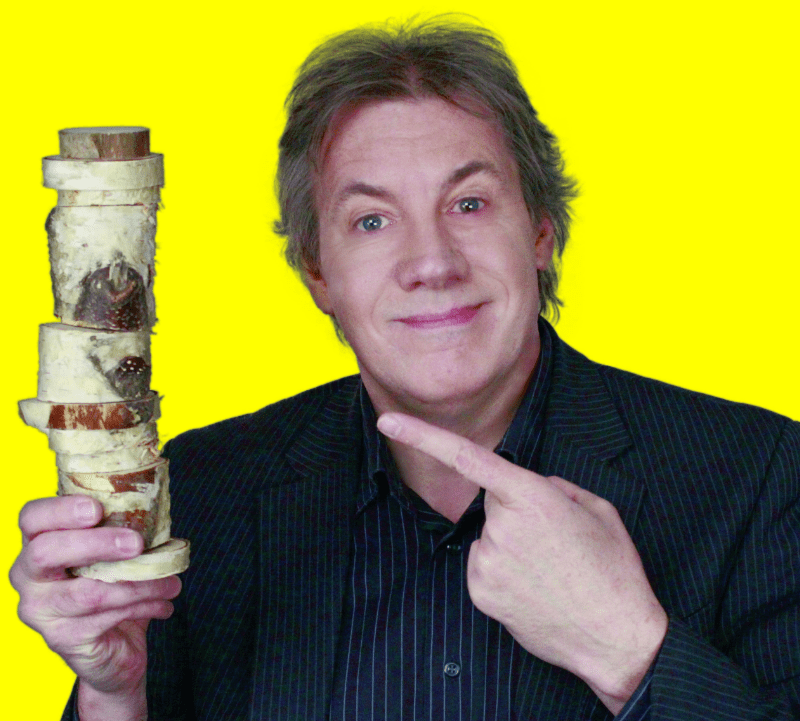
Now in his 18th year as what he calls “the motivational firewood guy,” Steve is a stand-up comedian, author, and keynote speaker who built his second act out of that storm. We talk about the phone call the next morning that changed everything, his brand-new life coach’s blunt question, “have you ever thought about being a motivational speaker?”, the spelling-bee humiliation at 13 that quietly cost him two decades of confidence, and the goofy mirror exercise, writing down one thing you like about yourself every morning, that he still uses with his own clients today.
Stick around for how a vision board, and one very specific sentence written down in June of 2007, led him to the woman he’d had a crush on in high school math class… and to sixteen years of marriage since.
Watch this episode
In this episode
- Losing his radio career twice, his marriage, and $62,000 to debt by 35, and what rock bottom actually felt like
- The severe thunderstorm, a bucket of golf balls, and the moment that became his signature stage story
- Why a life coach’s question, “have you ever thought about being a motivational speaker?”, changed everything the very next morning
- The spelling-bee humiliation at 13 that quietly cost him two decades of confidence
- The one-week mirror exercise that rebuilds self-talk from scratch (and why “my socks match” counts on day one)
- How a vision board and one written sentence led him to his wife of 16 years
Timestamps
- (00:01) Welcome and meet Steve Gamlin, “the motivational firewood guy”
- (02:12) Where “Some Days Your Phoenix Rides a Pogo Stick” comes from
- (04:14) Losing radio jobs twice, $62,000 in debt, and moving back into his dad’s house at 35
- (09:43) Hitting golf balls, and two strangers’ abandoned buckets, in a severe thunderstorm
- (11:08) “I dare you”: holding up his club to the storm
- (11:59) The phone call the next morning that changed his life
- (14:21) “We’re not going to be brothers anymore”: the friend who ended his self-deprecating act
- (14:51) The mirror exercise: writing down one thing you like about yourself, every morning
- (17:35) The spelling-bee humiliation at 13 that cost him his confidence for 20 years
- (19:12) Volunteering for the morning radio show he’d never actually been on air for
- (24:01) Discovering The Secret, vision boards, and John Assaraf’s three-minute segment
- (24:01) Writing “I am ready to fall in love,” and the email from Tina 10 days later
- (30:43) The eight-spoke life wheel, and why physical health impacts everything else
- (34:11) Where to find Steve Gamlin
About Steve Gamlin
Steve Gamlin is a motivational speaker, stand-up comedian, and author now in his 18th year as what he calls “the motivational firewood guy,” sharing a back-to-basics blend of positivity and humor with corporate and conference audiences around the country. After losing his radio career, his first marriage, and his financial stability at 35, he rebuilt his life around vision boards and what he calls his eight-spoke “life wheel.”
Learn more at SteveGamlin.com.
Favorite quotes
“I dare you.” —Steve Gamlin, holding up his golf club to a thunderstorm
“You’re better than that. And if you don’t build yourself up, or at least acknowledge yourself and respect yourself in the mirror, how the hell can you expect anyone else to? You can’t.” —Steve Gamlin
“I am ready to fall in love.” —Steve Gamlin, written down in the first week of June 2007
Resources mentioned
- SteveGamlin.com
- The Secret: the film that introduced Steve to vision boards, watched nine Sunday nights in a row
- John Assaraf’s vision board segment in The Secret, the specific part that stuck with him
Related episodes
- Change Is Possible! Dai Manuel and the Five F’s: another guest from this same season rebuilding a life around resilience and a values-based framework.
- From Suicide Plans to 20 Years as Tony Robbins’ Firewalk Captain (Dave Albin): another rock-bottom-to-motivational-speaker journey, for anyone who needed two of these back to back.
Subscribe & connect
If this episode gave you something to sit with, follow Phoenix and Flame so you never miss an episode: all apps in one place, or jump straight to Apple Podcasts, Spotify, Amazon Music, or YouTube. And if it moved you, leave a review; it’s the easiest way to help another listener find the show.
Learn more about Phoenix and Flame, connect with Dana, and listen to more episodes here.
Read the full transcript
[Dana] (00:01)
Welcome to Phoenix in Flame. I’m Dana, and this is my podcast on pushing through and transforming even when you feel like a pile of ash. We have a guest with us today who is so funny and inspiring, and we have already just been bouncing back and forth before I was even able to hit record. So I’m like, wait a minute, stop, stop, stop, I have to hit record, we’ve got to get this on the podcast so all the listeners can hear what’s going on. So Steve, actually, after blowing up his life, which means his radio career, his first marriage, and his financial stability, at the age of 35, he rose from the ashes. Now, I didn’t tell him to say that, okay, that was in his bio, I want that duly noted, that was in his bio before he even came onto Phoenix and Flame. But he says he rose from the ashes to become a motivational speaker, a stand-up comedian, author, and more, after he spent an afternoon hitting golf balls in a thunderstorm, daring the lightning to hit him. Now, in his 18th year as the motivational firewood guy, Steve Gamlin shares his back-to-basics blend of positivity and humor with corporate and conference audiences around the country. Steve Gamlin, welcome to Phoenix in Flame.
[Steve Gamlin] (01:34)
Hey there, Dana, thank you so much. And yes, phoenix is a big part of my story, because one of my stage stories is called “Some Days Your Phoenix Rides a Pogo Stick.”
[Dana] (01:46)
I saw that on your bio, and I put a note here, I was gonna ask you about that, because I think we all understand it’s like, you know, you’re up and down, and isn’t that the nature of a phoenix though, it just burns to ash and then it rises, and then it burns to ash and then it rises, it just kind of keeps doing that. So when you talk about your phoenix being like a pogo stick, tell us kind of where you’re coming from with that.
[Steve Gamlin] (02:12)
You know, when I was 11, I wanted to be a radio DJ, a stand-up comedian, an author of my own books, and a teacher of people, not in a classroom. When I was 24, a friend asked me why I’d never followed my dream of going on the radio. So I did it. Did radio for 10 years, flying high, got married somewhere in there, and then crashed the whole darn thing. And in the ashes of that came hitting golf balls in a thunderstorm, and a coach who asked a question that prompted me to become a speaker, and a stand-up comic, and start publishing my books. So we fly, we crash, we lose our tail feathers, I think I’m on my third or fourth set by now but they’re gorgeous, and we just fly up again. And my whole thing with the pogo stick is just, every time I come out of those ashes I just want to fly or bounce higher than I did last time, which means I was paying attention, I learned the lesson, I became a better version of myself. And I took a lot of notes along the way, and I love to blend the humor with that, and that’s, you know, just being authentic about my journey. The things I used to punish myself for, the stupidest things I ever did, are now what people pay me to share on stage to inspire other people. So I love sharing these stories.
[Dana] (03:15)
I love that. Well, that’s great, we’re a good match then, because that’s why I called my podcast Phoenix and Flame, because as interested as I am in how we become the phoenix, I am equally interested in what it feels like when we’re on fire. Okay? What is it, because I feel like as a listener to my podcast, I have people out there and they are currently on fire, and I want them to know that they’re not alone, that there’s other people that have gone through horrible things, that if another person can experience it, can weather it, can get through it, they can too. So I like to spend some time in what happened originally. You talk about how your whole life, you talk about blowing up your life, your radio career, your marriage, your financial stability when you were just 35. Let’s just hover over that for just a moment, I don’t wanna go through this too quickly. What happened, and what was that like?
[Steve Gamlin] (04:14)
I worked about 15 years’ worth of hours in 10. I was full time in radio, and every couple of years the radio stations I was at would get sold, and the owners would come in, or the general manager, and say, “hey everybody, we’re going to be sold to this big company and they’re going to put a big investment in,” every single time. As soon as the sale went through, we all got fired. So I got kicked in the teeth, as hard as I was working, and as many awards as I was winning for my comedy and everything else I was doing, every couple of years I just got kicked to the curb. And that happened twice at the last radio station I was at. Somebody came to me one day and said, “hey Steve, the owner is going through a divorce, he might have to sell the radio stations.” And all those old thoughts came into my head going, I can’t deal with this anymore, I can’t go through that one more time, I’m running out of places in New Hampshire to work. I had also owned a DJ business for nine of those 10 years, because radio doesn’t pay anything. So I’m just fried, I’m exhausted, spiritually, mentally, physically, emotionally, I’m brittle and I’m falling apart. And my first wife and I were not communicating well, because I was not a very confrontational person and our energies didn’t match, it was just getting more and more frustrating. So I wound up just walking away from radio without even having a conversation with my first wife that I was gonna quit my job, I just did it. That was a not-very-well-thought-out, very arrogant decision on my part. And then I realized, when we got divorced shortly after, I was $62,000 in debt without a full-time job, because I was not paying attention to where all the money was going. And I had just taken out a $30,000 line of credit to build my own recording studio, right after I quit my job. So I had nowhere to pay it back, I had no full-time job, I had a part-time DJ business at the time, was maybe making 11 and a half a year. And I was living at my dad’s house. And if that’s not a recipe for, “oh my God, you are the stupidest human being on the planet,” every day in my mirror, that’s pretty much how I woke up. I spent the first decade of the new millennium being about as brutally self-deprecating as you can be to yourself, without taking yourself out.
[Dana] (06:41)
So let me just pause there for just a moment, because I end up talking to people that are in that space. And when we talk about, you know, people that come on podcasts and they’re successful now, but when we’re going through it, we don’t know what’s going to happen in the future. So if I heard you correctly, at that moment you had lost your job yet again because of how the radio industry functions, you had a lot of debt, lost your marriage, living with your dad, and you were 35 when this was happening. So, and I just want to kind of pause there and say, that was your experience then, and when we’re experiencing that, like I said, we don’t know what’s going to happen. I mean, I can pull people to my mind right now that are in really what feels like very hopeless places of their life, and they don’t know what’s going to happen. We don’t know what the future holds, but at that particular moment, it feels very hopeless. And it sounds like you had a lot of components that really created a storm of what could have been hopelessness, despair.
[Steve Gamlin] (07:56)
Yeah, yeah, I had no idea what I was gonna do. Some people said, “Steve, just go back to radio, calm down a little and go back to radio.” I said, I don’t want to go back to radio, it’s like going back into a relationship with somebody you know is eventually gonna cheat on you. That’s what it felt like. I felt like the industry kept betraying me over and over and over, as hard as I worked. The second time it happened, I found out three weeks later I had won the largest award the radio stations had ever received, for a comedy bit that I wrote, a commercial parody about, you know, like the old Motel 6 commercials, “we’ll leave a light on for you.” Well, I wrote my own version with a biblical twist on the name, it was like a biblical reference thing, and it won first place out of all radio stations in the United States, Canada, Mexico, and England, for about a minute-and-20-second parody that I wrote and produced. And yet they fired me. And that hurt for a long time. But then I didn’t know what I was gonna do at age 35.
[Dana] (09:02)
Wow. And so people would see you, and other people like you that are winning awards or these kinds of things, and they don’t know the backstory. And that’s one of the reasons why I say frequently on Phoenix in Flame to not be judgmental of people, no matter what you think you know, because you don’t know the backstory, you don’t understand what that person has gone through, you don’t understand what their life is like. You might think you do, you don’t. And so somebody might have seen you winning this big award and thinking, “well, you’ve got the world by the tail,” and that’s not really what was going on. Now, is it about this time that you’re out in the thunderstorm with golf clubs?
[Steve Gamlin] (09:43)
It was, yeah, right about that time. It’s actually the 20th anniversary of that this month. And on a Friday afternoon, I was just still trying to figure out what I was going to do. I was just out running errands one day, and I had three dollars in my pocket, and I drove past this mini golf place that had a driving range a couple of towns away. And I said, well, I’ll just go take out my frustrations on a bucket of golf balls, just get the aggression out, that’s all. Every ball had a name, it was something about my life or what I’d done to it that I was mad at. And I was hitting like 200-plus yards, because I can’t shoot straight, but I can hit hard. So I went to the farthest tee box on the property, because I’m a horrible golfer and I didn’t want to dent anyone’s car. So I’m at the very edge, under these big giant steel-towered power lines, which, by the way, make an awesome noise when you can actually hit them.
[Steve Gamlin] (10:39)
So I’m hitting away, hitting away, it’s a hot, humid Friday afternoon in New Hampshire, and a thunderstorm came through, I mean a severe thunderstorm, thunder, lightning, driving rain, wind, everything. And everybody but me ran from the storm, and I hit my bucket of golf balls. And as I was looking around, I saw two almost-full buckets from a couple of the gentlemen who ran from the storm, and I looked around and thought, well, they’re paid for, I’ll hit theirs too. Sarcastic humor, it’s just always been a part of me. And I was not mad at God, for the people who say you shouldn’t be mad at God, I was not mad at God. It was like my Lieutenant Dan moment on the shrimp boat in the hurricane, like, “you call this a storm? Come on, I’m right here.” Held up the club and looked up and just said, “I dare you.” And nothing happened. So I just went back and hit the rest of the golf balls. And when I got to my car I could hardly lift my arms, and when I put my key in the door, the rain stopped and the sun came out, and I just started laughing. I looked up and thought, well played. And the next day I’m on a phone call with my then-brand-new life coach, who I only was working with because I knew his wife from networking, he was in a band, she knew I had a recording studio, he asked if I would trade recording time for coaching time, and I said yes, because I was his first client.
[Steve Gamlin] (11:59)
And his first question was, “how was your week?” And I told him the story, as funny as I can make it sound, brutally self-deprecating, but funny, about that one hour hitting golf balls in a thunderstorm. And when he stopped laughing, which is something that coaches shouldn’t do when their clients’ lives really suck, but when he stopped laughing, he goes, “I got two questions. Are you this open and honest and authentic about your life with everybody?” And I said, yeah. And he asked, “have you ever thought of being a motivational speaker or a stand-up comedian? I think you’d be really good at both.” He didn’t know that those were two of my four goals when I was 11 years old. And I said, yeah, I’ve wanted to do both, but I don’t know if I have the confidence, I don’t even know how to pursue each one. And then he laughed again and said, “in the junk mail pile on my desk there’s a brochure from a local community college, they have an intro to stand-up comedy class that starts in two weeks, do you want to go?” Yeah. “And have you ever heard of Toastmasters?” Kind of. He said, “you got it, just go in there and fine-tune it and work on your tools, that’s all.” And that was the moment my life changed. That golf club is in the corner of my recording studio, and I’ve never forgotten that moment. It literally changed my life, and it still impacts me today. The lowest point of my life, in the ashes, tail feathers on fire. So not the Hollywood version that you and I hear from so many people, like the clouds part and the phoenix rises in the majestic and the angels going, oh, no.
[Dana] (13:26)
You know, it’s rarely like that, is it? It just kind of feels like a non-moment, when you look back at some really important times, they just, at the moment, though, they don’t feel like much of anything most of the time.
[Steve Gamlin] (13:51)
It was just another day looking in the mirror, calling myself an idiot, that’s all it was at the time. And then when I learned the power of self-talk, thanks to another dear friend, who put on his steel-toe boots and kicked me in a part of my body my doctor only gets to see once a year, after he heard me doing a self-deprecating meltdown on his stage. I was running out of material, and I was in a bad mood that day, and I went back and beat myself up over some life things, I made them funny, but he said, “if I ever hear you talk about yourself like that again, A, we’re not going to be brothers anymore, and B, you’ll never set foot on one of my stages.” That was in 2011, when I finally said, okay, that’s it for that, that approach is over, the adorably pathetic comeback story. “Dude, you’re better than that, and if you don’t build yourself up, or at least acknowledge yourself and respect yourself in the mirror, how the hell can you expect anyone else to? You can’t.”
[Dana] (14:35)
Interesting. So how were you able to turn that around? Because I talk to a lot of people, again being a psychotherapist, professionally, personally, it’s like, how did you turn that around? How were you able to, because it’s one thing to say, you need to look in the mirror and think this, or view yourself this way, or think positively, and all that sounds nice, but how were you able to actually do it?
[Steve Gamlin] (14:51)
So that’s when I made friends with myself. My industry is so full of crap, with a lot of people in programs, and just believe, you know, and all that. I actually started doing something that seemed real silly at the time, but now I have all my clients go through it. I grabbed a slip of paper and put it in the bathroom, and each morning for a week I just looked at myself in the mirror and started at the top of my head and worked my way down, and when I saw something I thought was kind of cool, interesting, or I liked, loved, or even respected about myself, I would write it down. So I had a week to write down seven positive things about myself, and then realize that there’s so much more than that. But if the first thing you’re seeing every day is that you’re a moron because of something you did 12 years ago, then you probably need to work on your wiring, because you’re paying attention to old stories. And when I do that with my clients now, my visualization clients, I say, look, I’m going to give you day one, because it probably feels really foreign and really weird, and you’re probably not going to do it if you don’t get past day one. So you’re going to start at the top of your head, keep going down, shake your head, roll your eyes, and realize, holy crap, my socks match, write that down. But you can’t do the socks thing again, you got to pick something else the next day. And sometimes by day three or four my clients reach out and say, “hey Steve, I have really cool eyes.” Yeah, I know that, glad you know it. Or “I get a really cool laugh,” or “I get cute dimples when I smile, so I want to smile more.” Like, how cool is that, because you found something that only happens when you’re happy or joyful, so now you want to do that so you can see it more. And when you see it, trust me, other people see it and they feel it. It’s silly and weird, but it works.
[Dana] (16:58)
So what I’m hearing you describe is that everyone has the old stories, sometimes it’s trauma, sometimes it’s not, but still the negative narratives of old that are still driving the ship, so to say. And what I’m hearing you say is that you intentionally created space for a new story to provide some balance, at the very least, to all of the old stuff that keeps pushing to the forefront of the mind. That exercise in the mirror was intentionally creating something new to combat the old.
[Steve Gamlin] (17:35)
Yeah. And this was right about the time that I realized that when I was 13 years old, 99 percent of my friends went to one junior high, and I went to another with one other kid that I knew. So my confidence was already kind of brittle, because I was super popular up till grade six, great grades, teachers loved me, had a lot of friends. Go to this new school where nobody knows me, still getting good grades, but very uncomfortable, shy, and no confidence. And I get embarrassed in the spelling bee, in English class, that spring, and I did the walk of shame all the way back to my chair. And what I didn’t realize for more than 20 years was that was the day I stopped raising my hand in class, and my grades started to slip. It was like a World War II plane being shot, like, now the planes just explode because we use missiles and bombs, but back then you’d get a bunch of holes in the fuselage, and you’d leak a little oil, then there’d be smoke, then there’d be flame, and basically you would just trail smoke until you crashed. I got shot in seventh grade, and I trailed smoke until I graduated college by sixty-one-thousandths of a point from not getting invited to graduation.
[Steve Gamlin] (19:12)
My first eight of ten years in radio I was not a DJ, I was an off-air rock-morning-show producer. Did great at it, won awards for comedy, did all this stuff, didn’t use my voice, didn’t have the confidence. Until about the eighth year, when our morning guy quit, and the owner was gonna put our station, that we’d taken off satellite and made live without his knowledge, back on satellite. And I raised my hand and said, “guys, I’ve been doing this for eight years, come on, I’ll just do the morning show.” And in parentheses in my head I’m going, never been on the microphone, but… So what followed was about four days of the worst-sounding DJ you’ve ever heard, because I tried to make my voice sound different every break to find my style, and it was laughable how bad it was. And that Friday morning, at like five minutes of seven, knowing the axe was going to come down, I just came out of a song and said, “hey everybody, Steve here, New Hampshire’s classic rock, Big 101.5. I may suck as a DJ, but if you tolerate me reading the weather for the next 42 seconds, I’ll play you a kick-ass rock song.” Read the weather, hit the song, sat down, shook my head, and went, oh God. And then my boss leans his head in the door with a huge smile, and he goes, “brother, that was the funniest thing you said all week. Dude, just be yourself, that was great.” That was about the year 2000, so 23 years ago, that was the first brick in any foundation of confidence that I had. And then I wound up quitting radio and became a speaker. But if that moment hadn’t happened, to undo what had happened when I was 13, I wouldn’t be here doing what I’m doing, I wouldn’t be on this call with you.
[Dana] (20:26)
That is awesome. I mean, wow, and you look back and you realize how impactful it was, at the time you didn’t know, but what I’m hearing you say is that you were willing to do two things. One, you were willing to try something new that you had never done before, and you could have said, no, that’s not me, I’ve never done that, I’m not going to do that, find somebody else, or you’re just going to have to put it on satellite, do whatever you need to do because that’s not me, look for someone else. But you didn’t, you were willing to step out into an area that you’d never done before. And then when you really started getting traction, if I heard you correctly, was that when you finally got to the point where you were able to just accept who you were, that you were just, hey guys, I may not have the best voice, but if you can listen to me get through this weather then I’ll play you a kick-ass rock song. And that was just you saying, this is me. And I think those two things happening really possibly helped you turn that corner.
[Steve Gamlin] (21:48)
Yeah, and if my boss hadn’t stuck his head in the door and smiled and rewarded or acknowledged that moment, I probably would have, 15 minutes later, sounded different again. As a matter of fact, I just called him, I haven’t seen him, I’ve seen him maybe twice in the past 20 years, I called him the other day because I was laughing, thinking of a memory. And he still says, he goes, “I remember, oh, you were so horrible, but I didn’t want to get down and tell you because you were trying.” He goes, “but when you did that, I had to, I couldn’t just call you, I had to run down to the studio and tell you that was awesome.” And it was, I mean, that was one of those moments right out of the fire, because I just kept throwing myself back down in there, going, oh, I suck at this. You gotta be so careful about that. You know, it’s not an egotistical thing or arrogant thing to say, “hey, you know what, I’m pretty good at this, I can get better, but I got a good foundation.” I didn’t believe in my own voice until he told me that just being myself was the right sound. So now everything I write, everything I post on social media, everything I say in a conversation, everything I do in a video or on stage, it’s all the same voice.
[Dana] (22:56)
We might be able to edit this out in the podcast, I think we’re back, you got a little glitchy there for a minute, but we’re good now, I think.
[Steve Gamlin] (23:11)
Okay, sorry about that, I hope it wasn’t mine. You’re a little fuzzy on yours too, so…
[Dana] (23:18)
Yeah, and it’s just one of those things when you do stuff that’s online and you’re using Wi-Fi, that’s what we run into when we’re podcasters, it’s going to happen from time to time. So I wanted to make sure that we have plenty of time to talk about, because you talked about your vision-board mastery and your motivational firewood, I want to have time for you to kind of explain the rising, what you created from your experience and your honesty and your acceptance of yourself, and then what you created from that.
[Steve Gamlin] (24:01)
Yeah, right about the same time, shortly after the golf clubs in the thunderstorm, my coach asked me if I’d ever heard of The Secret, which had just come out on DVD at the time, which is all about the law of attraction and creating a better version of yourself. And I had not heard of it, so I went and got the DVD and watched it nine Sunday nights in a row. Some of it I thought was way too woo, way too out there, you know, a genie in a magic lamp who just says “your wish is my command,” not enough for me, sorry, dismissed. But about two-thirds of the way through, this guy named John Assaraf, who I’d never heard of before, spent three minutes talking about this thing he used called the vision board, where he put pictures of things he wanted on a board and just kept it where he could see it, and he realized he’d manifested some of the things that he wanted in his life. And I was so fascinated by that, it’s like planting a seed for something you want. Now, most of his was material stuff, and I’m not a material guy, but I thought, well, relationship-wise my life is in the toilet, financially in the toilet, all the other business in the toilet, and I said, well, what if I started to set goals for each of these areas in my life? And I put together my first couple of vision boards, they were all material things, because I was broke. And after about three weeks I said, there’s nothing on here I want except for the recording studio, and I finished building that. And after that I started to say, well, okay, I only want to fall in love one more time in my life, so I want to make sure I am the best version of me for whoever she may be. And I didn’t go on a single date for a year, and then I only dated one person for a little while, but it was just dating because I was still working on me. And in January of ’07 I said, this is the year I’m going to discover her, whoever she may be. And I ended that first relationship as maturely as I could. And then I wrote down, in the first week of June of ’07, “I am ready to fall in love.” And 10 days later I get an email from a woman I hadn’t seen or spoken to in 21 years, from, at that point, a thousand miles away, reaching out. And I almost deleted it because I thought it was spam. Thank God I didn’t.
[Steve Gamlin] (26:26)
The next day I opened it up again, and I said, oh my gosh, it’s Tina from high school, who I’d sat next to for three years in math class. And I sent an email back, and she sent an email back with her phone number. Three days later I called her, first words out of her mouth after 21 years were, “it’s about time he called.” And I laughed and said, “still sarcastic, funny Tina.” She would not send a picture of herself, she had no social media footprint. But over the next four weeks I remembered, via phone, text, and email, that I’d had a crush on her for three years in high school and never asked her out. And four weeks after that first email she asked me, I was DJing a wedding where I wasn’t even supposed to be scheduled to be, and she sent me a text: “can I tell you something if you promise not to freak out?” I said, sure. “Here’s how I really felt about you in high school, when I saw your name online, when I sent you an email, when I heard back, when I heard your voice: I love you.” So we spent the whole summer of 2007, a thousand miles apart, completely blind, eyes closed, hearts wide open. We just celebrated our 16th anniversary earlier this summer. And I still tell her to this day, “babe, if you ever end our relationship, just know you’re gonna demolish my speaking career.” She goes, “I know.” So that’s my, I mean, people say, oh, you’re lucky, no, if you knew the story, if you knew how much pain was so far back, and just wanting to create a better version of myself and figuring out what that looks like, feels like, sounds like, smells like, tastes like, all the senses and all the emotions, went into me designing the “one more fall in love” relationship that I wanted to have for the rest of my life. Right down to us making dinner together at least four nights a week in our kitchen, that’s where the smells and tastes come in. All of that went into building the greatest relationship, and that’s just one of eight areas of life that I set goals in, and that I coach people on.
[Dana] (28:37)
Wow, so you really kind of help individuals not only get the larger picture of, you know, what are these eight areas, which I’m interested in you sharing, but then also drilling down, unpacking each particular area, and giving them space and an opportunity to say, okay, what exactly do you want, and encouraging them to think about that, because I think so many of us are just kind of stumbling through life, and we just kind of, we think we know what we’re after, but we’re not really sure. I’ll take a brief minute here and say, I was rebranded about a year and a half ago, and that process was infuriating, if I’m brutally honest about it. I mean it was wonderful and needed and amazing, but it also annoyed the shit out of me, because it forced me, I’m a large-picture kind of person, and like, for my personal life, not with my patients, I’m very patient with them, I sit down and I unpack all these little minutia areas, but in my own life I’m just a large, large kind of vision kind of person, minutia and tedious things annoy me. And so I was forced to sit down and answer all of these questions about all of these areas of my life, and I thought I was going to scrape my face off. But it was important and it was necessary, and I’m hearing you say that that’s what you help your clients do, that you help them understand what are the main areas, and whether they feel like they’re gonna scrape their face off or not, and those are the people like me that probably needed it the most, that they’re going to sit down and think about creating that vision board about what do you really want in these particular areas. And that really requires intention that a lot of us just don’t provide. We just don’t do it.
[Steve Gamlin] (30:43)
Yeah, well, look at the language that gets taught to us for our lives. I’m 55 years old and I’m still hearing people say, “well, you gotta get that work-life balance thing.” I’m like, oh dear God, work, life. I use a standard life wheel, pretty common thing in the personal-development world, I’ve tweaked it a bit to how I teach and what I teach. There are eight spokes in the wheel: your physical health, your emotional wellbeing (imagine that, setting goals for the emotions you want to feel every day), your relationships, your core values that guide everything you do, your thoughts, your words, and your actions, your faith and spirituality if that’s an important part of your life, your connection to the world in a real way that’s gotten tested big time over the past four years, your work, and your money. And people think that’s a lot, I say, well, put it this way, they’re all interacting and working together 24/7, so wouldn’t it be a good idea to have some say in the way your wheel’s rolling. And when they still feel overwhelmed, I say, look, you can do one thing in one category and it’s gonna impact every single other one in a positive way. Just take, for example, your physical health: you choose to eat better, you walk more, you drink more water, you do less of the things that are harmful to you, you exercise, you do that every day, you have more energy, you sleep better, you wake up more focused, you can work more efficiently, you get more done, you can earn more money, you can buy back a little time and freedom and improve the quality of your relationships, your emotions are better, and when you’re doing your work and you’re more interactive, your connections are better with people. And if you do it in such a way that aligns with your core values, you never have to look over your shoulder or up at the sky waiting for a bolt of lightning to hit you. So by choosing to take care of physical health, you’ve just impacted all eight areas of your life in a positive way. It doesn’t take a ton of work, you don’t have to rewire the whole thing, but you start and you understand how tied together these things are. And I encourage people who are very overwhelmed: give me one one-year goal in each one of these categories. One year, don’t give me “in 20 years I want this.” It’s okay to have those, but what’s one year’s worth of progress towards that? Let’s start there. I’m not one of these people who says disrupt your entire life and take massive action every single day, you are going to scare the hell out of some people, and they’re going to be done and right back to their old habits within a day or two or three, and now you’ve completely cut them off from that potential future, because they ran screaming back to their comfort zone. So for me: give me some one-year goals. The most common one, and I coach a lot of guys and couples on this, is relationship goals. “I want a happier marriage.” What does that mean? “We’re going to go on date nights.” Okay, how often, a month? Awesome. And I wrote down a little slip of paper and it said “#datenight,” and I took a picture and sent it to him. I said, make one of these, fold it up, put it in your pocket, every time you go somewhere I want one of you to hold this up, the other one to take a selfie, make sure the background indicates where you are. And you share that picture on social media, or just keep it to yourselves, and at the end of the year you put them all in a collage, print them out, frame it, hang it on your wall, and there’s your 24 date nights for the year. Enjoy your improved relationship.
[Dana] (34:11)
That’s awesome. You know, Steve, I feel like we could really spend 30 more minutes talking about all of this stuff, but I want to make sure my listeners know how to get access to you, because if they’re hearing what you’re saying and going, I really resonate with what he’s saying, he’s authentic, he’s been there, he’s real, he knows what he’s talking about, he has small behavioral bite-sized goals that I can really do, how do I get a hold of Steve? What I have here, I’m gonna make sure it’s correct, your website is basically your name, SteveGamlin.com, is this correct?
[Steve Gamlin] (34:57)
That is correct, yeah, G-A-M-L-I-N dot com.
[Dana] (35:07)
And I will have all that in the show notes for listeners who maybe you’re out jogging or doing something that they can’t really write anything down, I’ve got it in the show notes. So Steve, I just really appreciate your time and your willingness to come on the show, as everyone else, I’m sure that you’re super busy and have all kinds of things to do, but I’m so thankful for you and what you’ve been through and what you’ve built from it, and your willingness to reach out and be so helpful to other people. Thank you very, very much.
[Steve Gamlin] (35:33)
My pleasure. Thank you so much for inviting me for this conversation, and I got a good feeling it’s not going to be our last time talking with each other.
[Dana] (35:41)
I hope not, I hope not. So guys, I know that you have heard so many things in this podcast today that you’re thinking not only, you really could benefit from and apply in your life, because I’m all about application and practicality, because if we can’t apply it, what’s the point? But also you’re thinking, I have a friend, I have a coworker, I have a relative that, oh my gosh, they need to hear exactly what Steve is saying. Please, listeners, take this episode and share it. If you need to copy and paste the link in a text, or in your, on email, if you want to take it and share it on your most favorite social media sites, do whatever you need to do to get the message out there, so we can grow our Phoenix in Flame community, where we’re reaching out to one another, knowing that we’re all in this together and we’re helping one another. I hope you’ve had a wonderful day, I hope the rest of your day goes fantastically. This is Dana on Phoenix in Flame.
Are your work boundaries supporting you—or quietly draining you?
Take my free Work Boundaries Quiz and find out where you stand.