First aired December 31, 2023
A gentle note before you dive in: this conversation touches on suicide crisis and grief. It’s okay to pause, skip ahead, or come back to this one another time.
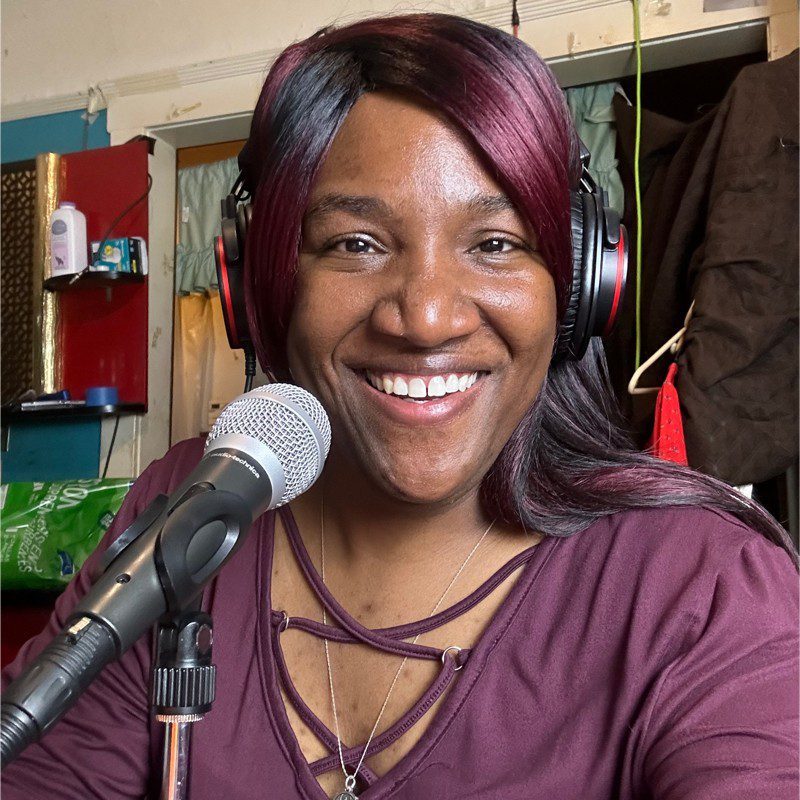
Portia Booker survived a suicidal crisis in her twenties, then two years later survived a grief she had no framework for when her mother died of lung cancer. Both of them cracked her wide open, and both of them are why she now talks about grief for a living. My guest today, known to her audience as Portia the Producer, credits an old college professor’s out-of-the-blue phone call with saving her life: “Portia, you are not well,” the professor said. “You need to get yourself to the hospital right now.” That call is the reason she’s here now to tell her story.
Portia landed her dream TV producer job two weeks after college graduation, a thousand miles from home, and within a month was diagnosed with bipolar disorder in a newsroom culture that had no room for it. She talks with me about the public humiliation that pushed her to the edge, what she calls “bystander syndrome” (the coworkers who stood there and said nothing), and what it was like being one of the only Black producers in that newsroom. Then, two years after she rebuilt her life, her mother’s death sent her into a grief she had no framework for, until she picked up her mom’s ashes from the funeral home and an unexpected thought changed everything: what if her mom’s transition was actually for her transformation?
We talk about learned helplessness, the courage it takes to actually stop and help a stranger in crisis instead of just driving past, and why Portia insists grief is not linear; that comparing your pain to someone else’s only makes it worse. If you or someone you love is walking through a crisis or a loss right now, this conversation is for you.
Watch this episode
In this episode
- Why the newsroom “pile of ash” moment mattered more than any one bad day, and what finally made Portia walk away from her dream job
- The phone call from a college professor that reached Portia in her most dangerous moment and got her to the hospital
- What “bystander syndrome” feels like from the inside, and why Portia now stops for strangers in crisis instead of driving past
- Being one of the only Black producers in her newsroom, and what she wishes people from other backgrounds understood
- Why “grief is not linear,” and how comparing your pain to someone else’s only makes it worse
- How picking up her mother’s ashes led to the audiobook that became her second act, “Finding Grace Within Grief”
Timestamps
- (00:01) Welcome and guest intro: meet Portia Booker, “Portia the Producer”
- (02:02) Landing her dream TV producer job two weeks after graduation, and the bipolar disorder diagnosis that followed
- (07:25) The newsroom incident that became her “pile of ash” moment
- (08:23) The phone call from her college professor that got her to the hospital
- (10:38) The bird-in-a-cage story, and the psychology of learned helplessness
- (13:18) Being one of the only Black producers in the newsroom, and the cost of bystander syndrome
- (23:03) Why Portia now stops to help strangers in crisis, from a man breaking down in the street to a young woman asking for help at a gas station
- (24:42) Losing her great-grandmother, then her mother’s lung cancer diagnosis
- (26:43) How “Groove with Portia” started as a cover story for her own mental health journey
- (29:43) Picking up her mother’s ashes, and the epiphany that became her audiobook
- (34:36) Portia’s parting words: grief is not linear
About Portia Booker
Portia Booker, known as Portia the Producer, is a TV-producer-turned-podcast-host and the author of the audiobook “Finding Grace Within Grief: Her Transition, My Transformation.” She currently produces 12 different shows, including her own, “Groove with Portia,” and is training to become a death doula.
Listen to her show, Groove with Portia, or find her on Instagram, Facebook, and LinkedIn.
Favorite quotes
“There’s more to Portia’s life than this.” —Portia Booker
“Don’t compare your grief pain to anybody else… you gotta feel it, and just learn to embrace your grief instead of evade it.” —Portia Booker
“What if your mom’s transition is for your transformation?” —Portia Booker
Resources mentioned
- “Finding Grace Within Grief: Her Transition, My Transformation”: Portia’s debut audiobook, written from letters she wrote to God after her mother’s death
- Groove with Portia: Portia’s podcast, also on YouTube, Spotify, Apple, and Google
- Portia on Instagram
- Portia on LinkedIn
Related episodes
- “You’re Not Alone” Interview Series: When a Loved One Commits Suicide: for anyone sitting with the same crisis Portia describes, from the other side of loss
- From Suicide Plans to 20 Years as Tony Robbins’ Firewalk Captain: Dave Albin’s Amazing Journey: another guest’s crisis moment and the decades of transformation that followed
- Thriving After Loss: Kim Sorrelle’s Story of the Transformational Power of Love: more on finding your footing after losing someone you love
Subscribe & connect
If this episode gave you something to sit with, follow Phoenix and Flame so you never miss an episode: all apps in one place, or jump straight to Apple Podcasts, Spotify, Amazon Music, or YouTube. And if it moved you, leave a review; it’s the easiest way to help another listener find the show.
Learn more about Phoenix and Flame, connect with Dana, and listen to more episodes here.
Read the full transcript
[Dana] (00:01)
Welcome to Phoenix in Flame. I’m Dana and this is my podcast on pushing through and transforming even when you feel like a pile of ash. Well, I have an inspiring and creative guest with us today. Her name is Portia Booker, otherwise known as Portia the Producer. She also has a podcast called Groove with Portia that was birthed from a heart-wrenching loss, where Portia brings forth hidden gems from the depths of grief. Now, her own experience of losing her mother ignited a fire to reshape how society perceives and processes grief. Crafting her debut audiobook, “Finding Grace Within Grief,” her transition, my transformation, within a mere three months, Portia’s resilience shines as she redefines grief’s narrative. Portia, welcome to Phoenix in Flame.
[Portia] (01:05)
First and foremost, Dana, I express gratitude because I love having these conversations. I’m telling you, I can talk about grief all day, so I express gratitude to you for having me as a guest. Thank you so much.
[Dana] (01:15)
I’m excited, really. And also you had said that being an accomplished producer, that you have curated 10 distinctive shows, each with its unique resonance, and even beyond the studio, you shape business narratives, harnessing the power of storytelling and on-camera presence. This is so exciting. I’m really kind of wanting to hear you describe your journey and your life and what happened and how grief got woven in with your experience. And just tell me, kind of bring all the listeners and me on board with how you got to be Portia the producer and working and specializing in the area of grief.
[Portia] (02:02)
Oh, Dana, let’s just take a little seat on the train of bumps and roads, because that’s what it’s been. It’s been bumps, roads, crashes, burns, all the things you can think of. So back in 2016, I was one of those lucky college kids that landed their dream career job two weeks after graduation. So I was a TV producer for a prominent network. I landed the job, moved a thousand miles away from home, away from my nucleus support system, brand new state, brand new city, I just went. And let’s just say that the dream that I envisioned turned into a nightmare very quickly. So here’s where grief kind of entered into the picture. A month after I started the position, I was diagnosed with bipolar disorder. And through that diagnosis, let’s be realistic, mental health back then didn’t have the open conversations like we are having today. It wasn’t as accepted as it is today, where you’re saying, hey, I’m having a mental health day, I want to take off work. Back then it’s like, no, you better bring your butt to work type of thing. And so when I was diagnosed with bipolar disorder, I didn’t understand what any of that meant. I mean, in my household, we never had conversations about mental health. The very first thing that I was told was, you better take that Bible and pray the disease away type of thing, right? So of course, I’m kind of stuck between a rock and a hard place, right? So obviously this therapist who diagnosed me, mind you, I’m already on a PIP from work because I’m not able to perform.
[Dana] (03:29)
Oh no.
[Portia] (03:46)
And let me preface for those of you who don’t understand news, your social life is determined by your shift at work. And I worked overnight, 11 p.m. to 7 a.m. Sunday through Thursday. And I’ve never been a night owl. I’ve always been somebody who’s up about going about the day. So you figure now I’m sleeping during the day and up at night. So this therapist who’s saying this to me, I’m clinging on to their words like a life jacket. I need this in order to save my job. I’m on the point of losing my house, my car, everything that I’ve worked hard to get. It’s about to, no pun intended, go up in flames. So they put me on a cocktail regimen of all these strong prescription drugs, right? Well, I thought things would improve, right? You know, you start on a good regimen, that whole thing.
[Dana] (04:15)
Mm-hmm.
[Portia] (04:38)
Well, no, things continued to go downhill for me, Dana. So I want to say within two months after this, I went from like a healthy size 16 in pants to a nine because I wasn’t able to really eat anything. I’m sleeping during the day. These meds require you to eat like a 1500-calorie meal, but how can I eat anything when I’m exhausted? So here’s where the grief comes in.
[Dana] (05:00)
Right.
[Portia] (05:06)
I’m wondering if I’ve made the right decision of coming down here to take on my dream job. Did I make a mistake? I don’t have my main nucleus support system because all my friends are sleeping when I’m up at night. And I will say, knock on wood, I’m grateful for my ex-boyfriend who was in the military at the time, and he and I could talk because he was in a 14-hour time difference. So we were both up at the same time. And here’s where I’d like to say my breakthrough happened. So one day I go into the newsroom, and let’s just say one of the producers I worked with kind of had somebody pee in their Cheerios, to say the least. And they took it out on me completely in front of the entire newsroom. Now, mind you, it reminded me of when I was in school being bullied, right? You’ve got kind of the serial killer’s knife in front of you, of all your fears of being bullied, of being publicly humiliated, and then nobody’s there to protect you. So all of those things are right in front of me, and it’s like a bird being in a cage, right? A bird being in a cage is gonna scream sometimes. A bird being in a cage is gonna cry, it’s gonna lay there. For me, I just had to get up and just walk away. So as I get up and I walk to the dressing room, I just cried, I just cried, I just cried. And the damage had already been done. And mind you, that day that I went into the newsroom, I didn’t take my meds, because I had no intentions of ever coming back. And I had made up in my mind that I wanted the pain to stop, and that added what I call the lighter fluid of proof to why I didn’t need to be in this world anymore. So when I left work that day, I’m driving, and what people don’t realize when you’re ready to commit suicide — I didn’t want to die then. I just wanted the pain to stop. And what people don’t realize is when you’re ready to end your own life, there’s like a level of euphoria that plagues you. You’re like, yes, this is it, this is solidified, I’m done with this.
[Dana] (07:02)
Got you.
[Portia] (07:25)
So as I leave work, I’m driving down Riverside Drive, and I pull over because the Arkansas River is right around the corner from my house. And I get out of my car. Mind you, I’d already cleaned out my desk and everything at work, maybe two or three weeks prior. And right when I’m about to make a decision I can’t take back, one of my professors from college calls my cell phone and says, Portia, you are not well. You need to get yourself to the hospital right now. And sure enough, Dana, she called the hospital to make sure that I went. So I got in my car, drove there, because she picked up on our text message exchange. I don’t remember what I said to her that
[Dana] (08:22)
Right.
[Portia] (08:23)
triggered immediately, hey, Portia, something’s going on. So I get to the hospital, you know, they admit you. Now, mind you, I’m lucky, knock on wood, that they did not keep me overnight. Considering the situation, they did not admit me. I begged them not to. I’m like, I have to go to work. So as I’m sitting there, Dana, in the hospital room, I just take a minute to think.
[Dana] (08:39)
That is shocking.
[Portia] (08:53)
There’s more to Portia’s life than this. There’s more than me going into this newsroom, being on deadline, being anxious every single day. There’s more to Portia’s life than this. So the only thing that I like to say that died that day was me living the life that other people wanted for me to live. So that night when I left the hospital, I went home, took like a little nap, went to work, and then I worked for maybe two or three weeks after that, and then I resigned. And I’ll never forget it, Dana. This is the first time I’m remembering this, but I remember when I left the newsroom that day, when I resigned, because it was sudden — nobody knew — but I remember the sky being this perfect color blue, like a new beginning was in front of me. And so I continued to live out of state for a couple years after that. And then I moved back home. So mind you, this is 2016. So I moved back home to Cleveland, Ohio in 2018. Still kind of in a rocky place, but not in a stressful way. That was pure chaos town 2.0.
[Dana] (10:08)
You know, Portia, I’m listening to you describe all of this, and I’m thinking how many people truly are walking that right now? Even people that are listening to this podcast right now that are feeling that. And as you’ve been talking, I’ve been kind of writing some notes down because I didn’t want to interrupt your flow. You’ve mentioned several things that I wonder if we could kind of hover over and discuss a little bit more.
[Portia] (10:19)
Mm-hmm.
[Dana] (10:38)
One was the experience of being bullied and how that feels and what do we do about that. Another thing, you talked about a bird in a cage. It reminded me of research about learned helplessness. I don’t know if you’ve ever heard of this research or not, but going through school, we had to learn about different things like that. Of course, I don’t know if they could do it nowadays, but they had mice that were on a platform and they would shock the floor and they would jump over onto the other side. At some point, they put this glass up to where they try to jump over to escape the floor. And they couldn’t escape because they would hit the glass and just come back down. They did this for a period of time. And then what they did was they removed the glass, and when they shocked the floor,
[Portia] (11:15)
Mm. Mm-hmm.
[Dana] (11:36)
the mice would not try to jump anymore. They just stood there. It was called learned helplessness, that they learned that even if they tried to escape it, like the bird in the cage, even if they tried to escape it, they couldn’t. And so they learned to just stay in there. And I think so many people are in that kind of a situation. And I’m remembering kind of how you described that part of your scenario and your experience.
[Portia] (11:41)
Hmm.
[Dana] (12:02)
where you just felt like you were being bullied and you were just kind of trying to react, but you felt like a bird in a cage. When you reflect back on that, any kind of insights that you have now that at the time you didn’t, because you were just going through it for the first time?
[Portia] (12:21)
When I think back to your first question about being bullied, when I was in middle school, I was bullied for being different. And a lot of times we don’t think about that when we embark on our careers, how that might resurface and what that looks like. And so if you’ve always been somebody who’s never really stood up for themselves and always wanted to keep the peace, then eventually, kind of like to your point with the experiment with the mice, eventually being that bird in the cage, you’re going to react somehow. Eventually, it’s going to boil over. All your emotions are going to surge and they’re all just going to come out at some point. And when I think back to that moment, there was a lot of fear because in the newsroom that I worked in, I’ll be realistic, I was one of the only African Americans who worked there.
[Portia] (13:18)
So of course, let’s be realistic, that plays a role in how you respond to certain situations at work, because there’s this level of — I don’t want to say it this way, but I have to — damned if you do, damned if you don’t. So when you’re in that boat of, no matter what you say or do, it’s not gonna be professional, you’re gonna react somehow. And from the very beginning, when I was there at that station, I felt like I was never welcomed. And the fact that all these other people, mind you, there were other women who were around, and none of them said a word. And that already set the tone for me moving forward with how I interact with people now. Because the bystander syndrome was in full effect in that newsroom. And to your point about the bird in the cage, think about all those other mice that are in there watching how each one is reacting. And it’s kind of like how when we yawn, yawning is contagious — it’s almost the same thing. And for me, I literally shut down. It took me back to when I was in fourth or fifth grade, being bullied, and again the teacher standing there not saying a word.
[Dana] (14:50)
And see, Portia, you bring up such an excellent point in the bystander syndrome. This is a huge, huge deal. And I know lately I’ve been seeing some various video snippets on TikTok about bullies, little scenarios from different movies about bullying and how to stand up to that and what that experience is like. And it’s kind of like the bystander is so powerful. And it’s really kind of, if
[Dana] (15:21)
I don’t want to say it’s caused by a bystander, not necessarily caused, but the bystander can do something. And when you’re the one being bullied, or maybe whoever’s listening, maybe you’re the one being bullied, or maybe you’re witnessing someone being bullied, it’s like, say something, do something, take a stand. This has to stop somewhere. And a lot of times it’s the bystander.
[Portia] (15:27)
Mm-hmm. Yeah, and I’d say even now, compared to when I experienced this, I feel like now it’s worse because of the internet, where you’ve got a collective of bystanders, where yeah, you might get a few people that say something in the comments, but no — let’s have a public apology, not this quiet back door, “hey, I’m sorry for what I said to you.” People have screenshotted this, it’s become a meme, it’s become all these other things that are gonna haunt me for the rest of my life, in comparison to me, where even though it was enclosed in an enclosed space, that still has scarred me for life. I’m still not over that. I’m able to handle myself in situations now when I feel that there’s a potential threat, I know my exit and safety plan. But then it makes you cautious, it makes you nervous, and makes you not want to form relationships with people, because when you see that stuff.
[Dana] (17:01)
Right. Well, and Portia, let me ask you this. You mentioned that you were the only person who was African American in that one. And so take a moment, if you would, and help explain to someone who is from another race what it feels like, so they understand, so that they can come together. Because I think for us, if we pull together and we can listen to each other and understand what it’s like to stand in each other’s shoes — but sometimes we don’t necessarily know
[Portia] (17:09)
One of them.
[Dana] (17:31)
what that feels like. And so being from this race or that race, I mean, there’s so many ways that we are different. And I love differences, I absolutely love that. And I love reaching out and making a space for that. And that’s one of the things that we do on Phoenix and Flame, is talking about not judging and really trying to see things from the other person’s point of view.
[Portia] (17:39)
Mm-hmm.
[Dana] (17:57)
So it’s kind of like, from your point of view, when you were describing that scenario when you felt so alone and you brought up race as one of the reasons why you felt alone — what did that feel like? What would you want people that were standing around, or people that are listening that are from another race, what would you want them to know about what that felt like for you at that moment?
[Portia] (17:57)
Mm-hmm. Let me preface, Dana, a lot of times I don’t consider race in my scenarios, but for context purposes I am, because of where the station was located, also what was going on at the time. So at that time, that was the case of Betty Shelby and Terrence Crutcher. If you guys remember that case, where Terrence Crutcher was on the freeway, Betty Shelby, who’s an officer, shot and killed him. So I’m prefacing it for that reason. Now, what I would just want moving forward is, why can’t we just be our brother and sister’s keeper? We wouldn’t want somebody talking to our sister like that. We wouldn’t want somebody talking to our brother like that. And for me, the fact that I had other women who were in that newsroom that did not say anything, they just stood there. And I’m thinking in my mind,
[Dana] (19:02)
I love that.
[Portia] (19:13)
what are you teaching your daughters? Are you teaching your daughters to be submissive? Are you teaching your daughters not to stand up for themselves if somebody comes and slaps them across the face? What example are you setting for them because of what you witnessed with me? That’s what I want more people to consider: what example are you setting? And it doesn’t have to be in an aggressive way.
[Dana] (19:15)
Mm-hmm. Mm-hmm.
[Portia] (19:42)
Somebody could just say, hey, don’t talk to her like that, you don’t talk to anybody that way. Because I’ve done that when I’ve been out and about in different places. Like a couple of weeks ago, there was a guy who — little story time — I could tell was having what appeared to be a mental breakdown. He was in the middle of the street, just throwing things, throwing his shirt off, pounding at the ground.
[Dana] (19:42)
Mm-hmm.
[Portia] (20:11)
I don’t know what happened in his life, I don’t know. But all the people who drove by him, none of them stopped to see what was wrong with this man. So I called 911. I said, hey, there’s a man, and I gave them a perfect description of him, where he was. And I waited until they came, because I don’t know what’s going on. But the fact that somebody saw him — he’s obviously in distress, in some type of emotional, mental distress where he needs somebody to say, I see you, somebody’s here to help you. And I wish that more of us would take that proactive approach. I love how in the world we live in today, there’s all these different sayings of collaboration over competition and removing the mean-girl culture, but it’s still here. The ones who say it are still the ones who perpetuate it.
[Dana] (20:46)
Yeah. Uh-huh.
[Portia] (21:08)
So it’s like, are we just saying this as a trending thing, or are we really willing to have the hardcore conversation around this?
[Dana] (21:08)
Gotcha. See, I love that. I love the “are we gonna do it? Is it just words, or are we gonna do it?” And your idea of looking at someone — imagine if that person was your brother, imagine if that person was your sister. What would you do? Would you just stand there and let other people, would you stand there and let them suffer, or would you step in and try to do something? I love that example.
[Portia] (21:38)
Yeah, I think we need to just put the whole race thing aside and look at it as, this person is another human.
[Dana] (21:44)
Mm-hmm.
[Portia] (21:49)
Just flat out, this person is — yeah, they might look a little different than me, but if we all cut each other’s wrists, we all bleed the same color blood.
[Dana] (21:56)
Mm-hmm. I like that, I like that. And also, looking at all kinds of differences — race is just one of many, many ways that we are different from one another. And I think if we appreciate the differences, and again, looking at people like, that’s my brother, that’s my sister, and loving them and defending them and stepping in for them, if they can’t do that on their own.
[Portia] (22:10)
Mm-hmm.
[Dana] (22:22)
And actually, like you said, doing it. It’s one thing to say it, to talk about it. It kind of reminds me a little bit of the scripture in the Bible of the Good Samaritan, that I think lots of people who even maybe aren’t Christian still usually understand. There’s so many people that walked by this guy that had been beaten up. And they had all kinds of reasons — they were late somewhere, or they don’t really know him, they don’t really know what he might need, or he’s
[Portia] (22:26)
Mm-hmm. Mm-hmm.
[Dana] (22:50)
from the other side of the tracks, so to say, or he’s from another nationality, I don’t really know. And then you have the guy that finally stopped. He didn’t really have any reason to stop other than, that’s my brother, I’m gonna stop. And he took care of him. And it’s kind of like, are we going to be the one that stops? Are we gonna be the one that has the excuse?
[Portia] (23:03)
Mm-hmm. And most of us make an excuse no matter what. Even when I go to the gas station now, I know we were kind of divvying off topic, but I don’t mind. Even when I go to the gas station now and I see there’s somebody who’s obviously asking people for money, a lot of times I keep bottled water in my car and I give it to them. Here, at least I can give you some water so you’re hydrated. I don’t know your situation, it’s not my business if you want to disclose. And one time I did ask. I asked a young lady at the gas station, I said, can I ask you what you’re doing here? Because she looked younger than me, I’m 31, and she looked like she was in her early 20s. And she just told me she’s waiting for her caseworker to get her food, so she’s standing out here to get money for food for her two kids. And I told her, I said, get out of here, I said, do not stand down here, I gave her $20, I said, get out of here, don’t stand down here because it’s dangerous down here, there’s all types of weird stuff that goes on. And think about how long she’d been standing there, I have no idea, until I got there. This was in the morning, around maybe 11 o’clock. But think about that, how the bystander syndrome makes us judge instead of really inquiring to get an understanding.
[Dana] (24:14)
Yeah. Got you. And that is so important. Now, what you were saying earlier — I did want to make sure that we wrap back around because I’m very intrigued and I want to hear more about how grief and your processing of grief and your experience of grief really transformed your life and brought you to this place where you are now.
[Portia] (24:42)
Mm-hmm. Yeah, so I’ll go back to 2018, after I moved back home from my TV career out of state — this is where grief really started to take form for me. A month after I moved back home, my great-grandmother passed away. My great-grandmother raised me as a kid, she was 102 when she passed. Then a month after that, my mom was diagnosed with lung cancer. So it’s like, oh great, I moved back home and my feet are already hitting the ground running. Immediately I’m like, what did I move back here for? Should I have just stayed out of state? So there’s already the grief of losing my granny, already leaving my dream career. Now my mom was diagnosed with cancer. And at the time, I didn’t really think about it as grief like I do now, now that I can reflect on it. So shortly after my mom was diagnosed with lung cancer, I was already producing a show on WLVU, which is the radio station where my show started. Then a year later, the station offered me my own show. And so “Groove with Portia” started as just me interviewing random cool people around the world, learning their story of how they started, getting a profile of the business owner — not just the business, but what’s their hardship story. And really it was a cover-up
[Dana] (26:43)
I love those stories, I love them.
[Portia] (26:50)
for me, because I wasn’t ready to talk about my mental health journey. So really it was about mental health from the very beginning, but I wasn’t ready to share my mental health journey of being diagnosed with bipolar disorder, almost committing suicide, that whole thing. And then after I kind of got my feet wet with that, in the mix of still taking care of my mom, “Groove with Portia” was my way of, I guess you could say, ministry, right? That was my calming place, where I could get away from focusing on the whirlwind of my life, of becoming a full-time caregiver of my mom. And “Groove with Portia” took on the theme of grief fully last year. In July of 2022, my mom made her transition, after a long battle of her lung condition eventually progressing to take over. I did see the need to have conversations, because after my mom made her transition, my mom was my biggest cheerleader. My mom was the one who named “Groove with Portia.” My mom was also the one who encouraged me to take my television career. And during that time after my mom, I just felt lost and I didn’t know who to turn to. You can call 911 if you’ve got a catastrophic thing. You can call 988. I covered different topics around grief, like end-of-life procedures, how music can help with grief. And it was healing for me to talk to these different people, to not really focus too much on the loss that I really experienced. And I have to say, Dana, this is where my audiobook kind of took its formation. Two weeks after my mom’s transition, I went to go pick up her ashes from the funeral home. I put them in like a nice, safe seatbelt so they’re not whooshing around in my car.
[Portia] (29:43)
And as I’m driving home, this epiphany comes into my mind: Portia, what if your mom’s transition is for your transformation? I’m like, where did that even come from? So I’m driving home, didn’t think too much of it. I get home, and that same day, one of my good friends connected me with a therapist, because I wasn’t able to sleep. I couldn’t sleep, I was so angry, I was so hurt, I couldn’t understand. And this therapist sat me down and said, look, I understand that this might not be what you want to hear, but your mom’s transition is for your greater good. And mind you, I’m ready to have a fist fight with this person, because I’m like, wait a minute, you’re telling me that my mom making her transition is for my greater good, what does that even mean? Well, they had me write an open, honest letter to God about how I felt. And I did, Dana. I let it out like dirty laundry. I’m surprised that every Bible in my house didn’t catch on fire, because I was not happy. Me and God were at odds, 100%. And sure enough, those two letters were the foundation of my audiobook, “Finding Grace Within Grief: Her Transition, My Transformation.” Because what I found is that all these people who knew
[Portia] (31:10)
that my mom made a transition, I didn’t want them to feel sorry for me. I didn’t want them to say, oh, it’s a great loss, Portia, oh, you’ll never get over it. That was all the comments I was getting from people, and I was like, uh-uh. I’m not about to take on the way you guys process grief, I wanna do it differently. And so when I wrote my audiobook, it was in response to all those people that had so much negativity associated with their grief journey. And so, her transition, my transformation, has truly been a powerful testament to where I am today. It’s been a year and two months since my mom, and I’m already the producer of 12 shows now, 12 different shows. I get to work with some amazing hosts, including my own show. Outside of that, I’ve become an author of two different books, I’ve done various speaking engagements, I’ve done some live productions for people, I even had the opportunity to film a funeral and I loved it. So that’s another spoiler alert: I am becoming a death doula too. I start my death doula class in October. So I’m really excited about that. But that’s kind of the premise, Dana, of how grief has been so powerful for me, because there was a hidden gift in my grief journey. And that hidden gift was coming home to me.
[Dana] (32:35)
Wow, Portia, that is so powerful. So, so, so powerful. And we’re all going to be facing some level of that, of someone that we love dying and what do we do about that. So I know our time here is about up, but I wanted to make sure that my listeners — how can they access you? Because I know they’re going to be listening to your story, there’s so much here. You’ve hit on so many things that are very real and very practical, and you’ve been so transparent about your experience and what you went through. And I know it’s really gonna resonate so much with my listeners and their walk. And maybe they’re burning now, maybe they’re ashes now, maybe they’re trying to pull themselves back together from ashes. We’re all in that, that’s the whole Phoenix and Flame — it’s constantly going round and round. Phoenix, and then we burn up, and then we’re ashes again, and then we pull ourselves together, and then we’re Phoenix again, and then we burn up. It’s a process that goes over and over, it’s not one and done, that’s life, it keeps happening and happening. So I love what you’re talking about, almost looking at death, that’s kind of what Phoenix and Flame is, the death of the phoenix is the ashes, but then look at what’s reborn, and then doing this again and again. And that’s what I’m hearing from your words.
[Dana] (34:00)
How and where do my listeners go to get more of you?
[Portia] (34:06)
Well, first and foremost, again, Dana, I express gratitude for you having me on your show. You can find me on Instagram at Portia the Producer. I am also on Facebook at Portia Booker, and also LinkedIn, Portia Booker. My show, “Groove with Portia,” is on all major platforms — YouTube, Spotify, Apple, Google. You can just type in “Groove with Portia” and you’ll be able to find my show. Literally, Dana, you can just Google my name, Portia Booker, and you will find me.
[Dana] (34:34)
I think that’s it, that’s it. I’m going to make sure that I put these things in the show notes. All right, Portia, I appreciate you so much taking your time — that is so valuable, because you have so much going on — and your energy that it took to come here and to pour into my listeners, to pour into the podcast. Thank you. Thank you so much.
[Portia] (34:36)
Yeah, anytime, Dana. If I can leave just one last word for your listeners — whether you’re in your grief journey of losing a loved one, losing yourself, maybe transitioning from a career, maybe embarking on a new relationship — one thing to always keep in mind is that grief is not linear, meaning that it’s gonna look different for you in comparison to somebody else. Don’t compare your grief pain to anybody else, because your level of love for whether it’s a person, a job, or a place is equivalent to somebody else’s love for somebody that they lost, okay? The other thing is, you gotta feel it. You gotta feel it. And just learn to embrace your grief instead of evade it. That way it doesn’t compound you into the ground and force you to face it. I’m Portia the Producer, everybody. Thank you so much.
[Dana] (35:58)
That is wonderful. Guys, I know you’ve heard multiple things today that you’re thinking, oh my goodness, this is just exactly what I needed to hear. Or maybe you’re thinking, I have a really good friend or a coworker or a relative that absolutely needs to hear exactly what Portia is talking about today. I’ve seen them going through this, they’re experiencing this now. They need to get in touch with her, they need to follow her, they need to figure out what’s going on with that. So please take this podcast and post it on your favorite social media platforms. You can copy and paste it in a text, you can copy and paste the link and email it, however you want to do it, whatever suits your style — get the podcast out there so that we can grow our Phoenix and Flame community, reach out to one another, and support each other as we walk this walk of life. Thank you so much for your day. I hope you’re having a great day, I hope the rest of your day goes fantastic. This is Dana on Phoenix and Flame.
Are your work boundaries supporting you—or quietly draining you?
Take my free Work Boundaries Quiz and find out where you stand.